
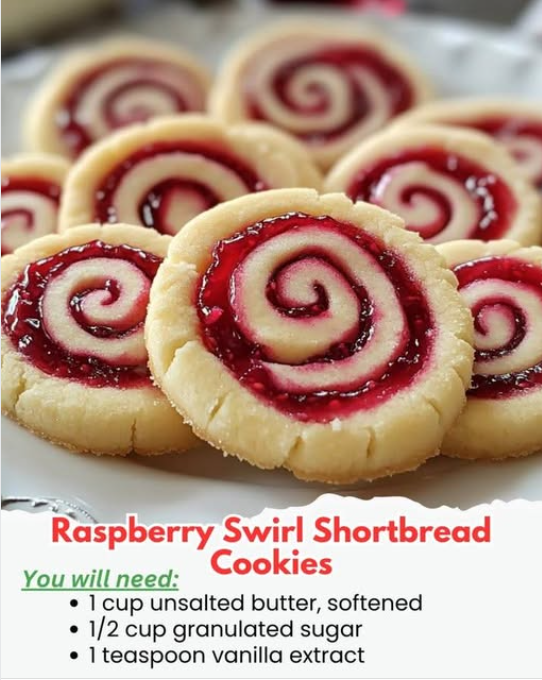
Tender Perfection: Mastering Raspberry Swirl Shortbread Cookies
Introduction: The Geometry of Shortbread
The **Raspberry Swirl Shortbread Cookie** elevates a traditional shortbread base by incorporating a vibrant, tart filling within a visually stunning spiral. The cookie’s structure is defined by its “shortness”—a high fat-to-flour ratio that results in a tender, crumbly texture that dissolves on the tongue. This texture is achieved by two primary factors: the **creaming method** and **minimal gluten development**.
The process begins with creaming the **1 cup of unsalted butter** and **1/2 cup of granulated sugar**. Creaming introduces essential air into the dough, which contributes to a delicate, open crumb. The butter must be **softened** (pliable but still cool) to properly emulsify with the sugar. The high butter content coats the **2 1/4 cups of all-purpose flour**, physically inhibiting water absorption and preventing the formation of long, elastic gluten strands. This is the definition of a “short” dough.
The non-negotiable regulation is the handling of the flour. Once the flour is added, the dough must be mixed only until it just comes together. **Overmixing** activates the gluten, resulting in a tough, hard, and chewy cookie—the opposite of the desired shortbread texture.
The unique challenge of the swirl format is managing the **temperature of the dough** and the **moisture of the filling**. The dough must be chilled after mixing, rolled thinly and evenly, spread with the raspberry filling (which is high in moisture), and then rolled tightly into a log. If the dough is too warm, the butter melts, making the dough sticky and prone to cracking when rolled. If the raspberry filling is too wet (e.g., thin jam or purée), the moisture will cause the surrounding dough to become sticky and prevent a clean cut.
Therefore, the recipe demands two critical chilling phases: one after the initial dough formation to firm the fat for rolling, and a second, longer chill after the log is formed to ensure the swirl sets rigid. This final chill is mandatory for achieving clean, uniform slices that maintain their beautiful spiral shape during baking, resulting in a cookie that is visually impressive and structurally perfect.
