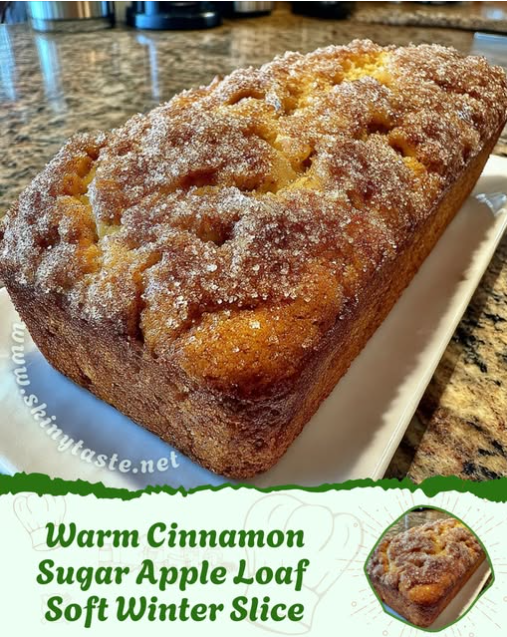
Soft Winter Slice: Mastering the Warm Cinnamon Sugar Apple Loaf
Introduction: The Quick Bread Science
A **Quick Bread** like this Apple Loaf relies on chemical leavening agents—**baking powder**—rather than yeast. This means the structure and texture are entirely dependent on how the wet and dry ingredients are mixed and how quickly the batter enters the hot oven. The goal is to minimize gluten development for a tender crumb while maximizing the lift from the leavening agents.
The core technique centers on the mixing process, which is governed by **The Gluten Control Mandate**. Overmixing quick bread batters develops tough gluten strands, resulting in a dense, chewy loaf. The ingredients must be combined quickly, leaving a few visible streaks of flour, to ensure a light, moist slice.
Success requires adherence to three core regulations: **The Gluten Control Mandate, The Chemical Reaction and Heat Protocol, and The Fruit Integration Principle.**
The first regulation, **The Gluten Control Mandate** (Instruction 4), dictates mixing technique. The **all-purpose flour** contains gluten-forming proteins. Since this recipe uses **oil** instead of solid butter, the mixing process must be very gentle once the wet and dry ingredients meet to prevent these proteins from bonding too tightly.
The second regulation, **The Chemical Reaction and Heat Protocol** (Instruction 1 & 5), ensures maximum lift. **Baking powder** begins to react instantly when combined with liquid, producing carbon dioxide gas. Preheating the oven (Instruction 1) and getting the batter into the heat quickly (Instruction 5) allows the gas bubbles to expand rapidly before the structure sets, ensuring a high, even dome and a light texture.
The third regulation, **The Fruit Integration Principle** (Instruction 4), manages moisture and distribution. The diced **apples** are folded in last. They not only provide flavor and texture but also release steam and moisture during baking, contributing significantly to the loaf’s moist final texture. Using a crisp apple variety (like Honeycrisp or Granny Smith) ensures the pieces don’t turn to mush during the $50\text{-minute}$ bake time.
Ingredients: Defining Structure, Moisture, and Flavor
The full components for a standard $9\times 5\text{-inch}$ loaf pan:
I. The Dry Structure:
- **$2\text{ cups}$** all purpose flour (Bulk, structure)
- **$\frac{3}{4}\text{ cup}$** sugar (Sweetness, moisture retention)
- **$2\text{ tsp}$** baking powder (Primary leavening agent)
- **$\frac{1}{2}\text{ tsp}$** cinnamon (Spice base)
- **$\frac{1}{4}\text{ tsp}$** salt (Flavor contrast)
II. The Wet & Moisture:
- **$\frac{1}{2}\text{ cup}$** vegetable oil (Fat, tenderizer)
- **$2\text{ large}$** eggs (Binder, richness)
- **$\frac{3}{4}\text{ cup}$** milk (Liquid, activates leavening)
- **$1\text{ tsp}$** vanilla extract (Aromatic flavor)
III. The Mix-ins & Topping:
- **$1\text{ cup}$** diced apples (Moisture, texture, flavor)
- **$\frac{1}{4}\text{ cup}$** sugar for topping (Crust sweetness)
- **$1\text{ tsp}$** cinnamon for topping (Crust spice)
