
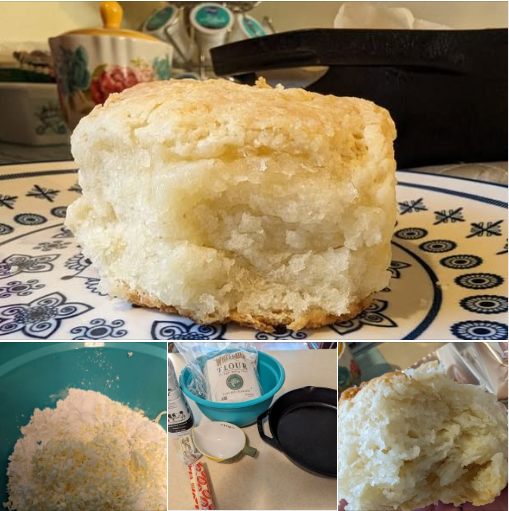
Flaky Perfection: Mastering the High-Rise Buttery Biscuit
Introduction: The Science of Layered Lift
The defining characteristic of a superior biscuit is its **flaky, tiered structure**. This structure is not created by leavening alone (the role of **self-rising flour**), but by the strategic placement of **cold butter** within the dough. When the cold butter melts rapidly in the hot oven, it releases steam. This steam pushes up the layers of dough created by the folding process, separating the flour and fat layers to yield the signature flaky texture.
Your technical description of **grating frozen butter** is a brilliant, professional-level method to ensure tiny, uniform pockets of cold fat—the most effective way to maximize steam lift. The enemy of a flaky biscuit is heat and friction, which melts the butter and allows the gluten to develop, resulting in a dense, tough final product.
Success requires adherence to three core regulations: **The Cold Fat and Minimal Handling Mandate, The Layering and Gluten Inhibition Protocol, and The Quick Bake Principle.**
The first regulation, **The Cold Fat and Minimal Handling Mandate** (Instruction 2 & 3), focuses on temperature control. The **butter** must be kept frozen or icy cold. Using a **pastry cutter and fork** for mixing minimizes the transfer of heat from your hands, keeping the fat solid until it hits the oven.
The second regulation, **The Layering and Gluten Inhibition Protocol** (Instruction 4), controls the interior texture. The brief **folding (two turns)** creates defined, horizontal layers of butter and flour. This technique develops minimal gluten (which keeps the biscuit tender) while simultaneously setting up the planes of separation for the steam to create flakiness. The half-and-half (an acceptable, high-fat substitute for buttermilk) aids in this tenderization by hydrating the flour.
The third regulation, **The Quick Bake Principle** (Instruction 5), dictates the environment. The high heat ($450^\circ\text{F}$ or $230^\circ\text{C}$) ensures that the butter transitions from solid to liquid rapidly, maximizing the steam production needed for the dramatic rise before the biscuit structure can collapse.
Ingredients: Defining Structure, Fat, and Flake
The formal components for approximately $8\text{–}10\text{ biscuits}$ (based on your measurements):
I. Dry Ingredients:
- **$3\text{ cups}$** self-rising flour (Structure and primary leavening)
- **$\frac{1}{2}\text{ tsp}$** salt (Optional, adjust based on flour type)
II. Fat & Liquid:
- **$1\frac{1}{2}\text{ sticks}$** ($12\text{ tbsp}$ or $170\text{ g}$) unsalted butter, **FROZEN** (Flake producer, richness)
- **$1\frac{1}{2}\text{ cups}$** half-and-half or cold buttermilk (Moisture, fat content)
- **$1\text{ tbsp}$** melted butter (for brushing tops)
