
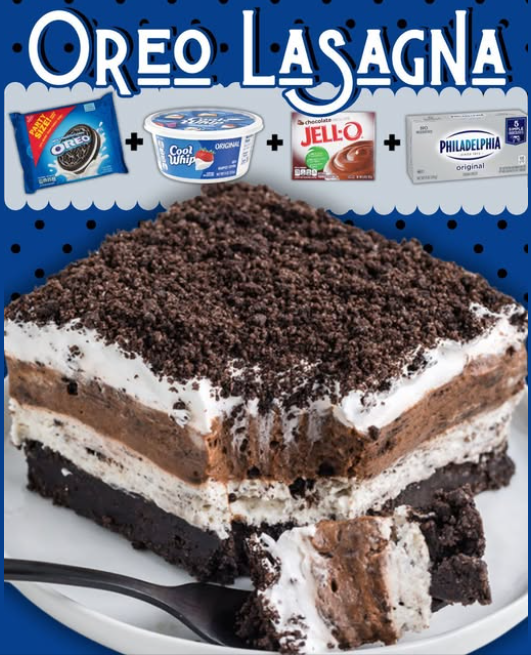
Oreo Lasagna: A Masterclass in Multi-Phase Texture Engineering
Introduction: The Physics of “No-Bake” Structural Integrity
The success of an Oreo Lasagna depends on Moisture Migration Control. Each layer has a specific Viscosity designed to interact with the dry Oreo cookies. Over a 4-hour chilling period, the cookies undergo Hygroscopic Softening, absorbing moisture from the cream cheese and pudding layers to transform from brittle wafers into a soft, truffle-like crumb. This guide explores the Emulsification of the dairy layers and the Starch Gelatinization of the instant pudding.
Ingredients: The Molecular Building Blocks
The Crust (The Carbon Scaffold)
- 48 Oreo Cookies: The Structural Foundation. The cocoa solids and sugar provide a dark, earthy base.
- 10 tbsp Salted Butter: The Binding Lipid. Once chilled, the butter recrystallizes, locking the cookie crumbs into a solid, waterproof base.
The Cream Cheese Layer (The Aerated Mousse)
- 12 oz Cream Cheese & 8 oz Cool Whip: The Stabilized Foam. The cream cheese provides tang and structural density, while the Cool Whip introduces Micro-air Bubbles for lightness.
- ¾ Cup Powdered Sugar: Fine-grain sugar that dissolves instantly to maintain a Laminar Flow texture.
The Pudding Layer (The Starch Gel)
- 3 Cups Half and Half: The Rich Solvent. The higher fat content (compared to milk) results in a denser, more luxurious gel.
- 7.8 oz Instant Chocolate Pudding: The Hydrocolloid Agent. Modified starches thicken the liquid instantly upon contact.
