
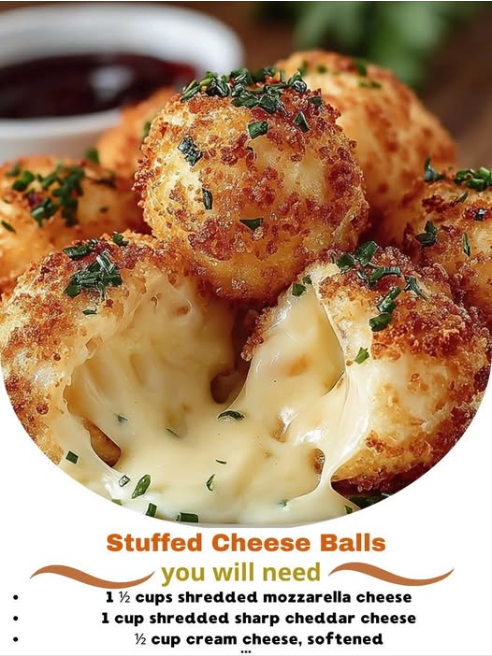
Stuffed Cheese Balls: A Study in Lipid Cohesion and Thermal Viscosity
Introduction: The Physics of the “Melt-Core”
The success of a stuffed cheese ball depends on Structural Layering. The objective is to create a shell that undergoes the Maillard Reaction (if fried or baked) while the internal core reaches its Glass Transition Temperature without separating into oil and solids. This is achieved by balancing the high moisture of mozzarella with the stabilizing fats of cream cheese.
Ingredients: The Molecular Building Blocks
The Structural Matrix
- 1 ½ cups Shredded Mozzarella: The Elastic Scaffold. Mozzarella is high in protein and has a unique “stretch” due to the alignment of its casein fibers during production.
- 1 cup Shredded Sharp Cheddar: The Flavor and Fat Inclusion. Cheddar provides the sharp ionic profile and a higher fat content, which adds richness but requires a stabilizer to prevent “oiling out.”
- ½ cup Cream Cheese (Softened): The Emulsifying Binder. Its high moisture and smooth texture act as a Plasticizer, allowing the other two cheeses to bond into a uniform, rollable mass.
Instructions: Engineering the Cheese Composite
Step 1: Homogenization (The Mix)
Mix the three cheeses until they form a single cohesive unit. The “Shear Force” Rule: Use a paddle attachment or heavy spoon to force the Lipid Droplets of the cheddar and cream cheese into the fibrous network of the mozzarella.
Step 2: Core Insertion (The “Stuffing”)
Take a small portion of the mix, flatten it, place your filling (like a jalapeño slice or pepperoni) in the center, and roll it into a sphere. The “Hermetic Seal” Physics: You must ensure there are no air pockets. Air expands when heated, which can cause the cheese ball to Mechanical Failure (burst) during cooking.
Step 3: Stabilization (The Chill)
Chill the formed balls for 30 minutes. The “Crystallization” Phase: Chilling allows the milk fats to solidify, creating a firmer ball that is easier to bread and less likely to melt prematurely in the heat.
[Image showing the process of fat crystallization and solidification]
Step 4: Thermal Processing
Deep fry at 375°F or bake at 400°F. The “Conduction” Secret: The heat moves from the outside in. You want the exterior to brown (Maillard Reaction) at the exact moment the core reaches its Liquid Phase.
