
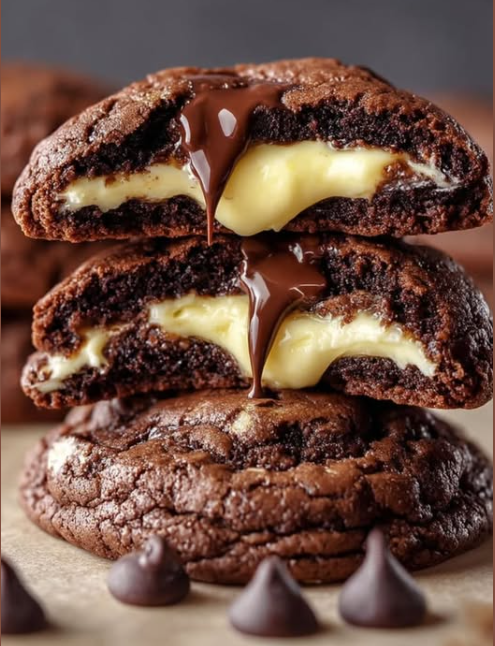
Cheesecake-Stuffed Chocolate Cookies: A Masterclass in Multi-Phase Baking
Introduction: The Physics of the “Pocket” Confection
The technical challenge of a stuffed cookie is Differential Hydration. The cheesecake center has a significantly higher water activity (aw) than the chocolate shell. Without proper Structural Layering, the moisture from the filling would migrate into the dough during baking, resulting in a soggy, collapsed cookie. By utilizing the Lipid Barrier of the cream cheese and the Protein Coagulation of the egg, we can engineer a cookie that is crisp on the outside and velvety on the inside.
Ingredients: The Molecular Building Blocks
The Outer Scaffold (The Chocolate Dough)
- 120g Butter: The Plasticizing Lipid. When creamed with sugar, butter traps air (the gas phase), which provides the initial lift before the chemical leaveners take over.
- 150g Cane Sugar: The Hygroscopic Solute. Cane sugar contains trace molasses, which adds acidity. This acidity reacts with leaveners to increase the Volume Expansion of the cookie.
- 1 Egg: The Emulsifying Agent. The proteins in the egg provide the Tensile Strength needed to stretch around the filling without tearing.
- Cocoa & Flour (Standard Additions): These provide the Structural Starch and Solids. Cocoa powder adds “alkalized” depth and absorbs moisture, helping the shell set quickly.
The Stabilized Core (Cheesecake Filling)
- Cream Cheese & Powdered Sugar: The High-Viscosity Matrix. Unlike liquid fillings, this mixture remains thick at room temperature, making it possible to “wrap” the dough around it.
