
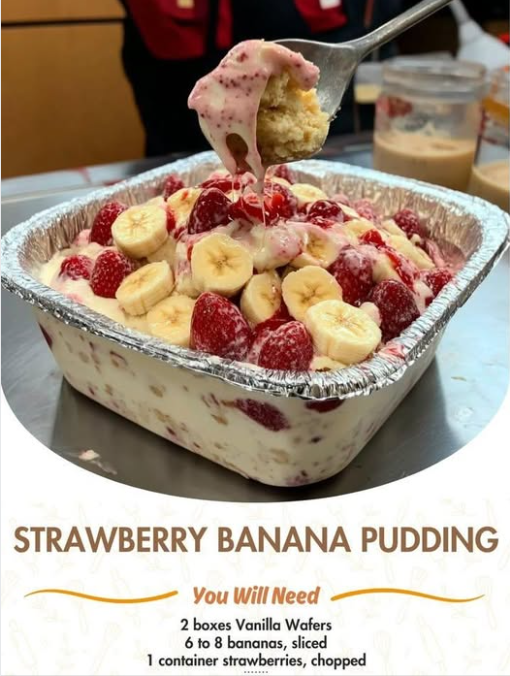
The complete list of components for this layered dessert:
I. The Pudding Base (Stabilizing Agents):
- **1 (8 oz.) package** cream cheese, softened (The stabilizing fat)
- **1 (14 oz.) can** sweetened condensed milk (Sweetener and binder)
- **2 cups** milk (The liquid base)
- **1 (5 oz.) box** French Vanilla pudding mix (Instant type, the primary thickener)
- **1 (12 oz.) container** frozen whipped topping, thawed (The airy lift)
II. The Layers:
- **2 boxes** Vanilla Wafers (The structural base)
- **6 to 8** bananas, sliced (The classic flavor)
- **1 container** strawberries, chopped (The fresh zing)
Instructions: Mix, Layer, and Chill
Phase 1: Preparing the Creamy Base
- **Whip Cream Cheese and Condensed Milk (CREAM CHEESE PROTOCOL):** In a large bowl, beat the **softened cream cheese** until smooth. Gradually beat in the **sweetened condensed milk** until the mixture is light and completely lump-free.
- **Mix Pudding:** In a separate medium bowl, whisk together the **2 cups of milk** and the contents of the **French Vanilla pudding mix** for about 2 minutes, until thickened.
- **Combine:** Add the thickened pudding mixture to the cream cheese mixture (from Step 1) and beat until fully combined and smooth.
- **Fold in Whipped Topping:** Gently fold in the **thawed whipped topping** using a rubber spatula until no streaks remain. Do not overmix, as this will deflate the air and make the pudding dense.
Phase 2: Layering and Setting
- **Layer the Dessert (MOISTURE MANAGEMENT):** In a $13\text{x}9\text{ inch}$ dish or large trifle bowl, begin layering:
* Place a single layer of **Vanilla Wafers** on the bottom.
* Arrange a layer of **sliced bananas** and **chopped strawberries** over the wafers.
* Spread about $\frac{1}{3}$ of the **pudding mixture** evenly over the fruit.
* Repeat the layers (wafers, fruit, pudding) two more times, ending with a final layer of pudding. - **Chill (OVERNIGHT CHILL RULE):** Cover the dish tightly with plastic wrap (or a lid). **Refrigerate for a minimum of 6 hours, but ideally overnight,** to allow the pudding to set completely and the wafers to soften.
- **Serve:** Garnish the top with reserved whole wafers or fresh fruit slices just before serving.
Serving and Storage: The Importance of Setting
Optimal handling for this chilled dessert:
- **Serving:** Must be served cold (Instruction 6). The texture is poor if the pudding is not fully set.
- **Storage:** Store in an airtight container in the refrigerator for up to **4 days**. Note that the fresh bananas will brown slightly after the first day, but the taste remains fine.
- **Freshness Tip:** If you want to retain a clean, white topping, save some whipped topping aside and spread it on the dessert *just* before serving, rather than folding it into the pudding mix.
Tips: Essential Techniques for Stability
Cream Cheese Temperature: The **cream cheese** (Step 1) must be at true room temperature. If it’s cold, it will not whip smoothly with the condensed milk, resulting in lumps.
Milk Choice: Use **whole milk** (Step 2) for the richest flavor and creamiest texture. Low-fat milk will work but may result in a slightly less stable final pudding.
Preventing Banana Browning: To slow the oxidation (browning) of the **sliced bananas** (Step 5), briefly dip them in a mixture of half lemon juice and half water before layering.
Whipped Topping Stability: Ensure the **whipped topping** (Step 4) is thawed but still very cold when folding it in. This prevents it from weeping moisture into the pudding.
Garnish Timing: Do not place the final, decorative **wafers or fresh fruit** on top until immediately before serving (Step 7). This keeps the decorative wafers crunchy and the fruit fresh.
Variations: Customizing Fruit and Flavor
Easily adapt the flavor profile of the pudding:
- **Caramel Drizzle:** Drizzle a thin layer of **caramel sauce** over the wafers and bananas in each layer for a richer taste (Step 5).
- **Different Fruit:** Substitute the **strawberries** with **raspberries or sliced peaches** (Step 5). The tartness of raspberries is an excellent counterpoint to the sweet pudding.
- **Cookie Change:** Substitute the **Vanilla Wafers** with **shortbread cookies or graham crackers** for a slightly different textural base (Step 5).
- **Chocolate Swirl:** Melt $\frac{1}{4}$ cup of chocolate chips and gently swirl the cooled chocolate through the finished pudding base (Step 4) before layering.
**Hand Whisking:** You must use a **whisk or electric mixer** (Step 2) to prepare the instant pudding. Simply stirring will not activate the stabilizers needed to properly thicken the mix.
**Pudding Mix Flavor:** While **French Vanilla** is specified, classic vanilla or even banana-flavored instant pudding can be used for a slightly different base flavor (Step 2).
**Serving Dish Size:** Use a $13\text{x}9\text{ inch}$ pan or a large, deep trifle bowl (Step 5). A pan that is too shallow will result in too-thin layers, and the dessert won’t set as high.
**Folding Technique:** When folding in the whipped topping (Step 4), use a gentle, sweeping motion (cutting down the center, sweeping up the side) to incorporate the topping without losing volume.
Conclusion: Decadent Dessert Success
The **Strawberry Banana Pudding** is a dessert triumph, thanks to the perfect marriage of stability and fresh flavor. By following **The Cream Cheese Whipping Protocol** for a smooth base, adhering to **The Vanilla Wafer Moisture Management** for the ideal texture, and respecting **The Overnight Chill Rule**, you ensure a dessert that is dense, creamy, refreshing, and holds its beautiful layers perfectly. This is a must-try twist on a beloved classic.
Frequently Asked Questions (FAQ)
Q: Why is my pudding runny and not setting?
A: Most likely, it was not chilled long enough (Step 6), or you may have used **non-instant pudding mix**. It must be instant, and it must chill overnight.
Q: Why are there lumps in my pudding base?
A: The **cream cheese was not softened** (Step 1). It must be at room temperature and beaten until completely smooth before the condensed milk is added.
Q: My wafers are soggy. How do I fix this?
A: They were either layered too far in advance, or you used a dish that was too small (Step 5). The moisture management is key; the goal is a soft, cakey texture, not a crisp one, but extreme sogginess comes from over-soaking.
Q: How ripe should the bananas be?
A: They should be ripe (sweet) but still firm (no green, but few brown spots) (Step 5). Mushy bananas will fall apart and turn brown too quickly.