
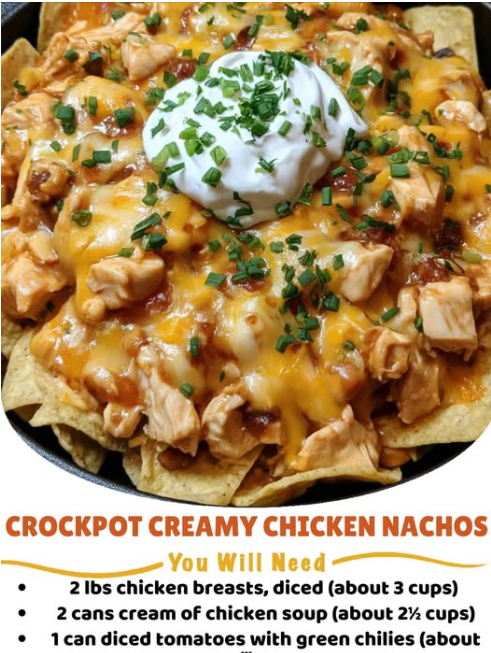
Step 1: The Low-Temperature Hydrolysis
Place the chicken, salsa, and tomatoes in the crockpot. The “Thermodynamic” Rule: Cook on Low for 6–8 hours. High heat causes proteins to contract too violently, squeezing out moisture. Low heat allows for the Slow Breakdown of Collagen, resulting in chicken that falls apart with minimal mechanical force.
Step 2: The Creamy Emulsification
Thirty minutes before serving, add the cream cheese block. The “Phase Transition” Science: As the cheese melts, whisk it into the salsa-chicken juices. You are creating a Homogenous Suspension. The fats in the cream cheese encapsulate the water-based salsa, creating a rich, opaque sauce that coats the chicken shreds perfectly.
Step 3: The Mechanical Shredding
Use two forks to shred the chicken directly in the pot. The “Surface Area” Physics: Shredding the chicken increases the surface area by roughly 400%, allowing the creamy sauce to coat every individual fiber. This ensures that no part of the nacho topping feels “dry.”
Step 4: The Strategic Assembly
Layer the chips on a baking sheet, then the chicken, then the shredded cheese. The “Structural Integrity” Rule: Do not “pour” the chicken. Use a slotted spoon to transfer the meat. This prevents Excess Hydration from reaching the chips, which would cause the starch lattice of the corn to collapse (sogginess).
Step 5: The Broiler Finish
Place the tray under the broiler for 2–3 minutes. The “Radiant Heat” Science: You are looking for Cheese Vesiculation (bubbling). The high, direct heat causes the fats in the shredded cheese to boil and the proteins to brown, creating a savory “crust” that locks the moisture of the chicken underneath.
Serving and Storage: Managing Sogginess
Serving: Garnish with cold elements like sour cream, cilantro, and lime. The Temperature Differential between the hot chicken ($160^{\circ}\text{F}$) and the cold sour cream ($40^{\circ}\text{F}$) creates a dynamic sensory experience. Serve on pre-heated plates to maintain the Fluidity of the cheese sauce.
Storage: Never store nachos fully assembled. Store the Chicken Emulsion in an airtight container in the fridge for up to 3 days. To serve leftovers, reheat the chicken separately and apply to fresh chips to preserve the Textural Contrast of the dish.
Tips: Pro-Level “Nacho” Nuances
- The “Chip Seal” Secret: Before adding the chicken, give the chips a 60-second “pre-toast” in the oven. This creates a slightly Hydrophobic Surface on the chip, giving you an extra 5 minutes of crunch-time once the sauce is added.
- The “Taco Seasoning” Booster: Mix your spices with a tablespoon of cornstarch before adding to the crockpot. This acts as a Secondary Thickener that ensures the sauce doesn’t run off the chips.
- Acidic Finish: Squeeze fresh lime juice over the chicken after the slow-cooking is done. Heat destroys the delicate Citral compounds in lime; adding it at the end provides a bright, aromatic “lift.”
Holiday Variations
| Variation | The Adjustment | The Vibe |
|---|---|---|
| Buffalo Christmas | Add 1/2 cup Buffalo sauce and swap Mexican blend for Blue Cheese. | Tangy, spicy, and high-energy. |
| White Christmas BBQ | Use white BBQ sauce and add pickled red onions. | Creamy, smoky, and sophisticated. |
| Fajita Style | Add sliced bell peppers and onions in the last 2 hours. | Colorful, textured, and classic. |
Tips: Preventing the “Broken” Sauce
A “broken” sauce looks oily and curdled. This happens if the cream cheese is subjected to Extreme Thermal Stress (boiled). To prevent this, always add the cream cheese at the very end on the “Warm” or “Low” setting. If your sauce breaks, whisk in a tablespoon of warm heavy cream to re-establish the Emulsion Matrix.
Conclusion: A Christmas Day Celebration
Crockpot Creamy Chicken Nachos are a triumph of Structural Gastronomy. By leveraging the slow-cooking process to tenderize the chicken and using a stable lipid-base for the sauce, you create a dish that is both decadent and functionally sound. On this Christmas Day 2025, as you share this tray of crunchy, creamy, cheesy bliss, you’re serving a masterclass in party-food physics. Enjoy the crunch!
Frequently Asked Questions
- Can I use frozen chicken?
- Technically yes, but it is not “Regulation” safe. Frozen chicken takes too long to reach the Bacterial Kill Zone ($140^{\circ}\text{F}$) in a slow cooker, which can lead to foodborne illness. Always thaw your chicken first for Thermal Safety.
- Why is my chicken rubbery?
- This is likely due to cooking on “High” for too long. High heat causes the Actin and Myosin filaments in the muscle to shrink rapidly, squeezing out all the water. Low and slow is the only way to ensure tenderness.
- What chips are best?
- Look for chips labeled “Cantina Style” or “Restaurant Style.” They are fried at a higher temperature, which creates a denser Amylopectin Crust that resists liquid penetration better than thin, airy chips.
Would you like me to suggest a “Homemade Pico de Gallo” recipe to top these nachos, or perhaps show you how to turn this chicken into “Creamy Chicken Enchiladas”?
Related posts:
 Slow Cooker Crack Chicken
 The Engineering of Slow-Cooked Chicken and Noodles
 Slow Cooker Decadence: Mastering Creamy Chicken Alfredo Tortellini
 The Lazy Slow Cooker Chicken Cheesesteak Sandwich
 Mastering Crock Pot Creamy Chicken Parmesan Soup
 Slow Cooker Comfort: Mastering Creamy Potato & Hamburger Soup
