Step 1: The Primary Set (Cheesecake Core)
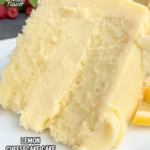
Whisk the cream cheese, sugar, and vanilla until smooth. The “Pre-Freeze” Secret: For the most distinct layers, spread the cheesecake mixture into a smaller round pan and freeze for 2 hours before placing it in the cake batter. This Thermal Lag allows the cake to rise around the cheesecake before the center begins to melt and expand.
Step 2: The White Chocolate Emulsion
Melt the white chocolate gently. The “Seizing” Physics: White chocolate is extremely sensitive to Thermal Shock. If it exceeds 110°F ($43^{\circ}\text{C}$), the sugar can clump. Incorporate it slowly into the butter-sugar-egg mixture to maintain a smooth Suspension.
Step 3: The Concentric Assembly
Pour half the cake batter into the pan, place the (semi-frozen) cheesecake disc in the center, and cover with the remaining batter. The “Displacement” Rule: Leave a 1-inch “buffer zone” around the edges. This ensures the cake batter forms a Structural Wall that prevents the cheesecake from leaking out of the sides during the bake.
Step 4: The Insulated Bake
Bake at 325°F ($163^{\circ}\text{C}$). The “Conduction” Science: We use a lower temperature than standard cakes to account for the cheesecake’s mass. The outer cake acts as Insulation, slowly conducting heat to the center to cook the eggs in the cheesecake without curdling them.
Step 5: The “Coconut-Pecan” Overlay
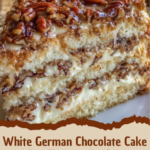
Prepare the traditional German Chocolate frosting using egg yolks, butter, and evaporated milk. The “Viscosity” Science: This frosting is a Custard-Based Emulsion. It must be thick enough to sit atop the cake without sliding off, providing the “Umami” notes that balance the sweetness of the white chocolate.
Serving and Storage: Protecting the Interface
Serving: This cake is a Temperature-Sensitive Composite. It is best served at Cool Room Temperature (approx. 65°F). If it is too cold, the white chocolate fat in the sponge will be too firm; if too warm, the cheesecake center will lose its “snap.”
Storage: Due to the high moisture and dairy content of the center, this cake must be refrigerated. To prevent the sponge from drying out, press plastic wrap directly against the “cut” surface of the cake to create an Airtight Moisture Seal.
Tips: Masterclass Nuances
- The “Lump-Free” Rule: Ensure the cream cheese is perfectly at room temperature. Any lumps in the center will create “Steam Pockets” during the bake, which can cause the cake to crack.
- Toasted Pecans: Toast your pecans for 5 minutes before adding them to the frosting. This initiates the Pyrolysis of the nut oils, significantly deepening the flavor profile.
- The “Tap” Method: After pouring the batter, tap the pan firmly on the counter. This removes Macro-Air Bubbles that could otherwise cause the cheesecake center to “float” or shift during the bake.
Holiday Variations
| Variation | The Adjustment | The Vibe |
|---|---|---|
| Winter Cranberry | Add a layer of cranberry reduction between the cake and center. | Tart, festive, and bright. |
| Macadamia White Chocolate | Swap pecans for crushed macadamias in the frosting. | Tropical, buttery, and luxurious. |
| Peppermint Center | Add crushed candy canes to the cheesecake core. | Minty, cool, and classically Christmas. |
Tips: Preventing the “Soggy Bottom”
A “Soggy Bottom” in a cheesecake-filled cake is caused by Vapor Entrapment. To prevent this, ensure your cake pan is not too deep. A shallower, wider pan allows for better Evaporative Surface Area, helping the excess moisture from the cheesecake escape through the sponge’s pores rather than pooling at the bottom.
Conclusion: A Christmas Day Achievement
The White German Chocolate Cake with a Cheesecake Center is more than a dessert; it is a triumph of Baking Engineering. By balancing the thermal properties of the dense core with the delicate aeration of the white chocolate sponge, you create a culinary experience that is both visually stunning and texturally complex. On this Christmas Day 2025, as you slice through the golden exterior to reveal the creamy heart, you are serving a masterclass in balance. Enjoy every decadent layer!
Frequently Asked Questions
- Can I use a cake mix for the white chocolate part?
- Yes, but you must Fortify it. Add an extra egg and use melted butter instead of oil to ensure the batter has the Density required to support the cheesecake disc.
- Why didn’t my center stay in the middle?
- This is usually due to Density Mismatch. If the cake batter is too thin, the cheesecake will sink. If it’s too thick, the cheesecake can “float.” Ensuring the cheesecake disc is frozen before baking is the best way to anchor it in the Viscous Batter.
- Does white chocolate contain real chocolate?
- Technically, it contains Cocoa Butter (the fat of the bean) but no cocoa solids. This is why it behaves more like a “Sweetened Lipid” in baking, providing a richness that dark chocolate cannot match without adding bitterness.
Would you like me to suggest a “White Chocolate Ganache” recipe to drizzle over the top, or perhaps show you how to turn this into “Mini Cheesecake-Filled Cupcakes”?