

Step 1: The Dry Matrix Homogenization
Mix oats, flour, sugars, coconut, and soda. The “Particle Distribution” Science: Mixing for a full minute ensures that the baking soda is perfectly dispersed. Because this cookie has very little moisture, “clumps” of soda would create bitter, soapy pockets in the final bake.
Step 2: The Thermal Emulsion (The Boil)
Boil the butter and corn syrup for 1 minute. The “Sucrose Inversion” Physics: You are creating a Supersaturated Syrup. The boiling point of this mixture is higher than water ($>212^{\circ}\text{F}$), which is hot enough to begin breaking down the complex carbohydrates in the flour and oats immediately upon contact.
Step 3: The Drizzle and Hydration
Drizzle the hot liquid into the dry mix while stirring. The “Hydrophobic Coating” Rule: The hot fat coats the flour particles, preventing them from forming long, tough gluten strands. This is why the cookie remains “short” and tender rather than bread-like.
Step 4: The Protein Binding (The Egg)
Add the egg once the mixture has slightly cooled. The “Emulsification” Secret: The egg acts as the Glue. If you add it to the boiling liquid, it will scramble. By waiting until the dough forms, the Lecithin in the yolk can bridge the gap between the butter fats and the flour starches.
Step 5: The Maillard Bake
Bake at 350°F for 10-11 minutes. The “Caramelization” Transformation: During the bake, the sugar and coconut undergo a double transformation—caramelization (sugar browning) and the Maillard reaction (protein/sugar browning). The result is a complex, nutty flavor profile.
Serving and Storage: The Moisture Migration
Serving: These cookies are “soft-set.” They must cool on the pan for 5 minutes. As they cool, the corn syrup and sugar matrix Re-solidifies, giving the cookie its structural integrity. Serve with a cold glass of milk to provide a Temperature Contrast and to wash away the rich lipids of the coconut.
Storage: These cookies are Hygroscopic—they love to absorb moisture from the air. To keep them crisp-chewy, store them in an airtight container with a piece of parchment paper between layers. If they become too hard, a 5-second microwave burst will soften the “syrup bonds.”
Tips: Pro-Level “Coconut-Oat” Nuances
- The “Salt” Regulation: Use fine sea salt. It dissolves instantly in the hot butter, ensuring the salt “pops” the flavor of the toasted coconut throughout the entire cookie.
- Oat Quality: Avoid “Instant” oats. They are pre-processed and too thin; they will dissolve into the batter, losing the Textural Contrast that makes these cookies iconic.
- The “Boil” Timing: Use a timer for the 1-minute boil. Under-boiling results in a greasy cookie that spreads too much; over-boiling results in a hard, brittle “tooth-breaker.”
Holiday Variations
| Variation | The Adjustment | The Vibe |
|---|---|---|
| Salted Caramel Oat | Add 1/2 tsp fleur de sel and swap white sugar for dark brown sugar. | Deep, salty, and sophisticated. |
| Tropical Christmas | Add 1/4 cup dried pineapple bits and a zest of lime. | Bright, zesty, and fruity. |
| White Chocolate Dipped | Dip half the cooled cookie in melted white chocolate. | Decadent, creamy, and festive. |
Tips: Preventing the “Soggy Bottom”
The “Soggy Bottom” is caused by Incomplete Heat Transfer. If your baking sheet is too thin, the bottom of the cookie won’t reach the caramelization point fast enough. Use a Heavy-Gauge Aluminum Pan. Aluminum has high Thermal Conductivity, ensuring the bottom of the cookie develops a crisp, “lacy” edge while the center stays chewy.
Conclusion: A Christmas Day Nostalgia Trip
Buttery Coconut Oatmeal Cookies are a masterpiece of Confectionery Balance. By leveraging the boiling-point physics of sugar and butter, you create a cookie that bridges the gap between a classic oat bake and a rich, buttery toffee. On this Christmas Day 2025, as the aroma of toasted coconut and warm syrup fills your kitchen, you’re serving a masterclass in childhood joy. Enjoy every chewy, buttery bite!
Frequently Asked Questions
- Can I use unsweetened coconut?
- Yes, but the cookie will be less chewy. Sweetened coconut is treated with Glycerol to keep it moist; unsweetened coconut is drier and will absorb more of the butter, resulting in a “crunchier” cookie.
- Why did my cookies spread into one giant sheet?
- This is usually due to Thermal Over-Saturation. If the butter-syrup mixture was too hot when you added the egg, or if you didn’t measure the flour correctly, the Viscosity will be too low, causing a collapse in the oven.
- Can I substitute the corn syrup?
- Honey or Maple Syrup can be used, but they have different Fructose-to-Glucose Ratios. Honey will make the cookies brown much faster and significantly softer, while Maple will result in a more brittle texture.
Would you like me to suggest a “Butterscotch Drizzle” recipe to go on top, or perhaps show you how to turn these into “Oatmeal Cookie Ice Cream Sandwiches”?
Related posts:
 Speed & Sweetness: Mastering No-Bake White Chocolate Raspberry Cookies
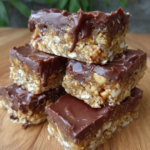 Effortless Energy: Mastering No-Bake Chocolate Oat Bars
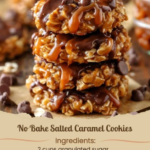 The Quick Confection: Mastering No-Bake Salted Caramel Cookies
 Mastering No-Bake Cottage Cheese Peanut Butter Bites
 Cottage Cheese Banana Oat Pancake Bites
 The Ultimate Comfort Bake: Mastering Cowboy Cookies
