
Step 1: The Lipid-Sugar Melt
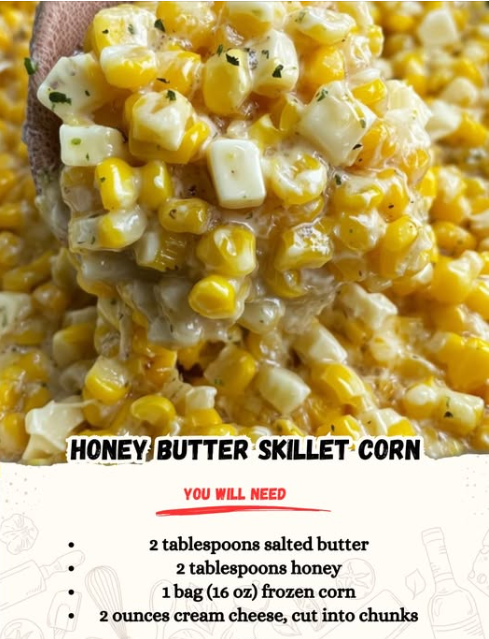
Melt butter and honey in the skillet over medium-high heat. The “Solubility” Science: You are creating a Saturated Solution. The heat allows the honey and butter to move from a heterogeneous state to a temporary homogeneous mixture.
Step 2: Thermal Shock (The Corn)
Add the frozen corn to the hot skillet. The “Vaporization” Phase: The ice crystals on the corn undergo Sublimation and evaporation. The resulting steam helps to gently cook the interior of the kernels while the sugars in the honey begin to glaze the exterior.
Step 3: The Cream Phase Integration
Add the cream cheese chunks and stir until melted. The “Phase Transition” Secret: As the cream cheese melts, it releases its protein network. These proteins wrap around the fat droplets from the butter, creating a Stable Colloidal Suspension that turns the thin honey-butter liquid into a thick, creamy sauce.
Step 4: Reduction and Maillard Browning
Cook until the liquid has reduced and coated the corn. The “Caramelization” Goal: Watch for small golden patches on the corn. This indicates that the sucrose and fructose are undergoing thermal degradation, creating complex “toasted” flavor notes.
Service and Storage Tips
- Service: Garnish with cracked black pepper or smoked paprika. The “Ionic Contrast” Benefit: A touch of salt or spice cuts through the high Lipid and Sugar Density, preventing the dish from feeling overly cloying.
- Storage: Store in an airtight container for up to 3 days. The “Retrogradation” Warning: When chilled, the butter and cream cheese will solidify into a Crystalline Lattice. Reheat gently in a skillet with a splash of milk to re-emulsify the sauce.
Variants: Iterative Flavor Designs
| Variation | Modification | Resulting Impact |
|---|---|---|
| Spicy Honey-Lime | Add 1/2 tsp chili flakes and 1 tsp lime juice. | Increased Capsaicin Heat and acidic brightness. |
| Smoky Bourbon Corn | Add 1 tbsp bourbon during the butter-melt stage. | Introduction of Volatile Oak Ethanol aromatics. |
| Herbaceous Garden | Stir in fresh chives and parsley at the end. | Fresh Chlorophyll Notes to balance the rich lipids. |
Tips: Pro-Level Skillet Corn Nuances
- The “Sizzle” Rule: Do not overcrowd the pan. If the corn is piled too high, it will Steam rather than Sauté. You want maximum Surface Area Contact with the skillet to achieve the Maillard reaction.
- Cream Cheese Prep: Ensure the cream cheese is cut into small, uniform chunks. This increases the Surface Area-to-Volume Ratio, allowing it to melt and emulsify faster without scorching the honey.
- Frozen vs. Fresh: Frozen corn is often sweeter than “fresh” corn found in grocery stores because it is frozen at its Peak Sugar Concentration. If using fresh corn, you may need to add 1/4 cup of water to facilitate the initial softening.
Conclusion: A Triumph of Emulsification
Honey Butter Skillet Corn is a masterpiece of Texture and Surface Chemistry. By balancing the waxy starch of the corn with a triple-stabilized dairy sauce, you create a side dish that is structurally sound and flavor-dense. On this Saturday, December 27, 2025, enjoy the perfectly executed results of sugar-lipid engineering. Happy cooking!
Frequently Asked Questions
- Why is my sauce greasy and separated?
- This is Emulsion Breakage. It usually happens if the heat was too high, causing the proteins in the cream cheese to denature and release the fats they were holding. Whisk in a teaspoon of warm water to help re-bind the emulsion.
- Can I use canned corn?
- Yes, but you must drain and pat it dry. Canned corn has a higher Free Water Content, which can dilute the honey-butter glaze and prevent the sauce from properly adhering.
- Can I use maple syrup instead of honey?
- Absolutely! Maple syrup has a different Viscosity and Flavor Profile, but it will follow the same sugar-reduction principles as honey.
Would you like me to suggest a “Crispy Bacon Topping” recipe to add some crunch to this dish, or perhaps show you how to turn this into a “Corn Chowder” base?
Related posts:
 Street Corn Chicken Casserole: Elotes Meets Comfort Bake
 Mastering the Creamy Mexican Street Corn Cup
 Creamy Cottage Cheese Chicken and Corn Skillet
 The Ultimate Guide to Backyard BBQ Bliss: Tender Ribs and Smoky Corn
 The Ultimate Guide to Backyard BBQ Bliss
 A Masterclass in Honey Butter Crispy Chicken
