
Adrian stood before he could stop himself.
“Elise…”
She froze.
For one second, the whole room seemed to disappear.
Then her expression changed.
Not fear.
Not longing.
Distance.
“This is not the place,” she said.
The little boy looked up at his mother.
“Mom, who is that man?”
Adrian waited for her answer like a man waiting for a door to open.
Elise put one hand on the boy’s shoulder.
“Someone I knew a long time ago.”
Someone.
Not their father.
Not family.
Just someone.
Brooke appeared behind Adrian with a smile that did not reach her eyes.
“What beautiful children,” she said.
Elise’s face changed the moment she saw Brooke.
She took both children by the hand.
“We’re leaving.”
Adrian stepped forward.
“Elise, please. I need to know—”
She cut him off with a calmness that hurt more than anger.
“You lost the right to ask questions when you chose a lie over my voice.”
Then she walked out into the evening air with the children.
Adrian moved to follow her, but Brooke caught his arm.
Her fingers tightened around his sleeve.
In a low voice, she whispered, “If you go after her, you are going to uncover something your family will never survive.”
The Truth Behind The Children
Adrian did not sleep that night.
He sat in his study with an old wedding photograph in front of him.
Elise was laughing in the picture, flowers in her hair, her face turned toward him as if he had once been safe.
At 2:17 in the morning, he called Naomi Pierce, the attorney who had handled his private business matters for years.
“Find Elise Marlowe,” he said. “Quietly. Do not scare her.”
Naomi paused.
“Are you trying to make peace, Adrian, or are you about to make another mistake?”
He stared at the photo.
“I need to know if those children are mine.”
The answer came the next afternoon.
Elise lived above her own restoration shop in Savannah. She repaired antique tables, church doors, old frames, and heirloom cabinets for families who trusted her hands.
She was not married.
Advertisements
She had two children.
Twins.
Oliver and Willa.
Five years old.
Adrian read their names again and again.
Oliver had been the name of his grandfather.
Willa had been the name Elise once whispered in bed when they were still dreaming of painting a nursery soft yellow.
He got her number through Naomi.
When Elise answered, she did not sound surprised.
Only tired.
“What do you want, Adrian?”
His throat tightened.
“The truth.”
A small bitter laugh came through the phone.
“That is interesting. Six years ago, you had no use for it.”
He closed his eyes.
“Are they my children?”
The silence that followed was not confusion.
It was pain.
Finally, Elise said, “Yes.”
Adrian leaned one hand against the wall.
“Why didn’t you tell me?”
Her voice trembled, but it did not break.
“Tell who? The man who looked at me like I had failed him? The man who let his uncle dig through my medical records like I was some dishonest stranger? The man who handed me divorce papers and never once asked what I was going through?”
“Elise, I didn’t know.”
“Because you did not want to know.”
He had no defense.
She continued, each word slow and heavy.
“I gave birth alone. I heard their first cries alone. I took them to appointments, paid rent, bought formula, fixed furniture with swollen hands, and held two babies through fevers while your name kept appearing in glossy magazines.”
Adrian pressed the phone harder against his ear.
“I am sorry.”
“Sorry is not a time machine.”
Before he could answer, Naomi entered his study with her tablet in her hand.
Her face was tense.
She showed him a live photo from outside Elise’s shop.
Two dark SUVs were parked across the street.
A man stood near the corner, looking up toward the second floor.
Adrian’s body went cold.
“Elise,” he said quickly, “close your curtains.”
“What?”
“Do it now. There are people outside your building.”
Her voice sharpened.
“Did you send someone?”
“No. But someone did.”
There was a small sound on the other end, like Elise pulling in a breath and refusing to panic.
Then Adrian heard her speak away from the phone.
“Oliver, Willa, turtle game. Shoes, jackets, backpacks. Quiet feet.”
Adrian understood something that made his chest ache.
His children knew a hiding game.
Not because of a story.
Not because of imagination.
Because Elise had trained them to stay calm when danger came too close.
The Family Name Was The Trap
By the time Adrian reached Savannah with Naomi and two private security guards, Elise opened the back door of her shop holding a heavy metal tool in one hand.
Oliver was in dinosaur pajamas, crying silently.
Willa was barefoot, clutching her rabbit.
Elise looked at Adrian with eyes full of blame.
“What have you brought to my door this time?”
“It wasn’t me.”
“You have said that before without saying anything at all.”
The sentence landed hard because it was true.
Naomi helped move Elise and the twins to a quiet house outside Asheville, North Carolina, owned by one of Elise’s old friends, a family law attorney named Rachel Boone.
Elise would not allow Adrian to ride in the same car as the children.
“You do not become their father automatically,” she told him. “Right now, you are the adult who arrived with problems.”
Adrian nodded.
He hated the words.
But he knew they were fair.
At the safe house, Rachel spread documents across the kitchen table.
Elise brought out a folder she had kept hidden for years.
Birth certificates.
Medical papers.
Photos of unfamiliar vehicles.
Messages from unknown numbers.
Reports that had been brushed aside.
Adrian looked at every page with a growing sense of shame.
Then Naomi found the most important piece.
A clause in the Caldwell family trust stated that if Adrian had biological children, a protected share of certain family assets would be transferred into accounts for those children when they turned five.
Oliver and Willa had turned five three weeks earlier.
Elise looked at Adrian slowly.
“So now they matter because money noticed them.”
Adrian shook his head.
“No. I swear I didn’t know.”
“Your promises always arrive after the damage.”
Before he could answer, someone knocked on the door.
Everyone went silent.
Rachel checked the security camera.
“It’s Brooke.”
Adrian opened the door.
Brooke stood on the porch without her perfect makeup, without jewelry, and without the cold elegance she wore in public. Rain dotted her coat. Her hands shook around a small flash drive.
“You need to let me talk,” she said. “If you don’t listen now, Warren will bury all of us.”
Elise stepped in front of the hallway leading to the children.
“You are not coming near my kids.”
Brooke’s eyes filled with tears.
“I know who changed the medical files.”
The room went still.
Adrian stared at her.
“What did you say?”
Brooke placed the flash drive on the table.
“Your uncle paid someone to alter Elise’s records. He made it look like she had hidden information from you. He wanted you to believe she had lied.”
Elise went pale.
“How do you know that?”
Brooke wiped her cheek.
“My cousin worked in records at the clinic.”
Adrian took one step toward her.
“How long have you known?”
Brooke closed her eyes.
“Since before I married you.”
No one spoke.
Elise did not cry.
She only folded her hands together as if holding herself in place.
Rachel’s voice was cold.
Advertisements
“Then tell the whole truth.”
And Brooke did.
Warren had never wanted Adrian to have direct heirs. As long as Adrian had no children, Warren could move money, sell property, hide debts, and make decisions inside the family business without certain protections being triggered.
When he learned Elise was pregnant after the divorce, he had people watch her.
Brooke found out.
But she stayed quiet because she wanted the Caldwell life.
The house.
The name.
The invitations.
The photos.
“I told myself it wasn’t my place,” Brooke whispered.
Elise’s voice was steady and sharp.
“My children growing up afraid was not your place?”
Brooke lowered her head.
“I know. I was wrong.”
The flash drive contained emails, payment records, clinic notes, and recordings of Warren discussing the trust.
In one recording, his voice was clear.
“Before those children turn five, any connection to Adrian has to disappear. If that trust activates, everything changes.”
Adrian felt sick.
For years, he had believed he had been fooled by Elise.
But the truth was worse.
He had helped the lie work.
Not by planning it.
By being too proud to question it.
By being too weak to stand beside the woman who loved him.
The Courtroom Could Not Return What Was Lost
The following months changed everything.
Rachel filed the proper legal motions. Naomi turned over evidence. Brooke gave a sworn statement. A former clinic employee confirmed that records had been altered. Several accounts connected to Warren were frozen while investigators reviewed the financial trail.
The Caldwell name no longer appeared only in society pages.
It appeared in reports about hidden records, broken trust, and business misconduct.
Warren lost control of the family company.
Brooke tried to save herself by telling the truth, but the life she had chased disappeared anyway.
Adrian cooperated too.
But the person everyone remembered from that hearing was Elise.
She stood before the judge in a simple cream blouse, her hair pulled back, her face calm.
She told the truth without making herself small.
She spoke about being blamed.
About being abandoned.
About giving birth without the father of her children because that father had chosen not to know.
About moving three times because she felt watched.
About raising Oliver and Willa with bedtime songs, locked windows, and emergency bags by the door.
Then she said the words that made the room silent.
“My children are not heirs before they are children. They are not a clause, not a threat, and not a prize for a regretful man. They are Oliver and Willa. They deserve to grow up without fear.”
Adrian could not lift his eyes.
Because in that moment, he understood something no lawyer could fix.
No apology could return five years.
No money could buy back first steps, first words, first birthdays, or the nights Elise stayed awake alone.
Six months later, Adrian saw the twins twice a week at a supervised family center in Charleston.
Oliver called him Adrian.
Willa did too.
He never corrected them.
He learned that Oliver hated peas because he said they tasted like “sad little marbles.”
He learned that Willa believed airplanes were “stars that got impatient.”
He learned that both children liked pancakes shaped like bears.
He learned that Willa needed the hallway light on at night.
He learned that Oliver watched doors closely whenever adults spoke too quietly.
Most of all, Adrian learned that his children had not begun existing the day he found them.
They had lived whole lives without him.
And he had to earn even the smallest place inside those lives.
The Distance He Finally Understood
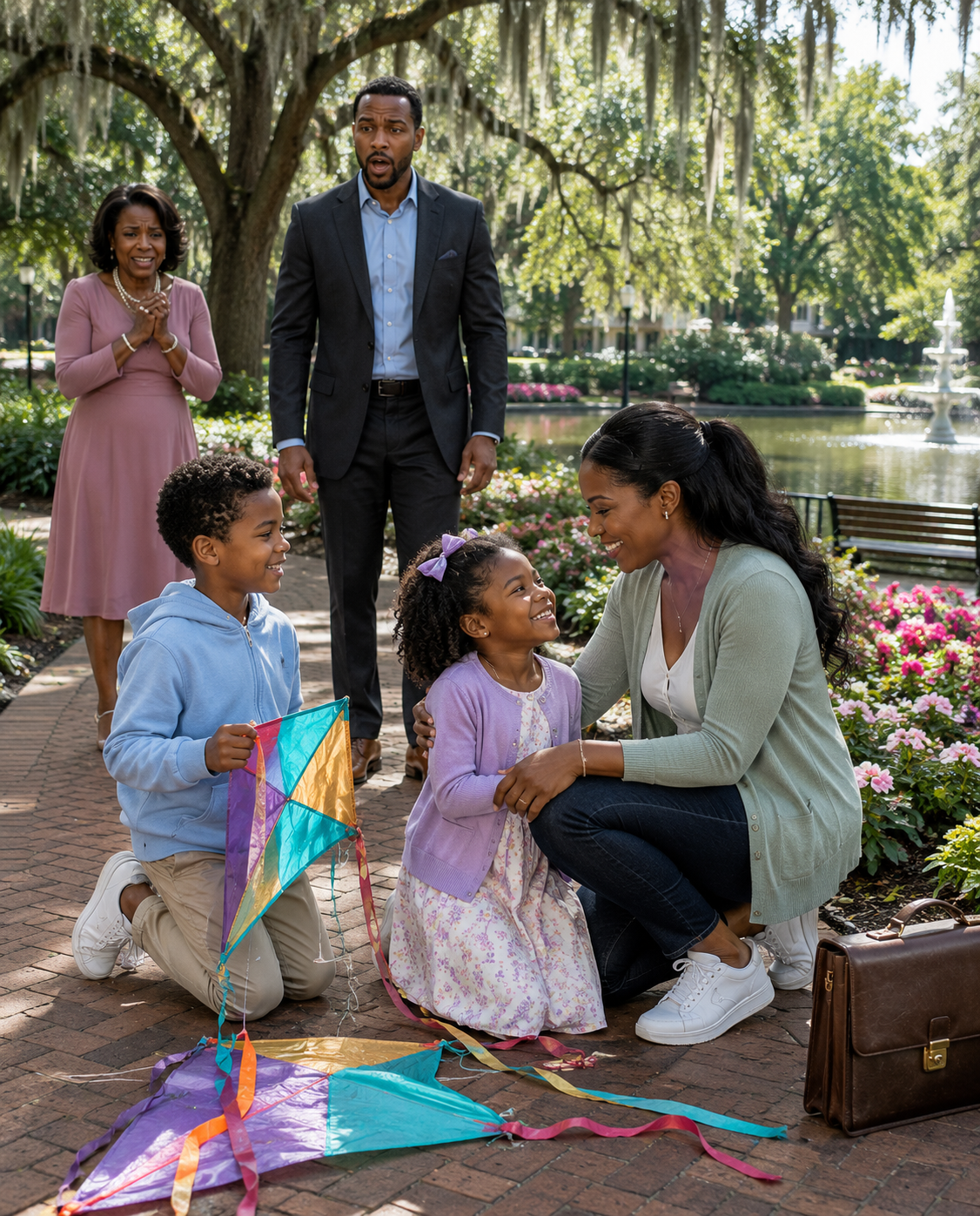
One spring afternoon, Adrian walked several steps behind Elise and the twins through Forsyth Park in Savannah.
Oliver chased pigeons across the grass.
Willa carried her rabbit under one arm and announced that the birds were “having an important meeting.”
Elise stood beside Adrian, quiet and composed.
He reached into his coat pocket and took out a small velvet box.
Inside was the wedding ring Elise had returned to him six years ago.
He held it out.
“I’m not giving this to you because I think we can go back,” he said. “I’m giving it to you because I kept it like I still had a right to some part of you.”
Elise looked at the box for a long moment.
Then she took it.
She did not smile.
She did not cry.
“Regret does not make you trustworthy.”
“I know.”
“Helping in court does not erase what you did.”
“I know that too.”
“And if one day they call you Dad, it will be because they choose to. Not because of your blood. Not because of your money. Not because you feel guilty.”
Adrian swallowed hard.
“I understand.”
From across the grass, Oliver shouted, “Adrian! Willa says the pigeons are voting!”
Willa yelled back, “They are! They just don’t have tiny papers!”
For the first time in years, Elise laughed.
It was brief.
Clean.
Unexpected.
Adrian heard it the way a man hears music from outside a house he once burned down.
He finally understood that forgiveness was not a speech, a tearful apology, or a reward for feeling sorry.
Forgiveness was a road.
And Elise might never choose to walk toward him.
But Oliver and Willa deserved something better than another war.
So Adrian did not ask for a family.
He did not ask for love.
He did not ask for a second chance he had not earned.
He only stayed at the right distance, watching his children play beneath the trees, understanding at last that some doors do not open for power, tears, or money.
Sometimes the only way to repair what you broke is to arrive late, stand humbly, and accept that no one owes forgiveness to the person who once chose to leave.
Sometimes the deepest wounds in a family do not come from one loud argument, but from years of silence, pride, and the painful choice to believe strangers before believing the person who once trusted you with their whole heart.
A person who truly loves you should never make you prove your pain over and over again, because love is not supposed to become a courtroom where one heart keeps defending itself while the other refuses to listen.
Regret can open someone’s eyes, but it cannot return the years that were lost, the birthdays that were missed, the lonely nights that were endured, or the tears someone had to wipe away without help.
Children are not trophies, bargaining tools, family assets, or proof of anyone’s worth; they are human beings who deserve safety, tenderness, stability, and adults who protect their peace before protecting their pride.
The truth may arrive late, but when it finally stands in the light, it has the power to expose every lie that was dressed up as concern, every betrayal hidden behind family loyalty, and every selfish choice made in the dark.
Forgiveness should never be demanded from the person who was hurt, because healing belongs to the wounded heart, not to the one who finally feels sorry after the damage has already been done.
Money can buy houses, attorneys, silence, and influence, but it cannot buy back a child’s first step, a mother’s lonely strength, or the trust that was broken when someone chose suspicion over love.
Related posts:
 Last night, I heard my husband giving my PIN to his mother while I was asleep: ‘Take it all out, there’s over a hundred and twenty thousand dollars on it.’ I just smiled and went back to sleep. Forty minutes later, his phone buzzed with a text from his mom: “Son, she knew everything. Something’s happening to me…” Then the phone suddenly went dead. – usnews
 The Wife Who Booked the Room. He Realized Too Late
 My Husband Packed a Suitcase to Leave With Another Woman and Told Me, “If It Bothers You So Much, Get a Divorce”
 My family never helped me buy a single thing, but the moment they saw my new house, they treated it like a family property.
 My sister became pregnant with my husband’s child. Then she revealed it through a microphone in front of three hundred guests, right in the middle of my tenth wedding anniversary celebration.
 My sister became pregnant with my husband’s child. Then she revealed it through a microphone in front of three hundred guests, right in the middle of my tenth wedding anniversary celebration.
