
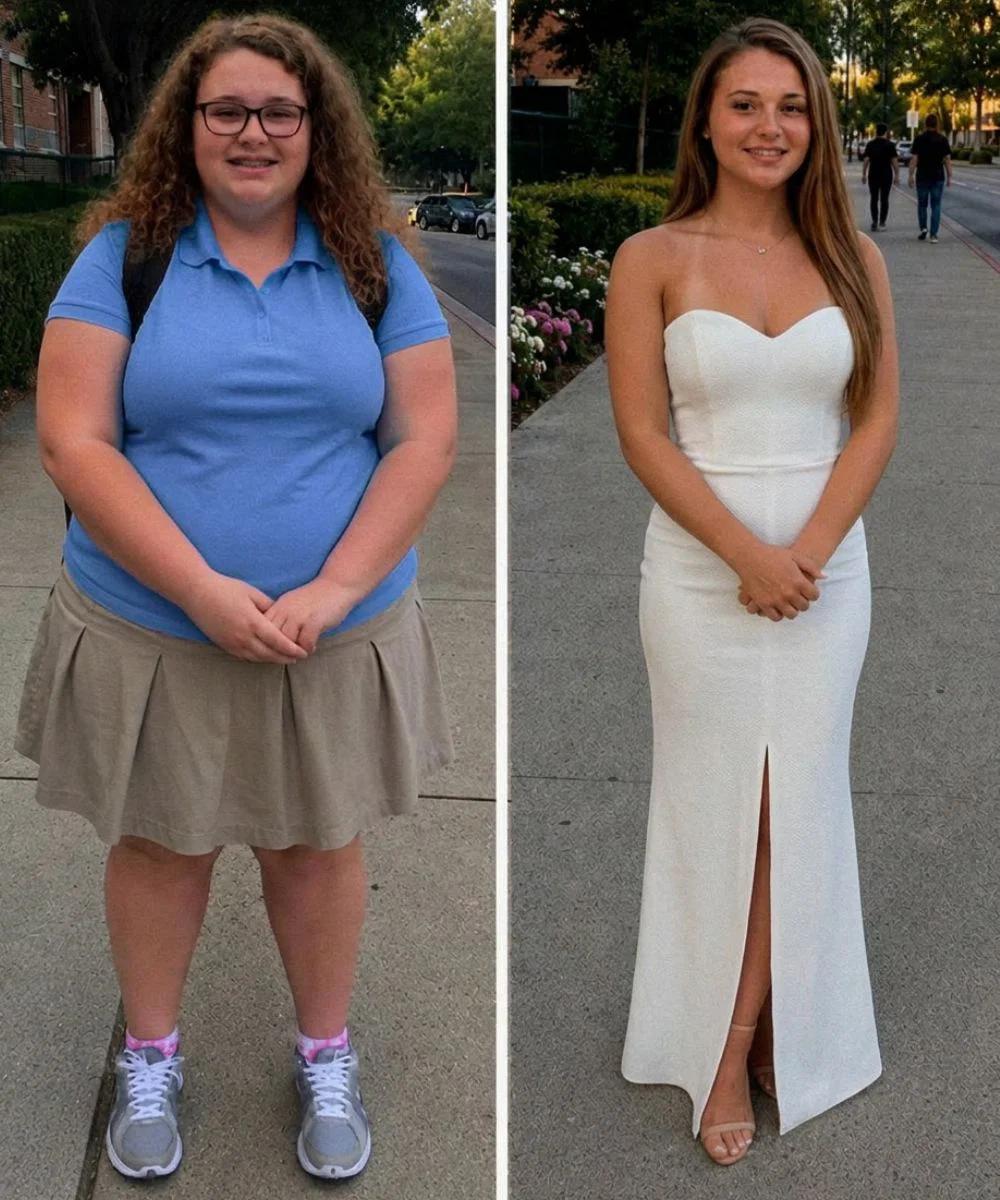
Then the music cut out. A grainy hallway video appeared—blue lockers, dirty floor, harsh fluorescent lights. Sixteen-year-old me appeared on screen, clutching my books. Teenage Madison’s voice rang through the ballroom. “Careful, everyone. The before picture is trying to walk.” Someone laughed in the video. My books hit the floor.
The girl on screen dropped to her knees so quickly it looked like she was apologizing for existing. The ballroom went silent. Madison laughed once. No one joined her. The organizer rushed toward the laptop. “I’m so sorry. I didn’t realize—” “Leave it up,” I said. Everyone turned. I walked toward the screen. “I want everyone to look at her for a second.”
“She spent four years trying to disappear,” I said. “She changed the way she walked, the way she laughed, and the way she answered questions in class. She learned which hallways to avoid and which girls could ruin her day with one look.” Madison’s face went pale. I turned toward her. “And ten years later, you still thought humiliating her was entertainment.”
Madison stood. “Wait.” I pointed at the screen. “That girl was me.” A low murmur moved through the room. Ashley covered her mouth. Brielle stared at the floor. Madison forced a smile. “Eva, come on. We were kids.” “I was a kid too, Madison.” Her smile faded. “I didn’t know you were still upset.” “You didn’t know because you never asked.”
“It was just a funny memory,” she said. “You remembered the laugh,” I replied. “I remembered going home in tears.” Someone near the back said, “That wasn’t funny.” Another voice added, “It never was.” Madison looked around, but this time, the room did not move toward her.
“No,” I said. “Everybody did not have a camera pointed at them while they tried not to cry.” The organizer stepped beside me and apologized. I nodded, then faced the room. “I don’t need anyone thrown out. I don’t need a perfect apology. I just need people to stop calling cruelty nostalgia.”
Madison’s eyes shone, but I could not tell whether it was shame or embarrassment. “I’m sorry,” she said quietly. “I didn’t think about what it felt like for you.” “That’s the problem,” I said. “You didn’t think of me as someone who felt anything.” Then I picked up my clutch and walked out.
In the restroom, my cardigan was still folded on the counter where I had left it. For a second, I held it against my chest. Then I put it back in my bag. Outside on the terrace, the cold air touched my face, and I finally cried. But it was not the old kind of crying, the kind where I tried to stay silent so no one would hear. This was different—quieter and cleaner.
The door opened behind me. “Eva?” Ashley stood there, arms wrapped around herself. I wiped my cheek. “If you’re here to defend Madison, don’t.” “I’m not.” She stepped closer, then stopped, as if she knew she had not earned the right to come nearer. “I should have said something back then.” “Yes,” I said. “You should have.”
Ashley nodded. “I laughed because I was scared they’d turn on me.” “I believe you,” I said.
“Madison made it easy to follow her. But that doesn’t make it okay.” “I know.” “And I’m not going to comfort you because you feel guilty.” She looked down. “I know that too.”
Then Ashley said, “You look beautiful tonight.” “Thank you.” “I mean, you changed so much.” I turned to her. “No,” I said. “I grew. There’s a difference.” Ashley swallowed. “There is.” I left before she could ask for more than I was willing to give.
In the lobby, I passed the ballroom doors. Madison stood near the wall, smaller than I had ever seen her. Brielle would not look up. The organizer was taking down the video screen. My phone buzzed. Mom: How’s my girl? I smiled. Me: She finally walked into the room, Mom. Mom: And? Me: Everyone finally saw her.
Mom replied: Good. No more shrinking, Eva. You were never meant to disappear. I looked at my reflection in the glass. My mascara was smudged. My dress was wrinkled. My hair had fallen loose around my face. I did not look perfect. I looked present.
I did not go back inside for the dry chicken or the reunion cake. Instead, I drove to the Chinese takeout place near my hotel, still wearing the red dress. The cashier glanced up. “Special occasion?” “Kind of.” “The good kind?” I thought about it. “The necessary kind.”
Back in my hotel room, I opened my fortune cookie last. The little paper inside said: You are stronger than you think. For once, I did not argue. At sixteen, I thought healing meant becoming someone no one could laugh at. At twenty-eight, I learned it meant walking away before the joke could follow me.
I did not leave that reunion as the girl they remembered. I left as the woman that girl had been waiting for.
Related posts:
 Last night, I heard my husband giving my PIN to his mother while I was asleep: ‘Take it all out, there’s over a hundred and twenty thousand dollars on it.’ I just smiled and went back to sleep. Forty minutes later, his phone buzzed with a text from his mom: “Son, she knew everything. Something’s happening to me…” Then the phone suddenly went dead. – usnews
 On Mother’s Day, my grown kids told me they had chosen the restaurant and expected me to pay for all twelve of them, just like always.
 The Most Popular Girl in School Asked My Mistreated Son to Dance at Prom – It Turned Out to Be a Mean Joke, But What He Did Next Made My Knees Shake
 At the lake house, my parents and sister screamed at me, “Get off Ashley’s property, you homeless junkie!”
 The Unexpected Gift of Kindness: A Father’s Journey Through Grief and Love
 My parents abandoned me in a hospital at 13 because my ca.nc.er treatment was “too expensive.” 15 years later, hearing I was the Valedictorian of Columbia University College, they demanded VIP tickets
