ADVERTISEMENT
Phase 1: Preparing the Sabayon (Pasteurization)
- **Make the Sabayon (PASTEURIZATION MANDATE):** In a heatproof bowl set over a pot of simmering water (double boiler), whisk the **egg yolks** and **sugar** constantly and vigorously until the mixture is thick, pale, and reaches a temperature of $160^\circ\text{F}$ ($71^\circ\text{C}$). Remove from heat and continue beating until cool and very thick.
Phase 2: Preparing the Cream (Aeration)
- **Whip Cream:** In a separate, cold bowl, whip the **cold heavy cream** until stiff peaks form.
- **Mix Mascarpone:** In a third bowl, gently beat the **softened mascarpone cheese** until smooth. Gently fold the cooled egg sabayon into the mascarpone until just combined.
- **Fold (CREAM AND FOLD):** Carefully fold the **whipped heavy cream** into the mascarpone/sabayon mixture using a spatula. Use slow, sweeping motions from the bottom up to preserve the air and volume.
Phase 3: Assembly and Setting
- **Prepare Soak:** Combine the **cooled espresso** and **coffee liqueur/rum** in a shallow dish.
- **Dip Ladyfingers (QUICK DIP):** Working quickly, dip each **ladyfinger** into the coffee mixture for just $1\text{–}2\text{ seconds}$ per side. Do not soak.
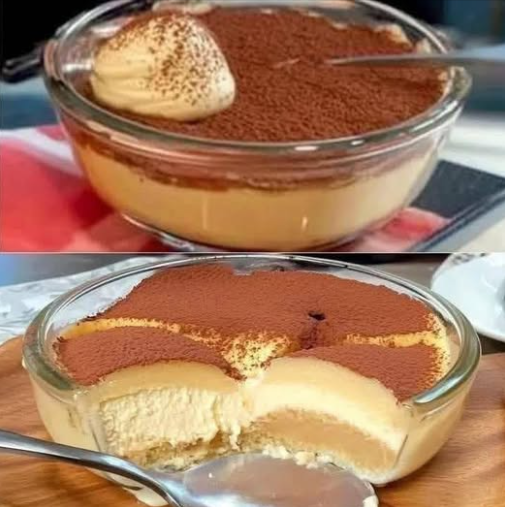
- **Layer:** Arrange a single layer of the dipped ladyfingers tightly on the bottom of your serving dish. Spread half of the mascarpone cream mixture evenly over the ladyfingers. Repeat with a second layer of dipped ladyfingers and top with the remaining cream.
- **Chill:** Cover the dish and **refrigerate for a minimum of $6\text{ hours}$**, or ideally, overnight. The chilling process allows the cream to firm up and the coffee flavor to fully permeate the ladyfingers.
- **Garnish and Serve:** Just before serving, generously dust the top surface with a thick layer of **unsweetened cocoa powder** and add **dark chocolate shavings**, if desired.
Tips & Technical Insights:
Egg Safety and Volume: Achieving the **$160^\circ\text{F}$ ($71^\circ\text{C}$)** pasteurization temperature (Instruction 1) is non-negotiable for safety. Heating the yolks to this temperature also strengthens the protein structure, enabling the sabayon to hold significant volume after cooling, which directly contributes to the final airy texture.
Mascarpone Temperature: Ensure the **mascarpone cheese** (Ingredient I) is genuinely softened (room temperature) before mixing (Instruction 3). If it is too cold, it will form lumps that are impossible to beat out without overworking and deflating the cream.
Cocoa Application: The **unsweetened cocoa powder** (Ingredient III) should only be dusted on **just before serving**. If applied too early, the cream’s moisture will absorb the cocoa powder, leaving a damp, mottled surface rather than a dry, velvety finish.
Liqueur Choice: The traditional liqueur is usually Marsala wine or dark rum, but **Kahlúa** or **Frangelico** (hazelnut liqueur) are common, flavorful variations. Ensure the liqueur is dissolved entirely in the coffee soak (Instruction 5).
The Final Chill: The required **$6\text{-hour}$ to overnight chill** (Instruction 8) is crucial. This not only allows the **ladyfingers** to soften to a cake-like texture but also allows the fats in the mascarpone and cream to solidify, ensuring the dessert maintains its shape when cut.
Variations: Customizing Flavor and Coating
Easily adapt the classic recipe with simple substitutions:
- **Lighter Sabayon:** For a slightly lighter base, you can substitute the sabayon process (Instruction 1) with **meringue** (beating egg whites with hot sugar syrup until stiff).
- **Non-Alcoholic Soak:** For a non-alcoholic version, simply omit the **liqueur/rum** (Ingredient II) and add $1\text{ tsp}$ of **vanilla extract** to the espresso soak for complexity.
- **Chocolate Tiramisu:** Dust the top layer with a mix of $\frac{1}{2}$ **cocoa powder** and $\frac{1}{2}$ **powdered sugar** for a less intense bitterness.
- **Fruit Infusion:** For a summer version, replace the coffee soak with a mixture of **fresh lemon juice, sugar syrup, and limoncello**, layering with **raspberries** or **strawberries**.
Conclusion: Aeration and Stability
The **Classic Tiramisu** is an enduring dessert because it perfectly balances the rich flavor of coffee and cocoa with the incredibly light texture of the mascarpone cream. Success hinges on the precise preparation of the safe egg **sabayon** and the delicate **folding** technique, which ensures the necessary aeration and stability, transforming simple ingredients into a sophisticated, chilled masterpiece.
Frequently Asked Questions (FAQ)
Q: Why did my cream layer collapse after chilling?
A: The cream collapsed because the **whipped cream and sabayon were overworked** during the folding stage (CREAM AND FOLD Protocol, Instruction 4), deflating the incorporated air. Always fold gently with a spatula, stopping as soon as the mixture is uniform.
Q: Why did my ladyfingers turn mushy?
A: The ladyfingers were dipped too long (QUICK DIP Principle, Instruction 6). They only need a **quick, fleeting dip**—just enough to get wet, as they continue to absorb moisture from the cream layer as the dessert chills.
Q: Can I use instant coffee?
A: **Yes**, but ensure it is very strong to provide the necessary flavor intensity. Dissolve $3\text{ tbsp}$ of high-quality instant coffee in the $1\frac{1}{2}\text{ cups}$ of water.
Q: How do I store leftover Tiramisu?
A: Tiramisu can be stored, covered tightly, in the refrigerator for up to **4 days**. Do not attempt to freeze Tiramisu, as the high-fat dairy components will separate and become grainy upon thawing.
ADVERTISEMENT