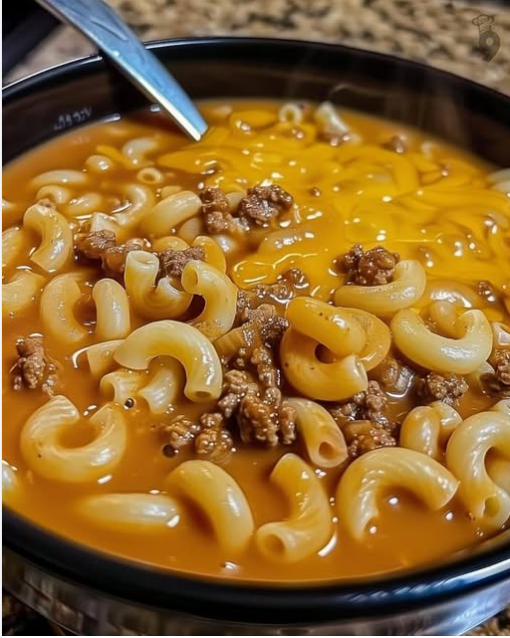
The full components for a substantial $4\text{-serving}$ soup:
I. The Core & Liquid (2 Ingredients Provided):
- **$1\text{ lb}$** ground beef (Bulk, foundation for Maillard reaction)
- **$2\text{ cups}$** beef broth (Liquid base, flavor concentration)
II. The Essential Remaining Ingredients (2 Ingredients Inferred):
- **$2\text{ cups}$** water (For necessary liquid volume to cook pasta)
- **$1\frac{1}{2}\text{ cups}$** uncooked elbow macaroni (Starch, bulk, thickening agent)
- **$8\text{ ounces}$** cubed Velveeta or $2\text{ cups}$ shredded cheddar/Monterey Jack cheese (Creaminess, final flavor)
- **$\frac{1}{2}\text{ tsp}$** salt and **$\frac{1}{4}\text{ tsp}$** pepper (Seasoning)
Methods: Brown, Boil, and Melt
Phase 1: Flavor Development
- **Brown Beef (MAILLARD MANDATE):** In a large pot or Dutch oven, brown the **ground beef** over medium-high heat. Break the meat into small pieces as it cooks. Drain off all excess grease, ensuring the **browned bits (fond)** remain in the pot. Season with salt and pepper.
- **Add Liquid and Boil:** Pour in the **$2\text{ cups}$ beef broth** and **$2\text{ cups}$ water**. Bring the mixture to a rapid boil, scraping the bottom of the pot to **deglaze** and release the beef fond into the liquid (Concentration Mandate).
Phase 2: Starch Release and Pasta Cooking
- **Cook Macaroni (STARCH RELEASE):** Stir in the **uncooked elbow macaroni**. Reduce the heat slightly to maintain a rolling simmer. Cook, stirring occasionally to prevent sticking, for **$10\text{–}12\text{ minutes}$**, or until the macaroni is tender and the soup has visibly thickened due to the released starch.
Phase 3: Final Creaming and Setting
- **Add Cheese (EMULSION PROTOCOL):** Turn the heat **OFF**. Add the **cubed Velveeta or shredded cheese** and stir continuously until the cheese is completely melted and the soup is smooth, velvety, and homogenous. The residual heat from the soup should be sufficient for melting.
- **Adjust and Serve:** Taste and adjust seasoning as needed (the cheese adds salt). Serve immediately while hot. The soup will continue to thicken significantly as it cools.
Tips: Essential Techniques for Creaminess
Draining the Grease: It is crucial to **drain almost all the rendered fat** (Instruction 1) from the ground beef before adding the liquid. Leaving too much fat will result in an oily film on the surface of the soup after the cheese is added.
The Power of Velveeta: While you can use shredded cheese, **Velveeta** (or similar processed cheese) is far superior in this recipe (Ingredient IV). Its high sodium phosphate content acts as a powerful emulsifier, guaranteeing a smooth, non-grainy, and stable cheese sauce that will not separate.
Cheese Temperature: If using **shredded natural cheese** (Cheddar, Monterey Jack), add it in small handfuls, stirring well after each addition (Instruction 4). The cheese must be at **room temperature** before adding to the hot liquid to prevent it from seizing.
Adjusting Thickness: If the soup is **too thick** after cooking the pasta, stir in an extra $\frac{1}{4}\text{ cup}$ of warm milk or broth until the desired consistency is reached. If it is **too thin**, simmer briefly (after removing the beef) before adding the pasta to reduce the volume.
Pasta Shape: The recipe calls for elbow macaroni (Ingredient III), but other small shapes like **ditali or small shells** work well. Avoid large or dense shapes (like penne) as they require much longer cooking times and more liquid.
Variations: Customizing Flavor and Crunch
Easily adapt the richness and savory profile:
- **Aromatics:** Sauté $\frac{1}{2}\text{ cup}$ of **diced onion** or $1\text{ tsp}$ of **minced garlic** with the beef before adding the liquid for a deeper flavor base.
- **Tomato Tang:** Stir in $\frac{1}{4}\text{ cup}$ of **ketchup** or $1\text{ tbsp}$ of **Worcestershire sauce** along with the liquid (Instruction 2) for a more authentic “cheeseburger” flavor profile.
- **Added Veggies:** Stir in $1\text{ cup}$ of **frozen corn or peas** during the last $5\text{ minutes}$ of pasta cooking.
- **Toppings:** Serve the soup topped with a sprinkle of **crispy bacon bits, diced fresh tomato, or chopped dill pickles** for the ultimate cheeseburger experience.
Conclusion: A Fast, Flavor-Packed Meal
The **4-Ingredient Macaroni Cheeseburger Soup** is a brilliant demonstration of culinary efficiency. By strictly adhering to **The Maillard and Concentration Mandate** when browning the beef and utilizing **The Starch Release and Emulsion Protocol** for natural thickening, you create a creamy, savory, and satisfying meal in a single pot. This is the perfect answer to a fast, comforting dinner craving!
Frequently Asked Questions (FAQ)
Q: Why did my soup separate or look oily after adding cheese?
A: The **heat was too high** when the cheese was added, causing the dairy proteins to seize (Cheese Integration Principle, Instruction 4). Make sure the heat is completely off, and the liquid is just hot enough to melt the cheese.
Q: Can I use vegetable broth instead of beef broth?
A: **Yes**, but the “beef” flavor will be less concentrated. Use a high-quality vegetable broth and consider adding $1\text{ tsp}$ of **beef bouillon paste or powder** for added depth (Concentration Mandate).
Q: Why is my macaroni sticking to the bottom of the pot?
A: When cooking pasta in minimal liquid, the starch settles quickly. You must **stir frequently** (Instruction 3), especially right after adding the macaroni, to prevent the starch from fusing the pasta to the pot.
Q: How long do leftovers last?
A: Store the soup, covered, in the refrigerator for **$3\text{–}4\text{ days}$**. Note that the macaroni will continue to absorb the liquid overnight, making the soup much thicker upon reheating.