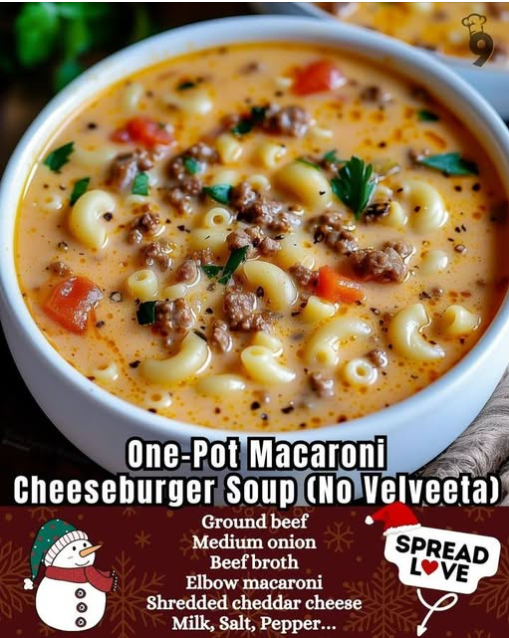
The finalized components for a rich, creamy, and hearty soup:
I. The Meat Base and Aromatics:
- **1 lb** ground beef (or ground turkey)
- **1 medium** onion, diced
- **$\frac{1}{2}$ cup** diced tomatoes (or canned, drained)
- **Salt & pepper** to taste (plus optional extra seasonings)
II. The Liquid and Structure:
- **2 cups** beef broth (Low-sodium recommended)
- **2 cups** elbow macaroni (The thickener)
III. The Creamy Finish:
- **1 cup** shredded cheddar cheese (The savory binder)
- **1 cup** milk (any kind, whole milk recommended for richness)
Instructions: Brown, Simmer, Thicken, and Serve
Phase 1: Building the Flavor Base
- **Brown Meat and Onion (BROWNING STRATEGY):** In a large soup pot or Dutch oven, brown the **ground beef (or turkey)** over medium-high heat. Drain any excess fat. Add the **diced onion** and cook until softened (about 5 minutes). Season generously with **salt and pepper** during this phase.
- **Add Tomato and Broth:** Stir in the **diced tomatoes** and cook for 1 minute. Pour in the **2 cups of beef broth**. Bring the mixture to a boil.
Phase 2: Cooking and Finishing
- **Cook Macaroni (COOK-IN-BROTH METHOD):** Once boiling, add the **2 cups of elbow macaroni**. Reduce the heat to a steady simmer, cover, and cook for **10–12 minutes**, or until the macaroni is cooked *al dente* (slightly firm) and has absorbed most of the liquid. Stir occasionally to prevent sticking.
- **Reduce Heat and Add Milk:** Remove the pot from the heat or reduce the setting to the absolute lowest. Stir in the **1 cup of milk**. Allow the temperature of the soup to drop slightly before adding the cheese.
- **Stir in Cheese (STARCH-AND-DAIRY PROTOCOL):** Slowly add the **1 cup of shredded cheddar cheese** to the soup, stirring constantly until the cheese is completely melted and the soup is smooth and creamy. Do not let the soup boil after adding the cheese.
- **Taste and Serve:** Taste the soup and adjust seasonings (salt, pepper) as needed. Serve immediately while hot.
Serving and Storage: The Leftover Factor
Optimal handling for this hearty, pasta-based soup:
- **Serving:** Garnish options include a dollop of sour cream, extra shredded cheddar, chopped pickles, or a shake of dried parsley.
- **Storage (Refrigerated):** Store leftovers in an airtight container for up to **4 days**. Note that the macaroni will continue to absorb liquid, making the soup very thick upon cooling.
- **Reheating:** To reheat, add a splash of extra milk or beef broth to loosen the thick soup back into a liquid consistency. Reheat gently on the stove or in the microwave.
Tips: Essential Techniques for Creaminess and Flavor
Deglazing for Flavor: If a fond (browned bits) forms on the bottom of the pot after cooking the beef (Step 1), pour in a small splash of the broth before adding the rest. Scrape the fond up—this adds immense flavor (umami) to the final soup.
Shred Your Own Cheese: Pre-shredded cheese (Step 5) contains anti-caking agents that can prevent smooth melting, sometimes leading to a grainy texture. **Shredding block cheddar cheese yourself** ensures the best, creamiest result.
Heat Control is Key: The most common cause of a grainy or curdled cheese sauce is overheating (Step 5). Ensure the pot is off the heat or reduced to low before adding any dairy.
Add a Condiment: To deepen the “cheeseburger” flavor, stir in **1 teaspoon of Dijon mustard** or a **splash of Worcestershire sauce** before adding the broth (Step 2).
Enrichment: Use whole milk or even half-and-half (Step 4) instead of low-fat milk for a much richer, creamier soup base.
Variations: Customizing Texture and Vegetables
Easily adapt the flavor profile of the soup:
- **Smoked Flavor:** Replace $\frac{1}{4}$ of the cheddar cheese with **smoked Gouda** for a deeper, smokier flavor (Step 5).
- **Added Vegetables:** Add **$\frac{1}{2}$ cup of chopped carrots and celery** along with the diced onion (Step 1) for extra nutrients and texture.
- **Thicker Broth:** If your soup seems too thin after the pasta cooks (Step 3), mix **1 tablespoon of cornstarch** with **2 tablespoons of cold water** and whisk it into the soup while simmering just before adding the milk.
- **Spicy Kick:** Add **$\frac{1}{4}$ teaspoon of red pepper flakes** with the salt and pepper (Step 1).
**Al Dente Check:** Always check the pasta toward the end of the cooking time (Step 3). Since it will cook more in the residual heat, it’s best to remove it *just* before it reaches your desired tenderness.
**Pot Size:** Use a large enough pot (Instruction 1) to ensure the ingredients are not crowded. A wider surface area also aids in the efficient browning of the beef.
**Full-Fat Cheese:** Use **full-fat cheddar** (Step 5). Low-fat cheeses tend to separate more easily when heated due to stabilizers and lower butterfat content.
**Liquid Level:** If the macaroni absorbs too much liquid during the simmer (Step 3), don’t hesitate to add an extra $\frac{1}{2}$ cup of broth or water to ensure you have enough liquid left for the soup base.
Conclusion: Hearty, Cheesy, and Simple
The **One-Pot Macaroni Cheeseburger Soup** is a demonstration of how clever technique can yield complex flavors from minimal effort. By utilizing **The Browning and Seasoning Strategy** for a deep umami base, relying on **The Cook-in-Broth Method** for natural thickening, and adhering to **The Starch-and-Dairy Protocol** for a smooth finish, you achieve a creamy, non-curdled soup that delivers serious comfort. This is the ultimate, fuss-free version of two American classics.
Frequently Asked Questions (FAQ)
Q: Why is my soup grainy or clumpy?
A: You likely **added the cheese when the soup was too hot** (Step 5) or used pre-shredded cheese (Tip 6). Ensure the pot is off the heat and the cheese is added slowly.
Q: Can I substitute chicken broth?
A: **Yes**, but the final flavor profile will be lighter and less “cheeseburger-like” (Step 2). You may need extra seasoning to compensate for the lighter base.
Q: Can I use different pasta?
A: **Yes**, small, short pastas like ditalini, small shells, or small tubes work best (Step 3). Adjust the cooking time according to package directions, but follow the same cook-in-broth method.
Q: What is the best way to drain the fat from the beef?
A: After browning (Step 1), tilt the pot and use a ladle to scoop the excess fat out, or transfer the beef to a colander for quick drainage before returning it to the pot.