
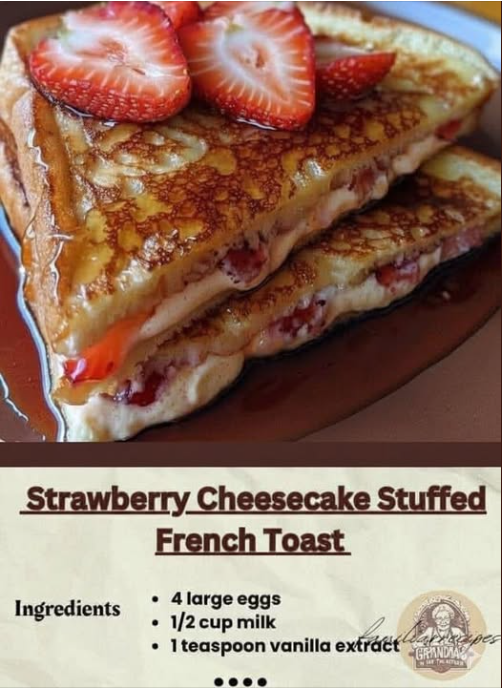
The full ingredient list for a stable filling, a rich custard, and the finished assembly:
I. The Strawberry Cheesecake Filling:
- **8 ounces** cream cheese, softened
- **¼ cup** powdered sugar
- **½ tsp** vanilla extract (Assumed, for flavor)
- **1 tbsp** cornstarch or flour (Assumed, for stability)
- **¼ cup** finely diced fresh or frozen strawberries (Assumed, the fruit element)
II. The French Toast Components:
- **8 slices** thick-cut bread (Brioche or Challah, at least $\frac{3}{4}$-inch thick)
- **2 large** eggs (Custard base)
- **½ cup** whole milk or heavy cream (For richness)
- **1 tbsp** granulated sugar
- **½ tsp** ground cinnamon (Assumed, aromatic)
- **2 tbsp** butter, for cooking
Instructions: Filling Stability and Temperature Control
Phase 1: Preparing the Stabilized Filling
- **Mix Filling:** In a medium bowl, beat the **8 ounces softened cream cheese** and **¼ cup powdered sugar** until completely smooth.
- **Add Stabilizers and Fruit:** Beat in the **$\frac{1}{2}$ tsp vanilla extract** and **1 tbsp cornstarch/flour** (assumed). Fold in the **diced strawberries** (assumed).
- **Chill (CRITICAL):** Cover the filling and place it in the refrigerator for at least **30 minutes**. This is mandatory to prevent the filling from becoming liquid during cooking.
Phase 2: Assembly and Custard Soak
- **Make Custard:** In a shallow dish, whisk together the **2 large eggs, $\frac{1}{2}$ cup milk/cream, 1 tbsp granulated sugar, and $\frac{1}{2}$ tsp cinnamon** (assumed).
- **Slice and Fill:** Using a sharp knife, slice a pocket into the side of **each bread slice**, cutting about two-thirds of the way through to create an opening without cutting through the bottom or the top.
- **Stuff:** Gently spoon or pipe the **chilled cheesecake filling** into each bread pocket. Do not overstuff; aim for 2–3 tablespoons per slice. Gently press the opening shut. [Image illustrating how to properly cut a pocket into a thick slice of bread for stuffing]
- **Soak:** Dip the **stuffed French toast** into the egg custard mixture (Step 4), ensuring both sides and the edges are coated. Let it soak for about **10–15 seconds per side**. Avoid over-soaking, which leads to sogginess.
Phase 3: Low-and-Slow Searing
- **Preheat Pan:** Heat a large non-stick skillet or griddle over **medium-low heat**. Add $\frac{1}{2}$ tablespoon of **butter** (assumed) for each slice being cooked.
- **Sear (LOW AND SLOW):** Place the soaked, stuffed French toast on the pan. Cook for **4–5 minutes per side**, or until deep golden brown. The key is low heat to allow the heat to penetrate the thick center.
- **The Center Cook (Optional):** If the exterior is golden but the center feels cool, place a lid over the skillet for the last 2 minutes of cooking. The trapped steam will heat the interior without burning the outside.
- **Finish:** Transfer the French toast to a cutting board. Dust with extra powdered sugar (optional) and serve immediately.
Serving and Storage: The Warmth Factor
This dish is temperature-sensitive due to the melted cheesecake core.
- **Serving:** Serve immediately while the cheesecake filling is molten and the custard is hot. Top with fresh strawberries, maple syrup, or whipped cream.
- **Storage (Best):** **Store the unsoaked, stuffed bread** in an airtight container in the refrigerator for up to 2 days. Soak and cook just before serving.
- **Storage (Cooked):** Cooked stuffed French toast can be refrigerated for 1–2 days, but the bread texture will soften.
- **Reheating:** Reheat in a **$350^\circ\text{F}$ oven for 10–15 minutes** (not a microwave) to ensure the exterior crisps up and the center filling melts again.
Tips: Essential Techniques for Perfection
Cream Cheese Temperature: Ensure the **cream cheese** (Step 1) is truly **softened** (room temperature). Cold cream cheese will result in a lumpy filling that won’t smooth out during beating.
The Bread Choice: The best bread is a **thick-cut brioche or challah** (Step 5). These breads are dense and high in fat and protein, making them ideal for soaking without falling apart.
Preventing Sogginess: If you are using very fresh bread, leave the slices out on a cooling rack for a few hours before soaking (Step 7). This will dry them out slightly, preventing immediate saturation.
Wiping the Pan: After cooking each batch, wipe the skillet clean and add fresh butter (Step 8). This prevents the residual powdered sugar and filling seepage from burning and leaving dark spots on the next batch.
Cooling the Filling: Do not skip the chilling step (Step 3). The cheesecake filling must be firm to withstand the stuffing and searing process.
Variations: Customizing Filling and Flavor
The stuffed French toast technique can be adapted for seasonal fruits and different flavor profiles:
- **Nutella Swirl:** Replace the strawberries with a **swirl of Nutella** mixed into the cream cheese filling. Omit the cinnamon and add a pinch of salt to the custard.
- **Pecan Praline:** Stir **$\frac{1}{4}$ cup of finely chopped candied pecans** and **1 tablespoon of maple syrup** into the cream cheese filling.
- **Lemon Zest:** Add the **zest of one lemon** to the cream cheese filling (Step 2) for a bright, tangy contrast to the sweetness.
- **Baked Finish:** After searing both sides until golden (Step 9), transfer the French toast to a **$350^\circ\text{F}$ oven for 5–8 minutes**. This is a fool-proof way to guarantee a fully cooked center without burning the exterior.
- **Savory Option:** Omit all sugar and fruit. Use a filling of **softened goat cheese and chives**. Soak the bread in a savory custard (egg, milk, salt, pepper) and serve with a dollop of crème fraîche.
**Griddle vs. Pan:** A **griddle** is superior for French toast (Step 8) as it provides a large, flat, consistent heat surface, promoting even browning across the entire slice.
**Use Heavy Cream:** If you have it, use **heavy cream** instead of milk in the custard (Step 4). The higher fat content creates a richer, more luxurious crust and minimizes the chance of the custard becoming watery.
**Powdered Sugar Test:** The cheesecake filling (Step 1) is ready when it is completely smooth and holds a stiff peak. If it is too soft, add another teaspoon of **powdered sugar** to tighten it up before chilling.
**Sealing the Edges:** When pressing the edges shut (Step 6), use the back of a spoon or fork to gently crimp the edges of the bread to ensure the opening is as sealed as possible before soaking.
Conclusion: A Taste of Excellence
The **Strawberry Cheesecake Stuffed French Toast** transforms a standard breakfast item through precise execution. By creating a **stable, chilled cheesecake filling**, selecting the right **thick, dense bread**, and mastering the **low-and-slow searing technique**, the baker ensures a dish with a crisp, golden exterior and a molten, sweet center. This recipe is a rewarding venture into elevated comfort food, delivering a taste and texture that is truly melt-in-your-mouth.
Frequently Asked Questions (FAQ)
Q: Why did my filling run out and burn on the pan?
A: The filling was **not chilled long enough** (Step 3) and was too soft, or the **bread was overstuffed** (Step 6). Ensure the filling is firm and the seam is pinched shut.
Q: My French toast exterior is burning, but the center is cold.
A: Your **heat is too high** (Step 8). Reduce the heat to medium-low, and let the toast cook longer. If necessary, use the lid trick (Step 10) to heat the center with steam.
Q: Can I use regular sandwich bread?
A: **Not recommended.** Regular sandwich bread is too thin and soft; it will absorb too much custard and lack the structural integrity to hold the heavy filling without falling apart.
Q: Can I prepare the whole dish the night before?
A: You can prepare the filling (Step 3) and stuff the bread (Step 6) the night before. **Do not soak the bread** in the custard (Step 7) until immediately before cooking, or it will become soggy.
Related posts:
 White German Chocolate Cake with a Cheesecake Center
 Mastering Mini Chicken Pot Pies
 The Best Banana Pudding Ever: A Classic Dessert with a Creamy Twist
 Mastering Cream Puffs with Vanilla Custard
 The Art of the Swirl: Mastering Blueberry Cheesecake Cookies
 Milktart Cookie Cups—Irresistibly Creamy and Homemade Delights
