ADVERTISEMENT
Phase 1: Preparing the Crust and Crunch
- **Make Crust (CRUST INTEGRITY RULE):** Mix graham cracker crumbs, melted butter, and sugar. Press firmly and evenly into the bottom and $1\text{ inch}$ up the sides of a 9-inch springform pan. Wrap the outside of the pan securely in **two layers of heavy-duty aluminum foil**.
- **Par-Bake:** Bake the crust at $350^\circ\text{F}$ ($175^\circ\text{C}$) for **$10\text{ minutes}$**. Let cool.
- **Make Crunch:** In a separate bowl, combine the **crushed cookies, pulverized freeze-dried strawberries, $\frac{1}{4}\text{ cup}$ melted butter, and food coloring**. Set aside.
Phase 2: Mixing and Baking the Cheesecake
- **Prepare Water Bath (WATER BATH PROTOCOL):** Place the foil-wrapped springform pan inside a larger roasting pan. Bring water to a simmer.
- **Mix Filling:** In a large bowl, beat the **softened cream cheese** and **sugar** on medium speed until smooth. Beat in the **sour cream** and **vanilla**. Add the **eggs** one at a time, mixing only until *just* incorporated. **Do not overmix.**
- **Bake (LOW-AND-SLOW METHOD):** Pour the filling into the cooled crust. Carefully pour the simmering water into the roasting pan (around the springform) until it reaches halfway up the side of the springform. Bake at $325^\circ\text{F}$ ($160^\circ\text{C}$) for **$60\text{–}75\text{ minutes}$**, until the edges are set and the center still has a slight jiggle.
Phase 3: Cooling, Chilling, and Topping
- **Cooling:** Turn off the oven, crack the oven door, and leave the cheesecake in the water bath for **$1\text{ hour}$**. Remove from the water bath, unwrap the foil, and cool on a wire rack for $1\text{ hour}$.
- **Chill:** Cover the cheesecake and refrigerate for at least **8 hours** (preferably overnight) before removing the springform ring.
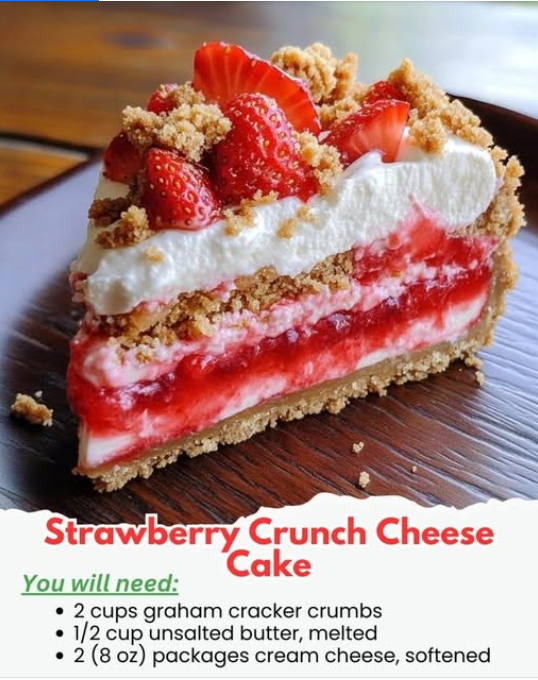
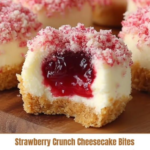
- **Topping (MOISTURE BARRIER RULE):** Just before serving, sprinkle the **Strawberry Crunch** mixture evenly over the top of the chilled cheesecake.
Serving and Storage: The Perfect Chill
Optimal handling for this chilled dessert:
- **Serving:** Serve cold, straight from the refrigerator. For clean slices, dip your knife in hot water and wipe dry between each cut.
- **Storage:** Store, covered, in the refrigerator for up to **5 days**. If freezing, freeze before adding the crunch topping.
Tips: Essential Techniques for Creaminess and Crunch
Ingredient Temperature: All dairy ingredients (**cream cheese, sour cream, eggs**) must be at **room temperature** (Ingredient II). This is essential for smooth emulsification and prevents lumps, which can lead to cracks.
Do Not Overmix: Overmixing (Instruction 5) incorporates too much air. Air bubbles trapped in the batter expand rapidly during baking, causing the cheesecake to rise and fall dramatically, which leads to **cracks**.
The Water Bath Seal: Ensure the outside of the springform pan is wrapped tightly in **two layers of heavy-duty foil** (Instruction 1) to prevent any water from seeping into the crust. A wet crust is a failed crust.
Crunch Flavor: Using **freeze-dried strawberries** (Ingredient III) provides an intense, natural flavor and color without introducing moisture, which is key to maintaining crispness.
Checking for Doneness: The cheesecake is done when the internal temperature is $150^\circ\text{F}$ ($66^\circ\text{C}$). Visually, the outer $2\text{ inches}$ should look set, while the center still wobbles slightly like Jell-O.
Variations: Customizing Texture and Flavor
Easily adapt the flavor profile of the crust and topping:
- **Crust Swap:** Substitute **graham cracker crumbs** (Ingredient I) with **vanilla wafers or golden Oreos** for a different base flavor.
- **Strawberry Swirl:** Before baking, swirl $\frac{1}{4}\text{ cup}$ of **strawberry jam or purée** into the top of the cheesecake batter with a toothpick for added visual appeal and concentrated strawberry flavor.
- **Cream Cheese Substitute:** For a slightly lighter filling, substitute up to $\frac{1}{2}\text{ cup}$ of the **sour cream** (Ingredient II) with **full-fat Greek yogurt**.
- **No-Bake Crunch:** For a faster method, use a **no-bake cheesecake recipe**. Ensure the no-bake filling is fully set and firm before applying the Strawberry Crunch (The Moisture Barrier Rule still applies).
**The Initial Cooling:** The **$1\text{-hour}$ cooling period in the turned-off oven** (Instruction 7) is essential. It allows the cheesecake to cool slowly and gradually transition from the high baking temperature, which minimizes the thermal shock that causes cracks.
**Crust Sides:** To achieve a neat, tall crust edge, use the bottom of a measuring cup or glass to firmly and evenly press the crumb mixture up the sides of the pan (**The Crust Integrity Rule**).
**Cutting the Chill:** For the neatest, most professional slices, **chill the cheesecake overnight**. This long chill time fully solidifies the fat and protein structure of the custard.
**Glazing the Crunch:** For an extra layer of flavor protection, mix the finished **Strawberry Crunch** with **2 tablespoons of melted white chocolate** before sprinkling it on the cake. The white chocolate acts as an extra moisture barrier.
Conclusion: A Technical Triumph in Layers
The **Strawberry Crunch Cheesecake** is a confectionery masterpiece when executed with precision. By strictly adhering to **The Water Bath Protocol** for uniform, gentle cooking, controlling the texture via **The Low-and-Slow Baking Method**, and protecting the crispness using **The Moisture Barrier Rule** , you create a dessert that is as structurally perfect as it is delicious.
Frequently Asked Questions (FAQ)
Q: Why did my cheesecake crack?
A: Cracking is usually due to **overmixing** (incorporating too much air, Instruction 5) or **sudden temperature changes** (skipping the water bath or removing the cheesecake too quickly from the oven, Instruction 7).
Q: Can I skip the water bath?
A: You can, but you risk a dry edge, a cracked top, and a grainy texture. If you skip it, bake at an even lower temperature ($300^\circ\text{F}$ or $150^\circ\text{C}$) and place a pan of water on the rack below the cheesecake for some humidity.
Q: Why is my crunch topping soggy?
A: The crunch was added too early (**The Moisture Barrier Rule**). It must be added right before serving, after the cheesecake has fully chilled, to prevent it from absorbing moisture from the air or the cheesecake’s surface.
Q: What is the best way to soften cream cheese?
A: Unwrap the blocks and leave them on the counter for at least **1-2 hours**. You can also microwave them on low power (50%) for $15\text{ seconds}$ per block.
ADVERTISEMENT