ADVERTISEMENT
Phase 1: Melting the Base
- **Prep:** Line two baking sheets with parchment paper or wax paper.
- **Melt Chips (LOW-HEAT MELT PROTOCOL):** Place the **11 oz butterscotch chips** and **1 cup smooth peanut butter** in a heatproof bowl set over a saucepan of simmering water (double boiler) or in a microwave-safe bowl. Stir frequently until completely smooth and melted. Remove from heat immediately.
- **Fold in Crunch (TEMPERING AND TEXTURE RULE):** Add the **4 cups of chow mein noodles** and the **1 cup of roasted peanuts** (if using) to the melted mixture. Gently fold with a rubber spatula until the noodles and peanuts are entirely coated in the creamy base, taking care not to crush the noodles.
Phase 2: Shaping and Setting
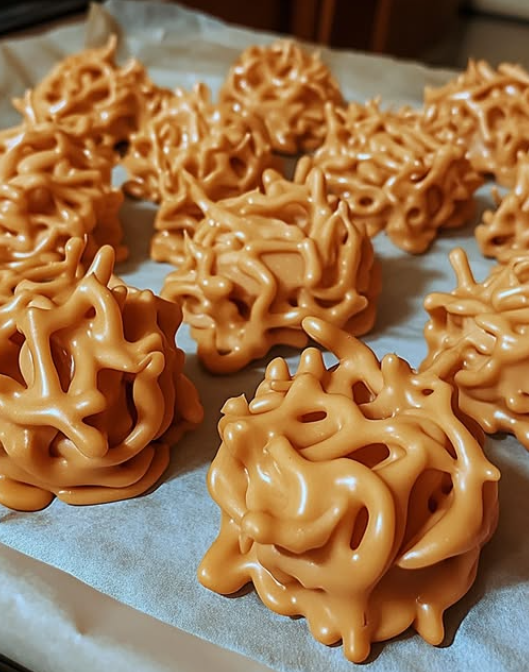
- **Shape (IMMEDIATE SHAPING MANDATE):** Working quickly, use two spoons or a small cookie scoop to drop the mixture onto the prepared baking sheets, forming small, loose mounds (haystacks).
- **Chill and Set:** Allow the haystacks to cool at room temperature for about **2 hours** or transfer to the refrigerator for **30 minutes** for a faster set.
- **Serve:** Once firm, store in an airtight container at room temperature.
Serving and Storage: The Stable Confection
Optimal handling for this simple confection:
- **Serving:** Serve at room temperature for the best blend of texture and flavor, allowing the peanut butter/butterscotch flavor to shine.
- **Storage:** Store in an airtight container at room temperature for up to **1 week**. If stored in the refrigerator, allow them to come to room temperature before serving for optimal texture.
Tips: Essential Techniques for Stability and Finish
Preventing Scorching: If melting in the microwave (Instruction 2), use **30-second intervals** on medium power, stirring vigorously between each interval. Butterscotch chips scorch very easily, leading to a burnt flavor and grainy texture.
Peanut Butter Choice: Use **smooth, commercial-brand peanut butter** (Ingredient I) for the best results. Natural peanut butter (the kind that separates) has inconsistent fat and water content, which can cause the butterscotch chips to seize.
Double the Crunch: For extra insurance against breakage (Ingredient II), use a slightly larger ratio of **noodles to melted base** (e.g., $4\frac{1}{2}\text{ cups}$ noodles) to ensure the coating is thin and the crunch is maximized.
Shaping Tool: A **small cookie scoop (about $1\frac{1}{2}\text{ tablespoons}$)** (Instruction 4) works best for uniform size and shape. Use a second spoon to scrape the mixture out of the scoop.
Seizing Solution: If the melted base suddenly turns thick, grainy, or “seizes” (Instruction 2), immediately stir in **$\frac{1}{2}\text{ teaspoon}$ of neutral oil or shortening**. This sometimes re-emulsifies the mixture, but proceed with caution.
Variations: Customizing Coatings and Flavors
Easily adapt the flavor profile of the haystacks:
- **Chocolate Peanut Butter:** Substitute half of the **butterscotch chips** with **milk chocolate chips** (Ingredient I) for a classic chocolate-peanut butter combination.
- **Salty-Sweet Twist:** Stir **$\frac{1}{4}\text{ teaspoon}$ of flaky sea salt** into the melted peanut butter mixture (Instruction 2) for an enhanced salty-sweet flavor.
- **Pretzel Crunch:** Substitute half of the **chow mein noodles** with **broken pretzel sticks** (Ingredient II) for a different kind of salty, savory crunch.
- **White Chocolate Cranberry:** Swap the butterscotch chips for **white chocolate chips** and replace the roasted peanuts with a mix of **dried cranberries and slivered almonds**.
**Keep Dry Ingredients Cool:** Keep the **chow mein noodles and peanuts** (Ingredient II) at room temperature or slightly cool. Adding them to a hot mixture risks over-softening the fats and making the noodles too fragile.
**Avoid Moisture:** Ensure your mixing bowl and utensils are **completely dry** (Instruction 2). Any water introduced during the melting process will cause the butterscotch to seize immediately.
**Don’t Refrigerate Too Long:** While refrigeration speeds up the set time (Instruction 5), prolonged chilling can cause the chocolate/butterscotch to “sweat” (develop condensation) when returned to room temperature. A quick chill is best.
**Double Batch:** If making a double batch, work in two separate phases. Melting a large quantity of chips at once increases the risk of scorching and makes the mixture set before you can finish shaping all the haystacks.
Conclusion: A Lesson in Simplicity
The **Peanut Butter Haystacks** are a testament to the power of simple ingredients and correct technique. By strictly adhering to **The Low-Heat Melt Protocol** to ensure a smooth binder, carefully executing **The Tempering and Texture Rule** to preserve the crunch, and following **The Immediate Shaping Mandate**, you produce a delicious, stable, and perfectly textured no-bake confection—a year-round favorite.
Frequently Asked Questions (FAQ)
Q: Why is my mixture grainy or clumpy after melting?
A: The **butterscotch chips scorched or seized** (Low-Heat Melt Protocol, Instruction 2) due to overheating or exposure to a small amount of water. Ensure you melt gently and slowly.
Q: My haystacks won’t hold their shape. What happened?
A: There was likely **too much peanut butter or too little chow mein noodles/chips**. This creates a ratio imbalance that is too soft to set firmly. Add $\frac{1}{4}\text{ cup}$ more chips next time, or reduce the peanut butter slightly.
Q: Can I use different types of noodles?
A: You can use other crunchy cereals, like **pretzels, crispy rice cereal, or flake cereal**, but the chow mein noodles (Ingredient II) offer the most unique, savory-sweet flavor and structure.
Q: How can I speed up the set time without refrigeration?
A: Place the baking sheets near a window or in the coolest area of your kitchen. The mixture must cool below the melting point of the fats to solidify.
ADVERTISEMENT