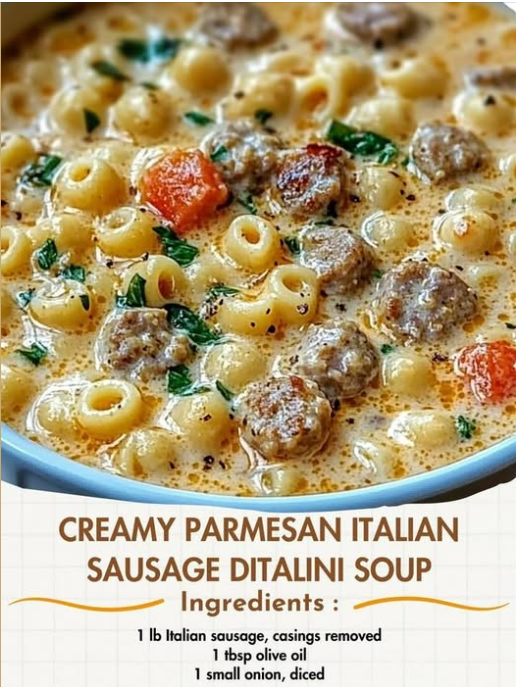
The list is balanced between the high-impact savory components and the rich, thickening dairy:
I. The Savory Foundation:
- **1 lb** Italian sausage, casings removed
- **1 tbsp** olive oil
- **1 small** onion, diced
- **2** garlic cloves, minced
- **1 can (14.5 oz)** diced tomatoes, drained
- **1 teaspoon** Italian seasoning (Assumed, for aromatic depth)
II. The Liquid and Enrichment:
- **4 cups** chicken broth
- **1 cup** heavy cream (The primary fat source for creaminess)
- **1 cup** grated Parmesan cheese (High-impact flavor and secondary thickening agent)
III. Texture and Finish:
- **1 cup** uncooked ditalini pasta (The tender starch element)
- **2 cups** fresh spinach (or kale) (For color and nutrients)
- **1/2 teaspoon** salt and **1/4 teaspoon** black pepper (For seasoning)
Instructions: Browning, Cooking, and Stabilizing the Finish
Phase 1: Building the Flavor Base
- **Brown the Sausage (Maillard Reaction):** In a large Dutch oven or soup pot, heat the **olive oil** over medium-high heat. Add the **Italian sausage**. Break the sausage up with a spoon and cook until it is fully browned and slightly caramelized. Drain excess grease, reserving about 1 tablespoon.
- **Sauté Aromatics:** Add the **diced onion** to the pot and cook in the residual fat for 5 minutes until softened. Add the **minced garlic** and **Italian seasoning** and cook for 1 minute until fragrant.
- **Deglaze and Simmer:** Pour in about 1/2 cup of the **chicken broth** and use a wooden spoon to scrape up all the browned bits (*fond*) from the bottom of the pot. Add the remaining **chicken broth** and the **drained diced tomatoes**. Bring to a boil, then reduce to a simmer.
Phase 2: Cooking the Pasta and Vegetables
- **Cook Pasta (Timing Regulation):** Add the **uncooked ditalini pasta** to the simmering soup. Cook for **8–10 minutes**, or according to package directions, until the pasta is *al dente*. Stir occasionally to prevent the pasta from sticking to the bottom.
- **Add Greens:** Stir in the **fresh spinach (or kale)**. Cook for 1–2 minutes, just until the spinach is wilted or the kale is slightly softened.
Phase 3: Dairy Integration and Stabilization
- **Remove from Heat (CRITICAL):** Turn off the heat. **Remove the pot from the burner** and allow the soup to cool for **5 minutes**. This reduction in temperature is mandatory to prevent the dairy from curdling.
- **Integrate Cream:** Slowly pour the **heavy cream** into the warm soup, stirring constantly until fully combined.
- **Add Parmesan:** Stir in the **grated Parmesan cheese** until it is completely melted and the broth is smooth and creamy. The high fat content of the heavy cream helps stabilize the Parmesan.
- **Final Seasoning:** Taste the soup and adjust the **salt and pepper** as needed. Parmesan cheese is salty, so add table salt cautiously.
Serving and Storage: The Pasta Absorption Problem
Like all cream and pasta soups, this recipe will thicken considerably upon cooling as the ditalini continues to absorb the liquid.
- **Serving:** Serve immediately, ensuring the soup is hot and the creamy base is homogenous. Garnish with an extra sprinkle of Parmesan.
- **Storage (Refrigerated):** Store leftovers in an airtight container in the **refrigerator for up to 3 days**. The soup will be very thick, almost stew-like.
- **Reheating:** When reheating, gently stir in **1/4 to 1/2 cup of extra chicken broth or milk** per serving to restore the liquid consistency. Reheat slowly over low heat, ensuring it does not come to a boil, which could cause the dairy to separate.
- **Tip for Best Leftovers:** For the best texture, cook the ditalini pasta separately and add it to the broth *just* before serving each portion. Store the creamy broth base without the pasta.
Tips: Essential Techniques for Creamy Consistency
The Temperature Buffer: The most crucial step is removing the soup from high heat (Step 6) before adding the heavy cream and Parmesan. High, rolling heat is the enemy of stable dairy in soup, leading to curdling.
Sausage Searing: Do not crowd the pot when browning the sausage (Step 1). If necessary, brown the sausage in two batches. Crowding lowers the pot temperature, causing the meat to steam rather than sear, which prevents the essential Maillard reaction.
Ditalini Check: Ditalini is a small pasta shape and cooks quickly. Ensure you test it (Step 4) after 8 minutes and pull it when it is truly *al dente*—it will continue to soften slightly in the broth off-heat.
Grated Parmesan Quality: Use **freshly grated Parmesan** (Step 8), if possible. Pre-grated varieties often contain cellulose (anti-caking agents) that can inhibit smooth melting and contribute to a grainy texture.
Fat Content: **Full-fat heavy cream** is essential for this recipe. Lower-fat dairy substitutes (like half-and-half or whole milk) have higher water and protein content and are far more susceptible to curdling.
Variations: Customizing Protein and Flavor
The creamy base is a robust foundation that can be easily adapted to other flavors:
- **Protein Swap:** Substitute the Italian sausage with **ground chicken or turkey** seasoned with **fennel seed and red pepper flakes** to maintain the Italian flavor, or use **shredded rotisserie chicken** (add during Step 5).
- **Vegetable Bulk:** Add other hearty vegetables that cook alongside the pasta, such as **diced zucchini, finely chopped mushrooms, or frozen peas** (add in the last 2 minutes).
- **Smoked Paprika:** Stir in **1 teaspoon of smoked paprika** along with the Italian seasoning (Step 2) for a complex, smoky undertone that pairs well with the sausage.
- **Spice Level Control:** Increase the heat by adding **1/2 teaspoon of cayenne pepper** or a pinch of chili powder with the spices.
- **Pasta Substitution:** Use other small pasta shapes like **orzo, acini di pepe, or small shells** in place of ditalini. Adjust cooking time based on the package directions.
Don’t Overcook Greens: Spinach and kale (Step 5) cook rapidly. Overcooking them results in a drab color and a bitter taste. Add them just before the final simmer check to allow the residual heat to wilt them perfectly.
Salt Check Timing: The soup must be tasted and salted *after* the Parmesan cheese is added (Step 9). Parmesan provides a significant amount of sodium, so seasoning beforehand risks an overly salty final product.
Deglazing Technique: Use a wooden spoon with a flat edge to effectively scrape the *fond* (browned bits) from the bottom of the pot after adding the first splash of broth (Step 3). This is where the concentrated flavor lives.
Broth Consistency: If you prefer a thicker soup, reserve 1/4 cup of the broth and mix it with 1 tablespoon of cornstarch (a slurry) before adding it to the simmering soup (Step 4). Cook for 2 minutes to thicken before adding the pasta.
Conclusion: A Reliable Comfort Bowl
The Creamy Parmesan Italian Sausage Ditalini Soup is a flavorful masterpiece achieved through careful cooking principles. By maximizing flavor through the Maillard reaction on the sausage and strictly adhering to the off-heat dairy integration rule, the cook creates a robust, savory broth with a flawlessly smooth, creamy finish. This recipe is a model for stable, creamy soups and delivers deep, satisfying homestyle comfort in every spoonful.
Frequently Asked Questions (FAQ)
Q: Why did my creamy broth separate or look grainy?
A: The most common cause is adding the cream/Parmesan while the soup was **too hot or boiling** (Step 6). High heat destabilizes the milk proteins. You must remove the soup from the heat and allow the temperature to drop before integrating the dairy.
Q: My pasta absorbed all the liquid after being stored. How can I fix this?
A: Pasta continues to swell and absorb liquid upon cooling. To fix, simply stir in an extra **1/4 to 1/2 cup of chicken broth or milk** per serving when reheating to restore the original consistency (Reheating Tip).
Q: Can I use diced tomatoes that haven’t been drained?
A: It is recommended to drain them. The excess liquid (water) in the canned tomatoes can thin the broth too much and increase the acid level, making the final creamy base slightly harder to stabilize.
Q: How can I make the soup vegetarian?
A: Substitute the Italian sausage with **crumbled meat substitutes** (e.g., Impossible or Beyond Italian sausage) or use **sautéed mushrooms and sun-dried tomatoes** for a savory base. Use vegetable broth instead of chicken broth.