
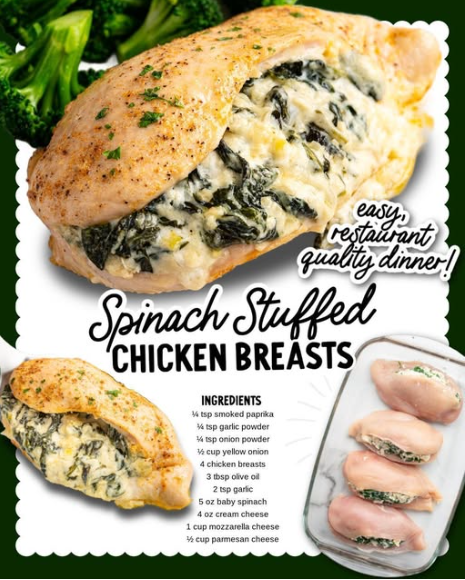
Step 1: The “Hinge” Incision
Slice a pocket into the thickest part of the chicken without cutting all the way through. The “Mechanical Hinge” Rule: You are creating a Biological Envelope. Maintaining a 1/2-inch border of uncut meat ensures the filling is contained during the thermal expansion that occurs during cooking.
Step 2: Surface Seasoning (The Maillard Prep)
Coat the exterior with the oil and spice blend. The “Lipid-Aromatic Diffusion” Science: The olive oil acts as a heat-transfer medium, ensuring that the spices don’t burn before the chicken proteins begin to brown.
Step 3: Stuffing and Sealing
Fill the pocket with the sautéed spinach and cheese mixture. The “Density Equilibrium” Secret: Do not overpack. Overstuffing increases the Thermal Mass of the center, which could lead to an undercooked core or “blowout” where the filling is forced out by internal steam pressure.
Step 4: The Searing and Roasting Phase
Sear in a pan for 3-5 minutes per side, then finish in the oven. The “Conduction-Convection” Hybrid: The pan sear provides Direct Conduction for a crispy crust, while the oven provides Convective Heat to gently cook the interior to a safe 165°F.
Service and Storage Tips
Service: Allow the chicken to rest for 5 minutes before slicing. The “Pressure Equilibrium” Factor: During cooking, juices are pushed toward the center. Resting allows the Myofibrillar Matrix to relax and reabsorb those juices, preventing them from leaking out on the plate.
Storage: Store in an airtight container for up to 3 days. The “Lipid Solidification” Warning: The cheese filling will firm up when cold. For the best experience, reheat in a 350°F oven to restore the Fluidity of the center without overcooking the meat.
Variants: Iterative Flavor Designs
| Variation | Modification | Resulting Impact |
|---|---|---|
| Mediterranean | Add sun-dried tomatoes and Feta cheese. | Higher Ionic Salinity and tangy acidity. |
| Pesto Infusion | Mix 2 tbsp pesto into the spinach. | Increased Volatile Aromatic density from basil and pine nuts. |
| Crispy Crust | Dredge the outside in Panko breadcrumbs. | Higher Mechanical Crunch and improved oil retention. |
Tips: Pro-Level “Stuffed” Nuances
- Toothpick Anchoring: If your pockets are opening up, use wooden toothpicks to secure the edge. This acts as a Temporary Mechanical Fastener to keep the steam inside.
- Squeezing the Spinach: If using frozen spinach, squeeze out ALL excess water. Too much Intercellular Water will turn your filling into a watery mess, preventing the cheese from emulsifying properly.
- Meat Uniformity: If the breasts are uneven, use a meat mallet to pound the thickest part slightly. Equal Thermal Mass ensures all four pieces reach the safety set-point at the same time.
Conclusion: A Triumph of Thermal Management
Spinach Stuffed Chicken Breast is a masterpiece of Culinary Engineering. By balancing the lean protein of the poultry with a high-moisture, fat-rich core, you bypass the traditional limitations of white meat. On this Saturday, December 27, 2025, enjoy the perfectly executed results of internal hydration and high-heat searing. Happy cooking!
Frequently Asked Questions
- How do I know the chicken is done without a thermometer?
- The juices should run clear, and the meat should feel firm to the touch (similar to the base of your thumb). However, for Microbial Safety, a digital thermometer is always the most reliable tool.
- Can I use frozen spinach?
- Yes, but you must thaw and drain it completely. Frozen spinach has undergone Cellular Wall Rupture, meaning it releases water much faster than fresh spinach.
- Why did my cheese filling all run out?
- This is usually due to a Structural Failure in the cut. Ensure you don’t cut through the back or sides of the breast. Searing the “opening” side first can also help “weld” the proteins shut early in the process.
Would you like me to suggest a “Lemon Butter Cream Sauce” to drizzle over these, or perhaps show you how to adapt this recipe for “Stuffed Pork Chops”?
Related posts:
 The Handheld Miracle: Mastering the Loaded Cheesy Pocket Taco
 Mastering Strawberry Cheesecake Stuffed French Toast
 The Engineering of Slow-Cooked Chicken and Noodles
 GREEK-STYLE GRILLED CHICKEN TENDERS
 The Regal Stuffed Cauliflower with Savory Minced Meat
 Stuffed Folded Cottage Cheese Chicken Cutlets
