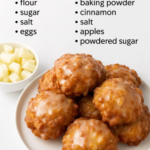
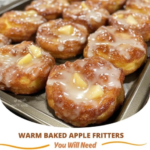
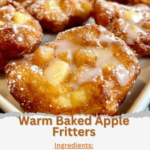
The ingredients are balanced to create a fluffy, moist interior and a signature spiced apple flavor:
I. The Fritter Base (Dry):
- **2 cups** all-purpose flour
- **1/3 cup** granulated sugar
- **2 teaspoons** baking powder
- **½ teaspoon** salt (Assumed, crucial for balancing sweetness)
- **1 teaspoon** ground cinnamon (Assumed, essential apple spice)
II. The Fritter Base (Wet & Flavor):
- **1 large** egg (Assumed, for structure)
- **1 cup** whole milk or buttermilk (Assumed, for moisture/acidity)
- **¼ cup** unsalted butter, melted (Assumed, for richness)
- **1 teaspoon** vanilla extract (Assumed, for aroma)
- **1 large apple, peeled and finely chopped** (Assumed, about 1 cup)
III. The Glaze and Coating:
- **2 cups** powdered sugar (The glaze base)
- **3 tablespoons** milk or water (Liquid for the glaze)
- **½ teaspoon** vanilla extract (Glaze flavor)
- **1 tablespoon** cinnamon sugar (For the coating, assumed)
Instructions: Folding Gently and Glazing Warmly
Phase 1: Preparing the Ingredients and Dry Mix
- **Preheat and Prepare:** Preheat your oven to **$400^\circ\text{F}$ ($200^\circ\text{C}$)** (Assumed high heat for quick baking). Line a large baking sheet with parchment paper or a silicone mat.
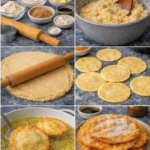
- **Prepare Dry Ingredients:** In a large bowl, whisk together the **2 cups all-purpose flour, 1/3 cup granulated sugar, 2 teaspoons baking powder, ½ teaspoon salt, and 1 teaspoon cinnamon**.
- **Prepare Wet Ingredients:** In a separate medium bowl, whisk the **egg, 1 cup milk, ¼ cup melted butter, and 1 teaspoon vanilla extract** until fully combined.
Phase 2: Minimal Mixing and Baking
- **Coat Apples (CRITICAL):** Add the **finely chopped apple** to the dry ingredients and toss gently until the pieces are lightly coated in the flour mixture. This step is critical for preventing the apples from sinking.
- **Combine Gently (Gluten Control):** Pour the wet ingredients (Step 3) into the dry ingredients (Step 4). **Fold the mixture gently** with a spatula until *just* combined. The batter should be lumpy, with streaks of flour remaining. **Do not overmix.**
- **Shape Fritters:** Drop the lumpy batter by large spoonfuls (about ¼ cup each) onto the prepared baking sheet. Leave irregular shapes, as this mimics the natural look of a fried fritter.
- **Bake:** Bake for **14–16 minutes**, or until the fritters are golden brown on the outside and a toothpick inserted into the center (avoiding a large apple piece) comes out clean.
Phase 3: Glazing Protocol (The Two-Part Finish)
- **Cool Slightly:** Immediately transfer the baked fritters to a wire cooling rack. They must still be **warm** for the next steps.
- **Cinnamon Sugar Coat:** Immediately after removing from the oven, brush the warm fritters lightly with a tiny bit of melted butter (optional, but helps sticking), and sprinkle liberally with the **1 tablespoon cinnamon sugar**.
- **Make Glaze:** While the fritters are cooling slightly (about 5 minutes), whisk together the **2 cups powdered sugar, 3 tablespoons milk, and ½ teaspoon vanilla extract** until smooth. The glaze should be thick enough to coat the back of a spoon, but still runny.
- **Glaze Warm Fritters (MANDATORY):** Dip the warm, cinnamon-coated fritters into the glaze (or drizzle heavily). The warmth of the fritter helps the glaze set quickly into a perfect, shiny coating.
- **Serve:** Let the glaze set for a few minutes before serving.
Serving and Storage: Retaining the Crisp Crust
Baked fritters are best consumed immediately to enjoy the crisp exterior and tender interior.
- **Serving:** Serve warm, right after the glaze has set.
- **Storage:** Store leftovers in an **airtight container at room temperature for up to 2 days**. The glaze will soften the crust over time.
- **Refreshing:** To restore the crispness, reheat stored fritters in a toaster oven or air fryer for 3–5 minutes. The glaze will become slightly tacky but the fritter will regain its fluffy texture.
- **Freezing:** Not recommended after glazing. The glaze becomes watery upon thawing. If freezing, freeze the plain baked fritters and glaze them after thawing and reheating.
Tips: Essential Techniques for a Tender Crumb
Overmixing Guardrail: The key to tenderness (Step 5) is to **stop stirring as soon as the flour disappears.** Overmixing develops gluten, which is the enemy of a tender quick bread like a fritter, resulting in a dense, rubbery texture.
Buttermilk Substitute: If using the assumed **buttermilk** instead of whole milk, the acidity reacts with the baking powder, providing an extra boost of leavening and tenderness. If using whole milk, adding **1 teaspoon of vinegar or lemon juice** to the milk and letting it sit for 5 minutes (creating “soured milk”) can mimic this effect.
Apple Preparation: **Finely chop** the apples (Step 4). Large apple chunks will not fully soften in the short baking time, and their weight can make the batter structure unstable, leading to a sunken, wet center.
Glaze Consistency Check: The glaze (Step 10) must be thick, but not stiff. If it is too thin, add more powdered sugar; if it is too thick, add a drop or two more milk. The glaze needs to set quickly on the warm fritter.
Baking Temperature: The assumed $400^\circ\text{F}$ is high for a baked product, but it’s intentional. This high temperature helps to **set the crust rapidly** before the internal starches fully gelatinize, trapping the air bubbles from the leavening for a lighter, fluffier result.
Variations: Customizing Fruit and Spice
The fritter base can be easily adapted to other seasonal flavors:
- **Pumpkin Spice Fritter:** Reduce the milk by 1/4 cup and add **1/4 cup of canned pumpkin puree** and **1/2 teaspoon of pumpkin pie spice** to the batter. The apple can be retained or replaced with diced pears.
- **Maple Glaze:** Replace the milk/water in the glaze with **maple syrup** for a distinct flavor, thinning with milk if necessary to achieve the right consistency.
- **Citrus Zing:** Add **1 tablespoon of lemon zest** (in the dry ingredients) and **1 teaspoon of lemon juice** (in the wet ingredients) to brighten the apple flavor.
- **Crunchy Topping:** Fold in **1/4 cup of finely chopped pecans or walnuts** into the batter (Step 5) for a nutty crunch.
- **Chocolate Glaze:** Replace 1/4 cup of the powdered sugar with **cocoa powder** to create a chocolate glaze, adding a drop or two more liquid as needed.
The “Irregular Drop”: Don’t try to make perfectly round scoops (Step 6). The irregular shape is crucial, as it creates extra surface area and thin edges that crisp up faster, mimicking the aesthetic and texture of a traditional fried fritter.
Applesauce Substitute: While chopped apple is traditional, if you prefer a smoother fritter, replace the chopped apple with **1/4 cup of unsweetened applesauce** (reducing the milk by 1/4 cup). This creates a highly moist, cake-like texture but eliminates the bits of softened fruit.
Glazing Alternative: For a less messy, non-glazed finish, roll the **warm** baked fritters immediately in a bowl of **cinnamon sugar** (Step 9) and serve as-is. The warmth will help the sugar adhere.
Pre-baking Prep: Ensure all components—especially the milk and egg—are at **room temperature** (Step 3). This helps them combine smoothly and reduces the dough’s temperature shock when it hits the hot oven, resulting in a more even and rapid rise.
Conclusion: Light, Tender, and Perfectly Spiced
The Baked Apple Fritter is a testament to the fact that maximum flavor does not require deep-frying. By meticulously controlling the batter consistency—prioritizing aggressive leavening and strictly forbidding overmixing—the baker achieves the tender crumb necessary to support the apples. The high baking temperature sets the irregular exterior, and the mandatory warm glazing step delivers the iconic shine and spice. The result is a light, easy, and deeply satisfying version of the beloved classic, perfect for any morning or dessert occasion.
Frequently Asked Questions (FAQ)
Q: Why did my fritters turn out dense and tough?
A: The most common culprit is **overmixing the batter** (Step 5). This develops the gluten in the flour, resulting in a tough, rubbery texture. You should only mix until the dry ingredients are barely incorporated.
Q: Why did the apples sink to the bottom of the fritters?
A: The apples were **not coated in flour** (Step 4), or the pieces were **too large**. The flour coating creates a physical barrier that helps suspend the apples in the lumpy batter, preventing them from sinking.
Q: Why did my glaze absorb into the fritters instead of setting on top?
A: The fritters were likely **too hot** when glazed (Step 11). They must be *warm*, not piping hot. The glaze melted into the porous structure. Alternatively, the glaze may have been too thin (Step 10).
Q: Can I use all-purpose flour instead of the other ingredients?
A: The recipe *uses* all-purpose flour, but you **must** use baking powder and baking soda as specified. If these leavening agents are omitted, the batter will not rise, resulting in a dense, heavy disc.