
The Alligator Challenge
Finally, Jacob capped his series of questions with a true test of imagination. “If there’s a river full of alligators and you want to cross it, how do you do it?” The teacher, confident in her reasoning, answered, “You walk over the bridge.” Jacob shook his head, eyes sparkling. “No,” he said. “You swim across. All the alligators are at the party.”
The room filled with laughter once again, and the teacher realized the brilliance of the sequence. Every question was connected, every punchline built on the last. The humor was layered with reasoning, memory, and creativity. Jacob had turned a simple series of questions into a lesson in cause and effect, sequence, and lateral thinking. The students learned without realizing it, their minds engaged and entertained simultaneously, guided by a child’s infectious curiosity.
The Transformative Power of Humor
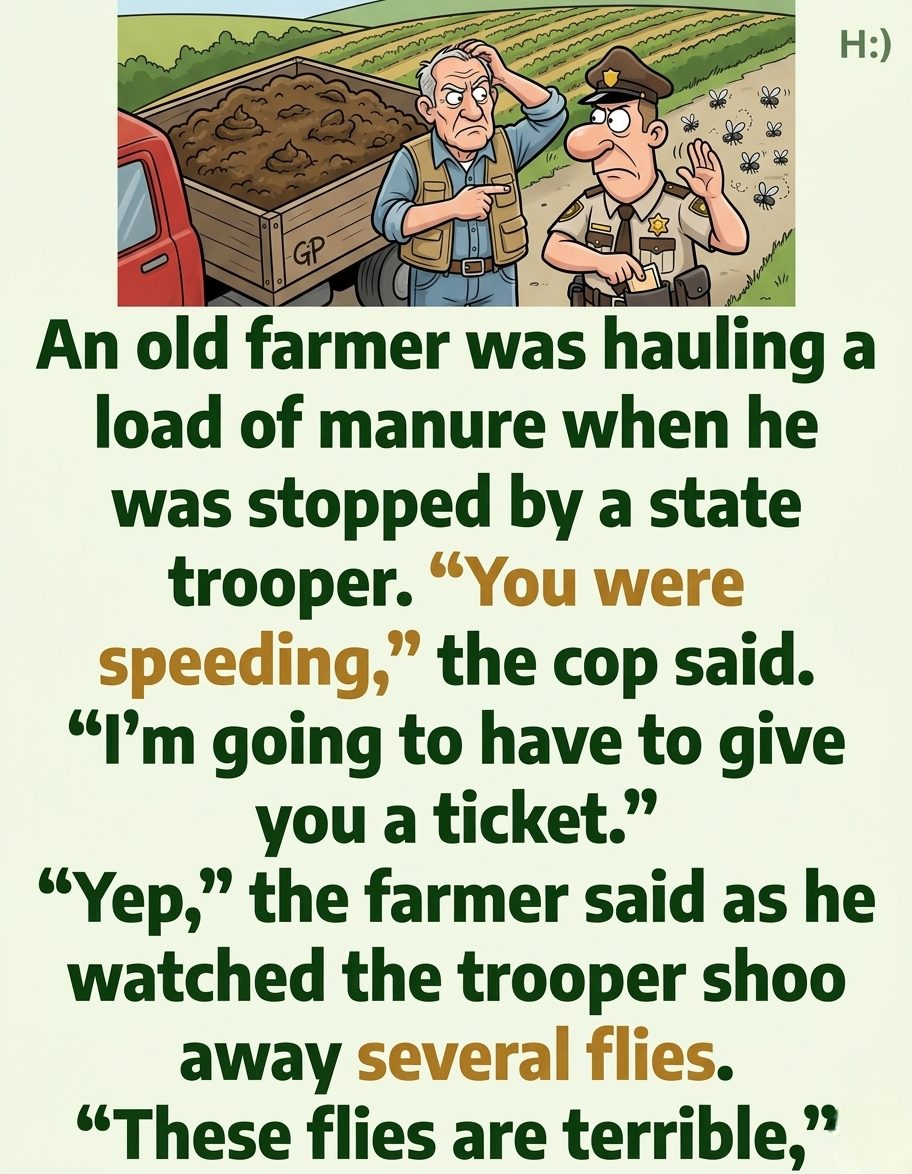
Both stories, though entirely different in setting and context, share a common theme: the power of wit to shift perspective. In the case of the farmer and the trooper, humor diffused tension, turning a moment of potential conflict into a memorable lesson about patience, perspective, and the limitations of control. Similarly, in Jacob’s classroom, humor became a tool for engagement, teaching critical thinking through laughter.
These narratives remind us that humor is not merely for amusement; it is a bridge between people, a tool for teaching, and a lens through which we can better understand the world. By embracing laughter, curiosity, and clever thinking, we learn not only about others but also about ourselves—and perhaps, in that realization, we find the truest lessons hidden within the simplest stories.
Related posts:
 A little girl sold her only bicycle just to buy food for her mother—but when a mafia boss discovered who had ruined their lives, everything changed.
 The Journey of Connection: A Tale of Lost and Found
 A Mother’s Fight: Uncovering the Truth Behind Andrew’s Collapse
 The Billionaire’s Baby Wouldn’t Stop Crying on the Plane — Until a Teen from Coach Did the Unimaginable
 The Unexpected Proposal: A Tale of Solitude and Apache Warriors
 The Unexpected Betrayal: A Journey of Loss and Empowerment
