
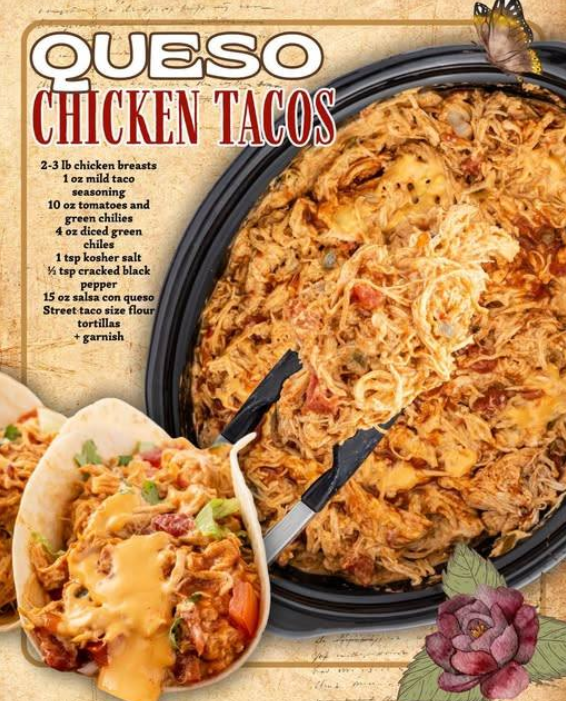
Place the chicken breasts in the slow cooker and coat with taco seasoning, salt, and pepper. Add the tomatoes with green chilies and the extra diced green chiles. Set to Low for 6-8 hours or High for 3-4 hours. This prolonged exposure to moist heat breaks down the myofibrillar proteins without the rapid contraction seen in high-heat searing.
Phase 2: Mechanical Shredding (Fiber Extraction)
Remove the chicken from the vessel once the internal temperature reaches 165°F (74°C). Use two forks to perform Mechanical Fiber Separation. Return the shredded chicken to the cooking liquid, allowing the meat to re-absorb the concentrated juices through capillary action.
Phase 3: The Queso Integration
Turn the slow cooker to the “Warm” setting and stir in the 15 oz of salsa con queso. Stir continuously for 60 seconds to ensure a Homogeneous Emulsion. The residual heat is sufficient to melt the cheese sauce into the protein fibers without overcooking the dairy solids.
4. Serving and Storage: The Shell Interaction
The tacos are best served in street-sized flour tortillas. In 2026, we recommend a Thermal Pre-Treatment (toasting the tortilla) to initiate the Maillard reaction, which provides a nutty contrast to the creamy chicken.
| Condition | Texture Observation | Storage Limit |
|---|---|---|
| Fresh Service | Glossy, fluid coating; tender fibers. | Best within 2 hours. |
| Refrigerated | Sauce thickens into a stable gel. | 4 Days. |
| Reheating | Requires a splash of broth to restore fluidity. | Microwave at 70% power. |
5. Tips: The Professional’s Secrets
The Liquid Regulation: If the chicken produces too much liquid during the cook, drain half of it before adding the queso. Excess water will prevent the cheese sauce from adhering to the chicken fibers, resulting in a “runny” taco filling.
- The Fat-Flavor Bridge: Use a full-fat salsa con queso. The fats in the cheese act as Flavor Carriers for the capsaicin in the green chiles, providing a more rounded heat.
- Tortilla Integrity: If serving for a crowd, keep the chicken in the slow cooker on “Warm.” This maintains the filling at its Optimal Viscosity throughout the service window.
6. Variations: Customizing the Flavor Profile
- The “Fire” Variant: Add 2 tablespoons of canned chipotles in adobo for a smoky, high-capsaicin profile.
- The Vegetable Infusion: Stir in a bag of frozen corn or a can of black beans (drained) during the last 30 minutes of cooking for added fiber and color.
- The Zesty Finish: Squeeze fresh lime juice over the shredded chicken just before adding the queso to provide Ascorbic Acid, which brightens the heavy dairy flavors.
7. Conclusion: The Triumph of Slow Heat
Slow Cooker Queso Chicken Tacos represent the pinnacle of Convenience Engineering. By leveraging the slow thermal breakdown of chicken and the stabilization of a pre-made cheese emulsion, you create a meal that is both structurally sound and rich in flavor complexity. It is a dish that honors the science of time—allowing low heat to do the work of a master chef. Enjoy the creamy, savory result!
Frequently Asked Questions:
Q: Can I use chicken thighs?
A: Yes! Chicken thighs have more Intramuscular Fat and collagen, making them even more resistant to overcooking. They will result in a richer, silkier taco filling.
Q: Why did my cheese sauce look “clumpy”?
A: This happens if the liquid in the slow cooker was boiling when the queso was added. Always ensure the cooker is on “Warm” or “Low” and stir thoroughly to stabilize the emulsion.
Q: Is this gluten-free?
A: The chicken and chiles are inherently gluten-free, but you must check the label on the Salsa Con Queso and Taco Seasoning, as some use wheat-based thickeners.