
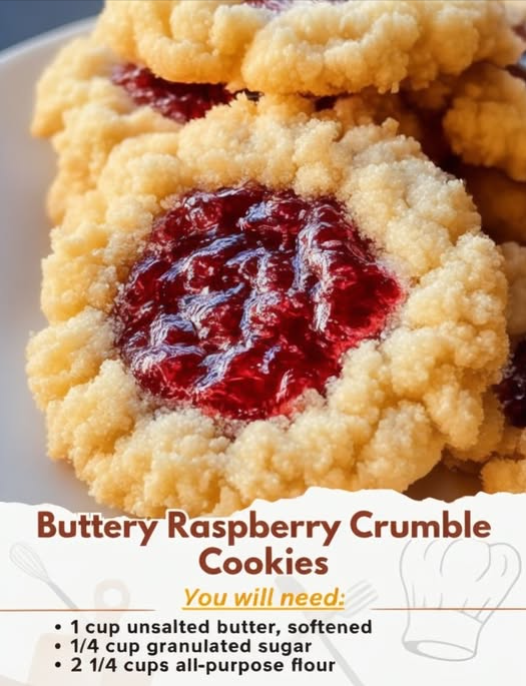
Baking Bliss: Mastering the Buttery Raspberry Crumble Cookie
Introduction: The Three Pillars of a Crumble Cookie
This recipe deconstructs the traditional crumble into three perfect layers: a tender base, a bright fruit filling, and a crunchy topping, all baked into a single cookie.
The **Buttery Raspberry Crumble Cookie** is an exercise in textural harmony, marrying the tender flakiness of a shortbread base with the vibrant moisture of fruit and the crunch of streusel. Success hinges on three distinct, yet interdependent, culinary regulations: **The High-Fat Tenderizing Mix, The Starch-Stabilized Fruit Protocol, and The Cold-Butter Crumble Technique.**
The first regulation, **The High-Fat Tenderizing Mix**, is vital for the cookie base. The base contains a high proportion of fat (**1 cup unsalted butter**) and a combination of sugars (**$\frac{1}{4}$ cup granulated sugar** and **$\frac{1}{3}$ cup powdered sugar**) relative to the **2 cups all-purpose flour**. The powdered sugar, which contains cornstarch, reduces gluten development and prevents the cookie from becoming tough, resulting in that signature “melt-in-your-mouth” texture . Importantly, this dough is often gently *pressed* into the pan or scooped rather than aggressively rolled, further minimizing gluten activation.
The second regulation, **The Starch-Stabilized Fruit Protocol**, prevents a common baking disaster: leakage. The **1 cup fresh or frozen raspberries** are mixed with **2 tablespoons granulated sugar** and crucially, **1 tablespoon cornstarch**. Cornstarch is necessary to absorb the moisture released by the raspberries during baking. This process gelatinizes the starches, turning the excess liquid into a thick, jam-like filling that stays perfectly in place rather than weeping out and making the cookie base soggy.
The third regulation, **The Cold-Butter Crumble Technique**, defines the topping. The crumble requires **$\frac{1}{4}$ cup cold unsalted butter** to be cut into the **$\frac{1}{2}$ cup flour** and **$\frac{1}{4}$ cup sugar** (Direction 1). The butter must be kept *cold* and cut in until the mixture resembles coarse sand or small peas. This ensures that the fat melts slowly in the oven, creating distinct pockets of steam that produce a light, flaky, and crunchy streusel topping, rather than melting immediately and forming a dense paste.
