
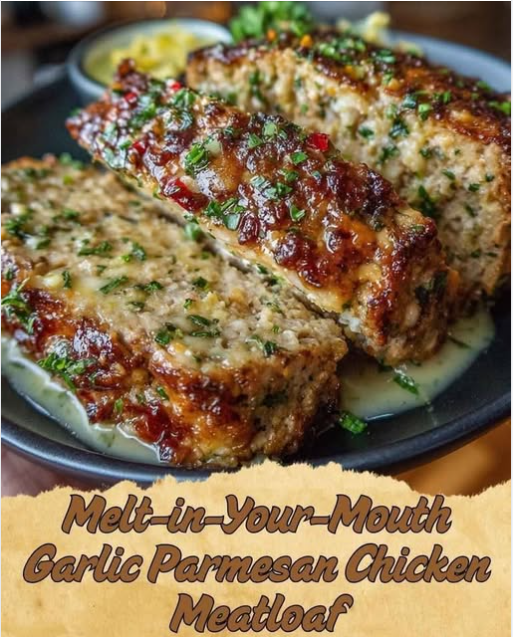
Juicy Perfection: Mastering Garlic Parmesan Chicken Meatloaf
Introduction: Conquering the Dry Chicken Challenge
Chicken meatloaf presents a unique challenge: **ground chicken is significantly leaner than beef**, making it prone to drying out during the necessary high-heat baking. This recipe expertly counteracts dryness using a high ratio of moisture and fat binders (eggs, milk, and high-fat **Parmesan cheese**) to ensure a juicy interior.
The success of the meatloaf hinges on two critical phases: the preparation of the loaf mass (mixing), and the final cooking temperature.
Success requires adherence to three core regulations: **The Moisture and Binding Mandate, The Gentle Mixing and Internal Temperature Protocol, and The Glaze Sealing Principle.**
The first regulation, **The Moisture and Binding Mandate** (Instruction 2), governs the texture. The **panko breadcrumbs** and **milk** serve as the internal hydration system. The breadcrumbs soak up the milk and the meat’s released moisture, holding it inside the loaf. The **eggs and Parmesan** provide the necessary protein structure to bind the loaf together, preventing it from crumbling.
The second regulation, **The Gentle Mixing and Internal Temperature Protocol** (Instruction 2 & 4), prevents toughness and drying. Overmixing meatloaf causes the protein structure to seize up, resulting in a dense, tough texture (Instruction 2). The meat should be mixed **until just incorporated**. Crucially, the internal temperature must be monitored to ensure the meat reaches the safe minimum of **$165^\circ\text{F}$ ($74^\circ\text{C}$)**—and *no higher*—to preserve internal moisture.
The third regulation, **The Glaze Sealing Principle** (Instruction 5 & 6), enhances flavor and locks in moisture. The loaf is first baked plain to form a set crust, and the **Garlic Parmesan Glaze** is applied only for the last few minutes. This timing prevents the butter/cheese from burning while allowing the glaze to melt into the crust, creating a moist, flavorful seal.
Ingredients: Defining Hydration, Binding, and Finish
The full components for $6\text{ servings}$:
I. The Meatloaf Base (Moisture & Binding):
- **$2\text{ lbs}$** ground chicken (Protein, bulk)
- **$1\text{ cup}$** grated Parmesan cheese (Binder, fat, umami)
- **$\frac{1}{2}\text{ cup}$** panko breadcrumbs (Hydration anchor)
- **$2\text{ large}$** eggs (Primary binder)
- **$\frac{1}{4}\text{ cup}$** whole milk (Liquid moisture)
II. Aromatics & Seasoning:
- **$4\text{ cloves}$** garlic, minced (Aromatic base)
- **$1\text{ tsp}$** garlic powder, **$1\text{ tsp}$** onion powder, **$\frac{1}{2}\text{ tsp}$** dried basil, **$\frac{1}{2}\text{ tsp}$** dried parsley, **$\frac{1}{2}\text{ tsp}$** salt, **$\frac{1}{2}\text{ tsp}$** black pepper (Seasoning)
III. The Garlic Parmesan Glaze:
- **$3\text{ tbsp}$** unsalted butter (Fat base for glaze)
- **$2\text{ cloves}$** garlic, minced
- **$\frac{1}{4}\text{ cup}$** grated Parmesan cheese (Glaze richness)
- **$1\text{ tbsp}$** chopped parsley, pinch of salt (Garnish/Finish)
