ADVERTISEMENT
Phase 1: Preparation and Gentle Mixing
- **Prep:** Preheat oven to **$375^\circ\text{F}$ ($190^\circ\text{C}$)**. Line a baking sheet with parchment paper or lightly grease a loaf pan.
- **Mix Loaf (GENTLE MIXING):** In a large bowl, combine **all meatloaf ingredients** (chicken, Parmesan, breadcrumbs, eggs, garlic, seasonings, and milk). Mix with your hands until the ingredients are **just combined**—do not overmix, as this will lead to a tough texture.
- **Shape:** Shape the mixture into a $9\text{-inch}$ loaf and place it on the prepared baking sheet (or press into a loaf pan).
Phase 2: Baking and Glazing
- **Initial Bake (TEMPERATURE PROTOCOL):** Bake for **$40\text{–}45\text{ minutes}$**, or until the meatloaf registers an internal temperature of **$165^\circ\text{F}$ ($74^\circ\text{C}$)** using an instant-read thermometer.
- **Prepare Glaze:** While the meatloaf bakes, melt **butter** in a small saucepan over medium heat. Add **garlic** and sauté for $1\text{–}2\text{ minutes}$. Stir in the **Parmesan** and **parsley**. Cook for another $1\text{–}2\text{ minutes}$ until slightly thickened.
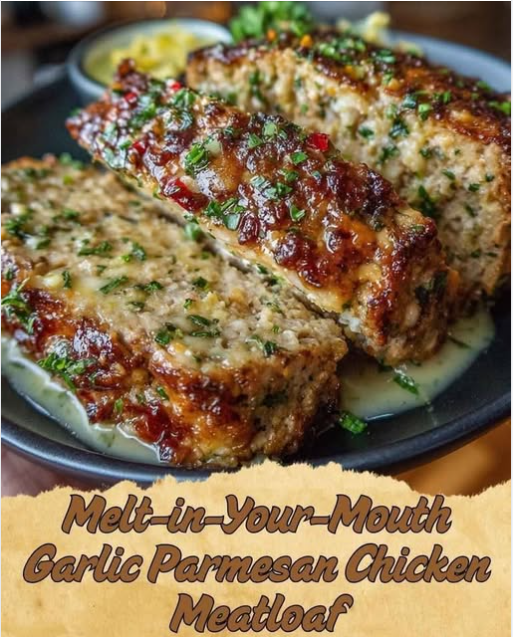
- **Glaze and Finish (SEALING PRINCIPLE):** Remove meatloaf from the oven, brush **generously with the garlic Parmesan glaze**, and return to the oven for an additional **$5\text{–}7\text{ minutes}$** until the glaze is bubbling and the final internal temperature is confirmed at $165^\circ\text{F}$.
Phase 3: Resting and Serving
- **Rest:** Let the meatloaf **rest for $5\text{ minutes}$** before slicing. This allows the internal juices to redistribute, ensuring a moist final slice.
- **Serve:** Garnish with extra parsley and serve warm.
Tips & Technical Insights:
The Temperature is Non-Negotiable: The $165^\circ\text{F}$ (Instruction 4 & 6) internal temperature is crucial. Since ground chicken lacks the color cues of beef, a **digital meat thermometer** is the only way to confirm safety and avoid overcooking, which is the primary cause of dry meatloaf.
Loaf Pan vs. Baking Sheet: Baking the loaf on a **parchment-lined baking sheet** allows the fat to drain away, resulting in a firmer exterior crust. Baking in a **loaf pan** holds the fat and moisture in, leading to a softer, juicier loaf. Choose the method based on your preferred texture.
The Panko Advantage: **Panko breadcrumbs** (Ingredient I) are superior to regular breadcrumbs because their flaky, coarse structure absorbs more liquid and holds it during baking, contributing to a more tender and moist final product.
Resting is Essential: Allowing the meatloaf to **rest for $5\text{ minutes}$** (Instruction 7) after baking is vital. During resting, the internal temperature continues to rise (carryover cooking), and the muscle fibers relax, allowing the juices—which have been pushed to the center—to flow back into the meat. Cutting immediately releases all the moisture onto the plate.
Freezing Tip: Meatloaf freezes beautifully. Cool the cooked loaf completely, wrap it tightly in plastic wrap, then foil, and freeze for up to $3\text{ months}$. Thaw overnight and reheat slices gently.
Variations: Customizing Flavor and Serving
Easily adapt the components and richness of your meatloaf:
- **Extra Umami:** Add $1\text{ tablespoon}$ of **Worcestershire sauce** to the meatloaf mixture (Instruction 2) for a darker, more savory base flavor.
- **Spicy Kick:** Add $\frac{1}{4}\text{ teaspoon}$ of **red pepper flakes** to the meatloaf mix for a subtle heat, or $\frac{1}{4}\text{ teaspoon}$ of **cayenne pepper** to the glaze for a fiery crust.
- **Cheesy Center:** During shaping, press a layer of **provolone or mozzarella cheese** into the center of the loaf before sealing the edges for a gooey, melted center.
- **Herb Swap:** For a brighter flavor, use $\frac{1}{4}\text{ cup}$ of fresh **chopped basil** in place of the dried herbs.
Conclusion: Juiciness Through Precision
The **Melt-in-Your-Mouth Garlic Parmesan Chicken Meatloaf** is a triumph of careful technique over lean protein. By adhering to **The Moisture and Binding Mandate** through strategic ingredients and strictly following **The Gentle Mixing and Internal Temperature Protocol**, you ensure a meatloaf that is not only safe and delicious but achieves a tenderness and juiciness that far surpasses standard chicken preparations.
Frequently Asked Questions (FAQ)
Q: Why did my meatloaf crumble when I sliced it?
A: It likely didn’t have enough binder (eggs/cheese) or wasn’t allowed to **rest** (Instruction 7). Resting allows the protein to set and the loaf to become structurally sound before cutting.
Q: Why is my meatloaf tough and rubbery?
A: This is the result of **overmixing** the meat (Instruction 2). Overmixing develops the protein structure, leading to a bouncy, dense, tough texture. Mix until just incorporated.
Q: Can I use regular breadcrumbs?
A: **Yes**, but the texture will be slightly denser. Regular breadcrumbs absorb less liquid than panko, so you may want to slightly increase the milk by $1\text{ tbsp}$ if using regular breadcrumbs.
Q: How can I tell if the chicken is safe without a thermometer?
A: While a thermometer is highly recommended, the loaf should be firm to the touch, and the juices running out of the loaf should be **clear, not pink**. However, relying solely on visual cues risks dryness or undercooking.
ADVERTISEMENT