
Peanut Butter Roll Cake: A Study in Protein Elasticity and Phase Transitions
Introduction: The Physics of the “Spiral Set”
The roll cake, or “roulade,” is a triumph of Structural Flexibility. Unlike a standard sponge, which is rigid, a roll cake must maintain Elasticity to bend without undergoing Mechanical Failure (cracking). This is achieved through the denaturation of egg proteins during baking and the use of a “pre-roll” technique to train the fibers of the cake while they are still in a plastic, warm state.
Ingredients: The Molecular Building Blocks
The Structural Scaffold (The Sponge)
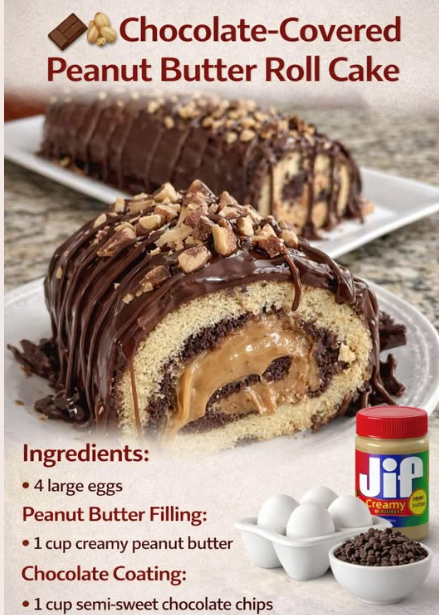
- 4 Large Eggs: The Primary Leavening Agent. When beaten, the egg proteins trap air bubbles (gas phase) within a liquid matrix. During baking, these proteins coagulate, trapping the air and creating the “foam” structure of the cake.
The Viscous Center (The Filling)
- 1 cup Creamy Peanut Butter: The High-Viscosity Stabilizer. Peanut butter acts as a non-Newtonian fluid in this context; it is firm enough to provide structural support for the roll but soft enough to spread without tearing the delicate sponge.
The Hydrophobic Shell (The Coating)
- 1 cup Semi-Sweet Chocolate Chips: The Amorphous Solid Phase. When melted, chocolate becomes a liquid; as it cools, the cocoa butter recrystallizes into a hard shell that provides a moisture barrier and a snap-like texture.
