
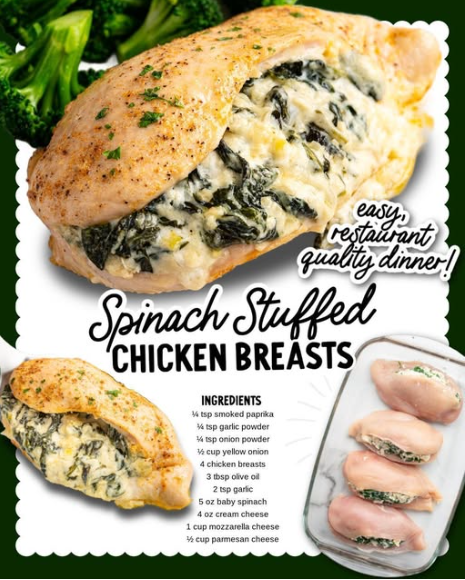
Spinach Stuffed Chicken: A Study in Thermal Buffering and Lipid Emulsions
Introduction: The Physics of the “Pocket” Method
The primary technical challenge of cooking chicken breast is its low lipid content and high protein density. Without a bone to slow heat transfer, the meat often dries out. Stuffed chicken breasts solve this through Internal Hydration. The spinach-and-cheese filling releases steam and fat from the inside out, creating a dual-directional cooking process that preserves the Mechanical Tenderness of the muscle fibers.
Ingredients: The Molecular Building Blocks
The Structural Scaffold
-
- 4 Boneless Skinless Chicken Breasts: The Primary Protein Matrix. These consist of long, bundled muscle fibers. The goal is to heat them to exactly 165°F (74°C) to ensure safety while avoiding the total expulsion of cellular water.
[Image of the structure of a skeletal muscle fiber]
The Seasoning Blend (Aromatic Coating)
- 2 tbsp Olive Oil, Salt, Pepper, Smoked Paprika, Garlic & Onion Powder: This forms an Ionic and Aromatic Rub. The salt facilitates osmosis, drawing seasoning into the surface layers, while the paprika and garlic powder provide the precursors for the Maillard Reaction.
The Filling Dynamics (Implicit Addition)
- Fresh Spinach & Cream Cheese/Parmesan (Standard additions): These provide the Aqueous and Lipid phases. Spinach is approximately 91% water; as it wilts, it provides the steam necessary to keep the internal chicken cavity moist.
