
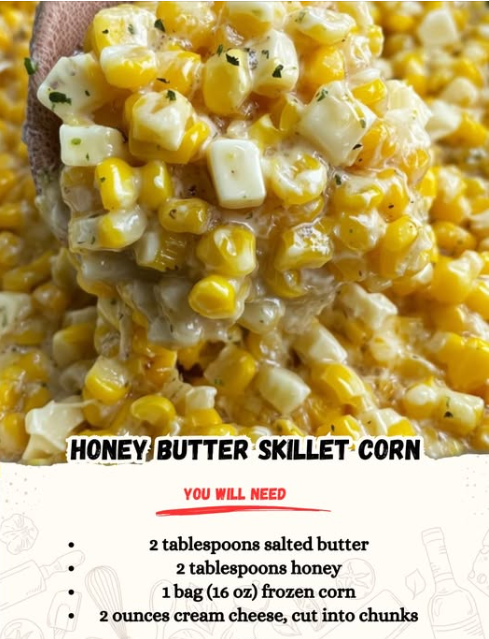
Honey Butter Skillet Corn: A Study in Emulsion Stability and Starch Gelatinization
Introduction: The Physics of the “Glossy Coat”
The success of skillet corn depends on Interfacial Tension. We are engineering a sauce that must adhere to the smooth, waxy Pericarp (outer skin) of the corn kernel. This is achieved by creating a Triple-Phase Emulsion using honey (sugar), butter (fat), and cream cheese (protein/stabilizer). The result is a sauce with high Yield Stress, meaning it clings to the corn rather than pooling at the bottom of the dish.
Ingredients: The Molecular Building Blocks
The Structural Aggregate
- 1 bag (16 oz) Frozen Corn: The Primary Carbohydrate Source. Frozen corn is blanched before freezing, which partially denatures the enzymes. As it reheats, the internal Amylopectin starches begin to swell, contributing to the dish’s final thickness.
The Emulsifying Matrix
- 2 tbsp Salted Butter: The Primary Lipid Phase. Butter provides the “mouthfeel” and acts as the carrier for the fat-soluble flavor compounds.
- 2 tbsp Honey: The Inverted Sugar Solute. Honey is a Hygroscopic liquid that adds viscosity and facilitates a slight Maillard Reaction when exposed to the high heat of the skillet.
- 2 oz Cream Cheese (Chunks): The Complex Stabilizer. Cream cheese contains Casein and Whey proteins that act as emulsifiers, preventing the butter and honey from separating into a greasy mess.
