Reklama
The secret lies not only in the perfectly cooked eggs but in balancing the richness of the yolks with acidic and textural components.
I. The Core Components (Texture & Protein):
- 8 large eggs: The foundation. They must be perfectly hard-boiled to ensure a dry, bright yellow yolk.
- 1/4 cup finely chopped celery: Essential for the **crunch and fresh vegetable flavor**. This prevents the salad from becoming uniformly mushy.
- 1/4 cup finely chopped dill pickle or sweet pickle relish: Provides a secondary textural element and a crucial layer of **tangy acidity** to cut through the richness of the yolk.
II. The Crème Base (Tang & Creaminess):
- 1/3 cup high-quality mayonnaise: The primary binder and source of creaminess. Using less mayo is key to avoiding the “swimming” texture.
- **2 tablespoons Greek yogurt or sour cream:** The “chef’s secret” creamy twist. This adds a necessary **tanginess and body** without the heaviness of pure mayonnaise, improving flavor balance.
- **1 teaspoon Dijon mustard:** Provides a sharp, savory depth and acts as a hidden emulsifier to keep the dressing uniform.
III. The Seasoning and Finish (Brightness):
- **1/2 teaspoon garlic powder:** A subtle savory background. (Optional: Use a tiny pinch of fresh chives or finely diced shallot for a brighter note.)
- **1/2 teaspoon paprika (or smoked paprika):** Adds color and a warm, slightly smoky depth.
- **Salt and freshly ground black pepper, to taste:** Generous seasoning is critical.
- **1 tablespoon fresh dill or chives, chopped (for garnish/mix-in):** Adds herbaceous brightness and freshness just before serving.
The Chef’s Ratio: The perfect egg salad uses a combination of high-fat (mayo) and high-acid/high-protein (yogurt/sour cream) binders. This ratio is why the salad is **creamy yet tangy**, not just fatty.
The Secret Technique: Perfect Eggs and Balanced Mixing
The legendary quality of this egg salad starts before mixing, focusing on the precision of the cook time and the method of mixing.
Phase 1: The Perfect Hard-Boiled Egg (Never Green)
The green-gray ring that develops around an overcooked yolk is iron sulfide ($\text{FeS}$), which forms when the sulfur in the egg white reacts with the iron in the yolk due to prolonged high heat. The secret is rapid chilling.
- The Boil and Steam Method: Place the **8 eggs** in a pot and cover them with cold water (about 1 inch above the eggs). Bring the water to a **rolling boil** over high heat.
- The Precision Timer: Once the water reaches a full boil, **immediately turn off the heat**, cover the pot tightly with a lid, and let the eggs sit in the hot water for **10 minutes**.
- The Immediate Chill: Immediately drain the hot water and transfer the eggs to a large bowl filled with **ice water**. Allow the eggs to chill for at least **5 minutes**. This rapid cooling stops the cooking process instantly, preventing the formation of $\text{FeS}$ (the green ring) and ensures the yolks remain bright yellow.
- Peel: Peel the eggs under running cold water, which helps separate the shell from the membrane.
Phase 2: The Balanced Mixing (Creamy Yet Textured)
The eggs are mixed in two stages to achieve both creaminess and necessary texture.
- Chop and Mash (Two Textures): Separate the eggs. Dice **6** of the eggs into uniform 1/4-inch pieces (for the main texture). Place the remaining **2 eggs** in a separate small bowl and mash them thoroughly with a fork until they form a coarse paste (for the creaminess).
- Build the Crème Base: In a medium mixing bowl, combine the **mayonnaise, Greek yogurt (or sour cream), and Dijon mustard**. Add the **garlic powder, paprika, and a generous pinch of salt and pepper**. Whisk until the base is uniform and smooth.
- Fold in the Textures: Stir the **mashed egg paste** into the crème base (Step 6) until fully incorporated. This creates the creamy, velvety matrix.
- The Final Fold: Gently fold in the **diced eggs**, the **chopped celery**, and the **dill pickle/relish**. Mix only until everything is coated. Overmixing here will lead to mushiness.
Phase 3: Rest and Serve
- The Flavor Meld: Cover the bowl and refrigerate the egg salad for at least **30 minutes**. The flavor components (mustard, pickle, garlic) will meld and deepen.
- The Bright Finish: Just before serving, stir in the **fresh dill or chives**. Serve on toasted bread, lettuce cups, or eat straight from the bowl.
Chef’s Tips and Variations: Elevating Simplicity
Secret Sauce Enhancements:
- **Mustard Variety:** For a deeper flavor, use whole-grain mustard in addition to the Dijon. For a sharper profile, a small squeeze of yellow mustard works well.
- **Umami Boost:** A tiny splash (**1/4 teaspoon**) of apple cider vinegar or white wine vinegar can brighten the overall flavor without making the salad taste vinegary.
- **Adding Heat:** Mix in a few drops of your favorite hot sauce or a pinch of cayenne pepper for a subtle warming spice.
- **Serving Temperature:** While chilling is necessary for flavor, serve the egg salad slightly cooler than room temperature—never straight from the refrigerator, as the cold can dull the complex flavors.
Variations for Next-Level Egg Salad:
- **Curry Egg Salad:** Mix in **1 teaspoon of curry powder** with the paprika for a South Asian twist. Add a handful of **golden raisins** and chopped cilantro for texture and sweetness.
- **Mediterranean Egg Salad:** Replace the pickle relish with **1/4 cup of chopped sun-dried tomatoes** and **2 tablespoons of chopped fresh basil**. Use a pinch of dried oregano and skip the garlic powder.
- **Smoked Salmon Egg Salad:** Fold in **2 ounces of finely diced smoked salmon** and garnish heavily with chopped fresh dill. This elevates the dish into a brunch or light entrée option.
Conclusion: Taste the Difference Technique Makes
This recipe proves that the difference between ordinary and extraordinary egg salad is simply technique. By using the **Boil and Steam Method** followed by an **Ice Bath** (Steps 1–3), you guarantee bright yellow yolks. By blending a portion of the eggs into the sauce base (Step 7), you ensure a luxurious creaminess that requires far less mayonnaise.
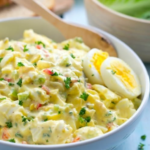
The result is a perfectly balanced classic—chunky, savory, and tangy—ready to elevate your next lunch or picnic spread. Go ahead, taste it straight from the bowl; we won’t tell.
Frequently Asked Questions:
Q: Why did my yolks still turn green?
A: The green ring is $\text{FeS}$ (iron sulfide), caused by cooking too long or failing to chill rapidly. Even after 10 minutes off the heat, if the pot is left covered on a warm burner, the internal temperature continues to cook the eggs. The **immediate ice bath** (Step 3) is critical to stopping the chemical reaction instantly.
Q: Why do you mix some eggs into the dressing base?
A: Mashing some eggs into the dressing (Step 7) creates a smooth, creamy matrix primarily composed of **yolk fat and protein**. This allows the salad to achieve its creamy texture using less external fat (mayonnaise), resulting in a cleaner, less oily flavor and a lighter feel.
Q: How long can I keep this egg salad?
A: Due to the fresh ingredients (eggs, mayonnaise, yogurt), this egg salad should be stored in an airtight container in the refrigerator and consumed within **3 to 4 days** for the best quality and safety.