
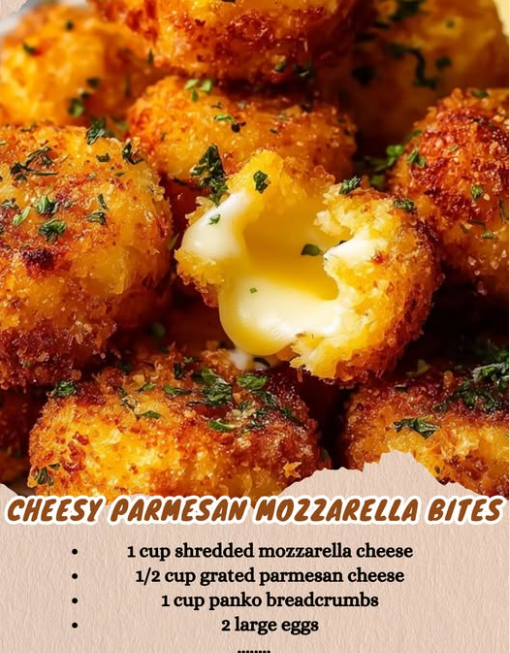
Cheesy Parmesan Mozzarella Bites: The Science of the Perfect Crunch and Stretch 🧀💥
The **Cheesy Parmesan Mozzarella Bite** is the epitome of appetizer perfection, balancing a crunchy exterior shell with a gooey, molten, and highly stretchable interior. The recipe hinges on two critical technical elements: the selection of the cheese and the application of the **double-coating technique**. The filling is a calculated blend of **1 cup of low-moisture mozzarella** (chosen for its superior melt and elasticity due to its protein structure) and **$\frac{1}{2} \text{ cup of Parmesan cheese}$** (which provides a sharp, savory flavor and helps stabilize the melt due to its granular structure).
The exterior, which delivers the satisfying “crack,” relies on **1 cup of Panko breadcrumbs**. Panko, a Japanese-style breadcrumb, is made from crustless bread and processed into light, airy, sliver-like flakes. This structure prevents excessive oil absorption and provides a far crunchier, lighter texture than traditional breadcrumbs. Crucially, the entire formed bite is **frozen solid** before being **double-coated** (an egg wash followed by Panko, repeated once). This double-coating and freezing protocol ensures that the delicate cheese core is completely sealed and chilled, maximizing the temperature difference between the core and the frying oil. This thermal differential allows the crust to set quickly and brown perfectly before the cheese melts enough to rupture the shell, guaranteeing the signature “cheese pull.”
Introduction: The Physics of the Cheese Pull and Thermal Barrier
A successful cheese bite is defined by the elasticity of the melted cheese and the integrity of the crust. Both are managed by controlled thermal processes.
The Cheese Melt and Stretch ($\eta$)
The cheese pull relies on the rheological property of **viscoelasticity**. Mozzarella’s unique composition—high moisture and specific calcium-to-protein ratios—allows the caseins (milk proteins) to form long, intertwined strands when heated to the appropriate temperature ($140^{\circ}\text{F}$ to $160^{\circ}\text{F}$). The addition of grated **Parmesan** enhances the savory flavor and lowers the melt point slightly, but its dry, hard structure also ensures the combined mixture retains some shape within the bite.
The Thermal Barrier (The Double Coat)
When deep-frying, the objective is to cook the crust to golden perfection ($350^{\circ}\text{F}$ to $375^{\circ}\text{F}$) in under 90 seconds, while only heating the core cheese just enough to melt, but not enough to boil or rupture the coating. The $\mathbf{2 \text{ large eggs}}$ mixed with $\frac{1}{2} \text{ teaspoon of salt}$ serves as the protein-rich binding agent. The **double-coating** technique builds a dense, robust shell. The initial **freezing** of the cheese is the thermal safeguard, buying crucial seconds in the fryer for the **Panko** crust to completely seal and rigidify before the internal pressure from the melting cheese becomes too great.
