Step 1: The Lipid Tempering (Creaming)
Beat the cream cheese until completely smooth. The “Lump-Free” Regulation: You are aiming to break down the Intermolecular Casein Bonds. If the cheese is too cold, the lipids will remain in a semi-crystalline state, resulting in “beading” that ruins the snowy aesthetics.
Step 2: The Sifted Sugar Integration
Gradually incorporate the sifted powdered sugar. The “Anti-Clumping” Physics: Sifting is a mechanical process that increases the surface area of the sugar. This ensures immediate Solubilization within the moisture of the cream cheese, preventing a gritty mouthfeel.
Step 3: The Viscosity Adjustment (The Milk)
Slowly drizzle in the whole milk while whisking. The “Shear Rate” Secret: The milk acts as a lubricant between the fat globules. By adding it slowly, you maintain an Emulsion rather than creating a “broken” or watery liquid phase.
Step 4: The Aeration Fold (The Snow Layer)
Gently fold the cream cheese mixture into your whipped medium. The “Pore Retention” Rule: Use a spatula in a “figure-eight” motion. This preserves the Structural Integrity of the air bubbles. Over-mixing will cause the bubbles to pop, leading to a dense “slush” rather than “snow.”
Step 5: The Stratified Assembly
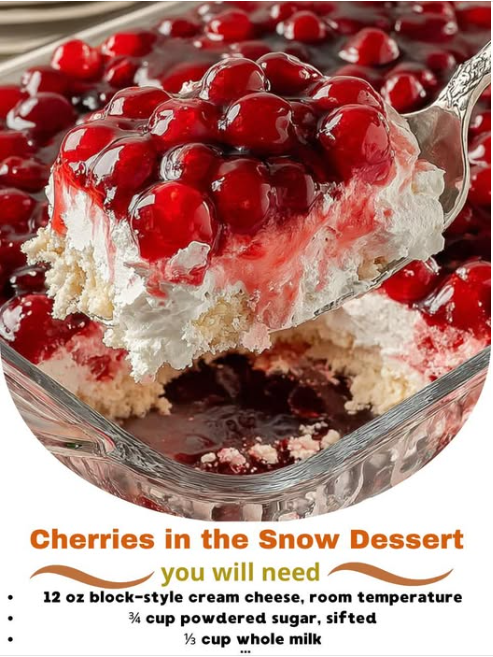
Layer the snow base into a chilled dish and top with cherries. The “Hydrostatic Balance” Secret: Chilling the snow layer for 30 minutes before adding the cherries ensures the “snow” has enough Compressive Strength to prevent the heavy fruit from sinking to the bottom.
Serving and Storage: Protecting the Cloud
Serving: Serve at approximately 4°C ($40^{\circ}\text{F}$). The cold temperature tightens the fat matrix, giving the dessert a crisp, clean break when scooped. Pair with a Graham cracker crust or a simple shortbread for Mechanical Contrast.
Storage: This dessert is highly Hygroscopic (it absorbs odors). Store in an airtight container for up to 3 days. To maintain the Snowy Loft, avoid stacking other items on top of the container, as the pressure will collapse the air pockets.
Tips: Pro-Level “Snow” Nuances
- The “Room Temp” Mandate: Never skip the softening of the cream cheese. If you attempt to whip cold cheese, the Mechanical Shear will fail to incorporate air, leaving you with a dense, heavy paste.
- Cherry Regulation: Drain a small amount of the excess syrup from the cherries if it appears too thin. This prevents Capillary Bleeding, where the red syrup dyes the white snow pink before serving.
- Lemon Spark: A 1/2 tsp of lemon juice added to the cheese mix can act as a Protein Coagulant, slightly firming up the “snow” while brightening the flavor profile.
Holiday Variations: Seasonal Infusions
| Variation | The Adjustment | The Vibe |
|---|---|---|
| Winter Mint Snow | Add 1/4 tsp peppermint extract and top with crushed candy canes. | Cool, refreshing, and festive. |
| Almond Orchard | Stir in 1/2 tsp almond extract and garnish with toasted slivered almonds. | Nutty, sophisticated, and floral. |
| Bourbon Berry Blast | Add 1 tbsp of bourbon to the cherry filling before topping. | Deep, warming, and adult. |
Tips: Preventing the “Syneresis” (Weeping)
Syneresis is the expulsion of liquid from a gel or foam—the “water” that pools at the bottom of the dish. To prevent this, ensure your Powdered Sugar contains cornstarch (most commercial brands do). The starch absorbs free water molecules, locking them into the Molecular Matrix and keeping your snow dry and fluffy.
Conclusion: A Christmas Day Confectionary Victory
Cherries in the Snow is a masterpiece of Dairy Aeration. By respecting the temperature requirements of lipids and the delicate nature of whipped foams, you transform basic refrigerator staples into a heavenly, festive treat. On this Christmas Day 2025, as you serve these bright red cherries atop their pristine white bed, you are presenting a masterclass in texture. Enjoy the fluff!
Frequently Asked Questions
- Can I use low-fat cream cheese?
- You can, but the Structural Elasticity will be reduced. Low-fat versions contain more water and gums, which can lead to a “gummy” rather than “cloud-like” texture.
- Why is my snow grainy?
- This is Sugar Recrystallization. It happens if the powdered sugar wasn’t sifted or if the milk wasn’t fully incorporated. Ensure the sugar is fully dissolved into the cheese fats before adding the whipped medium.
- Can I use fresh cherries?
- Yes, but you must Macerate them in sugar and a thickener (like cornstarch) first. Raw cherries release too much water, which will cause the “snow” to melt via Hydrolysis.
Would you like me to suggest a “Graham Cracker Base” recipe to serve this in, or perhaps show you how to turn this into a “No-Bake Snow Cake”?