
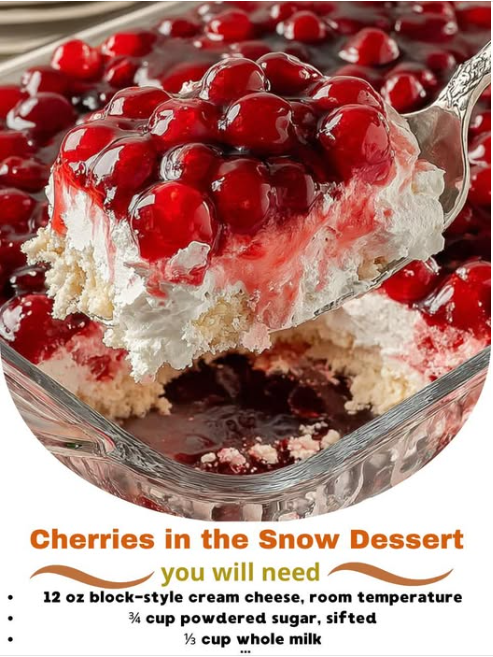
Cherries in the Snow: Engineering a Low-Density Holiday Masterpiece
Introduction: The Physics of “Cloud-State” Confectionery
In the hierarchy of holiday desserts, Cherries in the Snow represents a triumph of Aerated Lipid Stabilization. On this Thursday, December 25, 2025—Christmas Day—this dish serves as a masterclass in Phase Transformation. By manipulating the dense, room-temperature molecular structure of cream cheese with sifted sugars and milk, we create a colloidal foam that mimics the visual and textural properties of fresh snowfall. The technical challenge lies in the Structural Integrity of the cream cheese base: it must be light enough to dissolve instantly on the tongue while remaining sturdy enough to support the weight of the cherry topping through surface tension.
This guide explores the Casein Plasticity of the cheese, the Hygroscopic Nature of powdered sugar, and the Viscosity Regulation provided by whole milk.
Ingredients: The Molecular Building Blocks
- 12 oz Cream Cheese (Room Temperature): The Structural Scaffold. At room temperature (approx. 21°C), the lipids in the cheese are sufficiently pliable to trap air during the whipping process.
- ¾ Cup Powdered Sugar (Sifted): The Sweetening Stabilizer. Powdered sugar contains a small percentage of cornstarch, which acts as a moisture-binding agent, preventing the dessert from weeping or separating over time.
- ⅓ Cup Whole Milk: The Viscosity Diluent. The milk fats interact with the cheese proteins to “loosen” the matrix, transforming a stiff block into a pipeable, cloud-like medium.
- Whipped Topping/Cream (Implied): The Aeration Phase. This provides the “Snow” volume, relying on protein-stabilized air bubbles to create the signature lightness.
- Cherry Pie Filling: The Acidic Contrast. The cherries provide the anthocyanins (red pigments) and malic acid required to cut through the heavy richness of the dairy base.
