
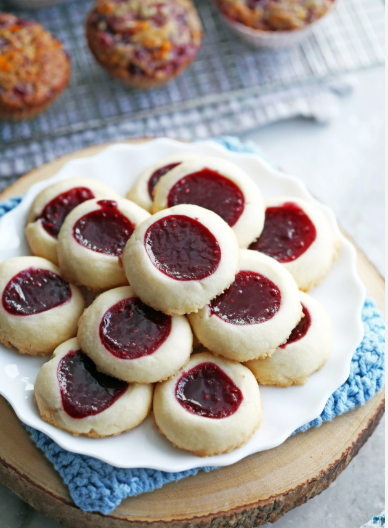
The Ultimate Guide: Classic Raspberry Shortbread Thumbprint Cookies
Introduction: The Science of Superior Shortbread
This recipe provides a technically superior approach to the classic shortbread thumbprint, utilizing precise weight measurements and the addition of cornstarch for unmatched tenderness.
The **Classic Raspberry Shortbread Thumbprint Cookie** recipe, thanks to its high-fat, low-protein composition, delivers a truly exceptional result. By replacing a portion of the flour with **cornstarch** and using fine **icing sugar** instead of granular sugar, the cookie achieves a delicate crumb that granulated sugar cannot replicate. Success is contingent upon three critical regulations: **The Cornstarch Standard, The Softened Butter Method, and The Single-Stage Dough Development.**
The first regulation, **The Cornstarch Standard** (Instruction 2), is the texture game-changer. Cornstarch is pure starch, containing no protein, meaning it has zero gluten potential. When mixed with the **1½ cup (245 g) all-purpose flour**, it actively dilutes the available gluten, ensuring the final cookie is incredibly tender, sandy, and crumbly—the hallmark of true shortbread.
The second regulation, **The Softened Butter Method** (Instruction 4), dictates the proper binding technique. Unlike many cookies that require creaming (whipping air into the butter), traditional shortbread often benefits from a “rubbing” or “sanding” method where the fat is worked into the dry ingredients. Here, using **1 cup (225 g) unsalted butter, softened and chopped**, and blending it with the dry ingredients in a **single stage** prevents excessive air incorporation. This results in a dense, uniform dough ball, minimizing spread during baking.
The third regulation, **The Single-Stage Dough Development** (Instruction 4), ensures minimal handling. The recipe combines the flour mixture, butter, and extract all at once. By mixing until *just* combined into a smooth dough ball, you limit the development of gluten, which would otherwise result in a tough cookie. The smooth, uniform ball signals that the ingredients have emulsified correctly, and the dough is ready to be portioned.
Ingredients: Defining Texture and Weight
Utilizing weight measurements ensures the precise, delicate balance of the shortbread’s high fat-to-starch ratio.
I. The Dough Base (Measured by Weight and Volume):
- **1½ cup (245 g / 8⅝ oz)** all-purpose flour (The primary structure)
- **½ cup (150 g / 5¼ oz)** icing sugar (Aka confectioners’ sugar—for fine texture)
- **¼ cup (37 g / 1¼ oz)** cornstarch (The tenderizing agent)
- **1 cup (225 g / 8 oz)** unsalted butter, softened, chopped into small cubes (The richness and binding fat)
- **½ tsp** vanilla (or almond) extract (Flavor enhancer)
II. The Filling:
- **¼ cup – ¾ cup** raspberry jam (The sweet-tart center)
