
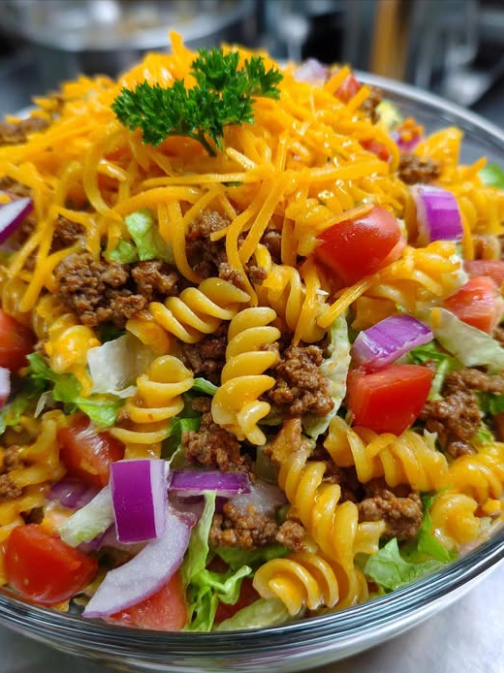
Cold and Creamy Crunch: Mastering Taco Pasta Salad
Introduction: The Intersection of Hot and Cold
The **Taco Pasta Salad** is a popular hybrid dish that succeeds by balancing the rich, warm flavors of seasoned ground beef with the cool, tangy creaminess of a pasta salad dressing and crisp vegetables. The key to its harmony lies in temperature control and proper flavor integration across all three main components: the **meat filling**, the **pasta**, and the **dressing**.
The success hinges on three core regulations:
The first regulation, **The Meat and Seasoning Mandate** (Instruction 1), ensures the beef is savory and not dry. After cooking and draining the fat, the **taco seasoning** must be added along with a small amount of water or broth and simmered briefly. This process, called “hydration,” ensures the spices properly adhere to the meat and dissolve, creating a moist, flavorful coating rather than just a dry powder.
The second regulation, **The Al Dente and Chill Protocol** (Instruction 2), dictates the pasta texture. The **rotini pasta** must be cooked *al dente* (firm to the bite) to withstand the tossing and chilling process. It is essential to rinse the cooked pasta immediately under cold water to stop the cooking and remove excess starch. This step prevents the pasta from becoming mushy and ensures the dressing clings better.
The third regulation, **The Emulsion and Chill Protocol** (Instruction 4 & 5), manages the creamy binder. The dressing, a mix of sour cream/mayonnaise and the remaining taco seasoning, must be whisked smooth before mixing. The final, essential step is a long **chill time** after mixing, which allows the pasta and vegetables to absorb the dressing and seasoning flavors fully, transforming the dish from a simple mixture into a cohesive, flavorful salad.
Ingredients: Defining Protein, Texture, and Binding
The formal components for $8\text{–}10\text{ servings}$:
I. Protein & Base:
- **$1\text{ lb}$** ground beef, cooked & drained (Protein, base)
- **$1\text{ lb}$** rotini pasta, cooked & cooled (Texture, bulk)
- **$1\text{ oz}$** taco seasoning (Flavor concentrate)
II. Vegetables & Crunch (Inferred):
- **$1\text{ cup}$** sweet corn, drained or thawed (Sweetness, crunch)
- **$1\text{ can}$** ($15\text{ oz}$) black beans, rinsed and drained (Earthy flavor, texture)
- **$1\text{ cup}$** grape tomatoes, halved (Acidity, juiciness)
- **$\frac{1}{2}\text{ cup}$** red onion, finely diced (Sharpness, color)
III. The Creamy Dressing (Inferred):
- **$1\text{ cup}$** sour cream (Primary binder, tang)
- **$\frac{1}{2}\text{ cup}$** mayonnaise (Secondary binder, richness)
- **$2\text{ tbsp}$** milk or buttermilk (Thinner, liquid base)
IV. Toppings & Garnish (Inferred):
- **$1\frac{1}{2}\text{ cups}$** shredded cheddar or Colby Jack cheese
- **$\frac{1}{2}\text{ cup}$** sliced black olives
- **$1\text{ cup}$** crushed tortilla chips, for serving (Crunch)
