ADVERTISEMENT
Phase 1: Steak Preparation and Searing
- **Prep:** Remove the steak from the refrigerator $30\text{ minutes}$ before cooking. Pat it completely **dry** with paper towels. Season aggressively on all sides with **salt and pepper**.
- **Sear (HOT PAN PROTOCOL):** Place a heavy-bottomed pan (cast iron is ideal) over high heat for $5\text{ minutes}$. Add the **$1\text{ tbsp}$ oil or butter**. Once the fat is shimmering (or just beginning to smoke for oil), add the steak. Sear for **$3\text{–}4\text{ minutes per side** for medium-rare ($\text{130}^\circ\text{F}$ internal temp). Adjust time for desired doneness (see chart below).
- **Rest (MAILLARD MANDATE):** Immediately transfer the steak to a cutting board. **Rest the steak for $5\text{–}10\text{ minutes}$**. *Do not skip this step.* While the steak rests, proceed to Phase 2.
Phase 2: Frying Eggs and Serving
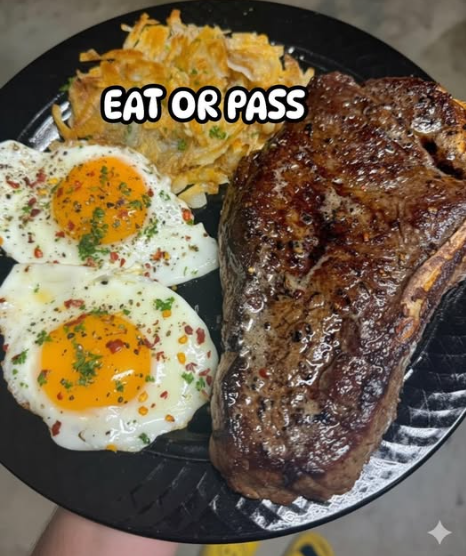
- **Fry Eggs (FLAVOR TRANSFER):** Reduce the heat to medium-low. Add a small pat of **butter** (if needed) to the pan containing the rendered steak fat. Crack the **$2\text{ eggs}$** into the pan. Fry the eggs to your liking (sunny-side up, over easy, or over medium), utilizing the steak fat for flavor transfer.
- **Plate and Serve:** Slice the rested steak against the grain. Serve the sliced steak immediately with the freshly fried eggs on the side or on top. Pour any accumulated juices from the resting steak over the top for maximum flavor.
Steak Doneness Guide:
| Doneness |
Internal Temp |
Approx. Time ($\frac{3}{4}\text{-inch}$ steak) |
| Rare |
$125^\circ\text{F}$ ($52^\circ\text{C}$) |
$2\text{ min per side}$ |
| Medium-Rare |
$130^\circ\text{F}$ ($54^\circ\text{C}$) |
$3\text{ min per side}$ |
| Medium |
$135^\circ\text{F}$ ($57^\circ\text{C}$) |
$4\text{ min per side}$ |
Tips: Essential Techniques for Juiciness
The Dry Surface: **Pat the steak completely dry** before seasoning and searing (Instruction 1). Moisture on the surface turns into steam when hitting the hot pan, cooling the pan and preventing the development of a crispy brown crust (Maillard Reaction).
Use High-Heat Oil: If using oil (Ingredient II), choose one with a high smoke point (Canola, Grapeseed, or Avocado) to withstand the high heat required by **The Hot Pan Protocol** without burning.
The Butter Baste: For a professional finish, during the last minute of cooking, drop $1\text{ tbsp}$ of **butter, a crushed garlic clove, and a sprig of thyme/rosemary** into the pan. Tilt the pan and spoon the melted butter over the steak repeatedly (basting). This adds incredible flavor.
Resting Surface: Rest the steak (Instruction 3) on a **cutting board or plate** to collect the juices, but do not cover it tightly with foil. This risks steaming the exterior, which compromises the hard-earned sear.
Seasoning Timing: Always season the steak **right before it goes into the hot pan**. If you salt it too far in advance, the salt draws moisture out of the steak, compromising the dry surface necessary for searing.
Variations: Customizing Flavor and Eggs
Easily adapt the flavor and components of the dish:
- **Classic Gravy:** Stir $1\text{ tsp}$ of flour into the pan drippings after the eggs are removed. Add $\frac{1}{4}\text{ cup}$ beef broth and simmer briefly until thickened. Season to taste and serve over the steak.
- **Steak Seasoning:** Mix $\frac{1}{2}\text{ tsp}$ of **onion powder and garlic powder** into the salt and pepper blend for a more complex seasoning rub.
- **Egg Style:** Substitute the simple fried eggs with a quick **omelet** or scrambled eggs cooked using the same pan drippings.
- **Compound Butter Finish:** Instead of plain butter, top the final, rested steak with a slice of **compound butter** (like blue cheese or herb butter) for richness.
**Initial Temperature Check:** For the most accurate doneness (Instruction 2), use a **meat thermometer**. Insert it horizontally into the center of the thickest part of the steak. Remember the temperature will rise by $5\text{–}10^\circ\text{F}$ during the resting period (carry-over cooking).
**Re-Seizing the Crust:** If you choose to baste or worry the crust is softening while resting, place the steak back in the **hot pan for $30\text{ seconds}$ per side** immediately before slicing and serving. This re-crisps the exterior.
**Use Room Temp Eggs:** Bring the eggs (Ingredient I) to **room temperature** before cracking them into the pan. This promotes more even cooking of the whites and yolks.
**Cleaning Cast Iron:** After cooking, deglaze the pan with a little water while it’s still warm, scraping off the *fond*. Do not use soap; gently scrub with a stiff brush and re-season with a thin layer of oil.
Conclusion: A Perfectly Executed Classic
The **Steak & Eggs** recipe is a study in precision cooking. By rigorously applying **The Hot Pan Protocol** for a perfect Maillard crust, respecting **The Maillard and Rest Mandate** to ensure a juicy interior, and honoring **The Flavor Transfer Principle** by cooking the eggs in the rendered beef fat, you transform simple ingredients into a meal that is impressive at any hour of the day. Enjoy the tender steak and the richness of the yolk!
Frequently Asked Questions (FAQ)
Q: Why did my steak not get a nice crust (it steamed)?
A: The steak was likely **too wet** or the **pan was not hot enough** (Hot Pan Protocol, Instruction 2). The surface must be completely dry, and the pan must be preheated for at least $5\text{ minutes}$ on high heat.
Q: Why did my steak lose all its juice when I sliced it?
A: The steak was **not rested** (Maillard and Rest Mandate, Instruction 3). Juices spill out immediately if the steak is sliced before the muscle fibers have relaxed.
Q: Can I use tenderloin for this recipe?
A: **Yes**, but the cook time will be shorter, and the temperature must be carefully monitored, as tenderloin contains less fat and is more prone to drying out if overcooked.
Q: Should I cut the fat cap off the ribeye?
A: **No**, leave the fat cap on. The ribeye’s fat melts during cooking, adding flavor and richness to the entire pan, which is then used to cook the eggs (Flavor Transfer Principle).
ADVERTISEMENT