
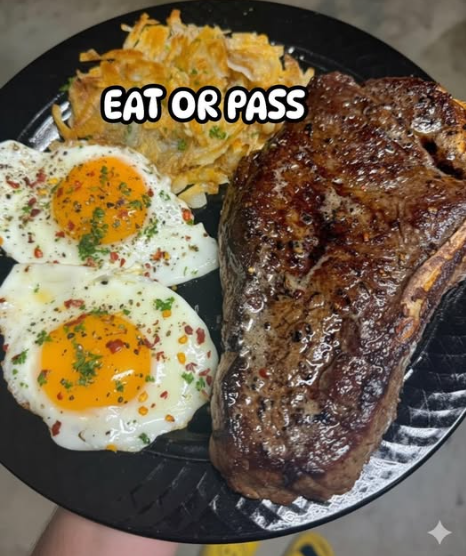
Dinner or Breakfast Perfection: Mastering Steak & Eggs
Introduction: The Fundamental Techniques of Seizing Flavor
The simplicity of the **Steak & Eggs** recipe belies the high-level technique required for its success. The entire dish is a study in **heat transfer and flavor utilization**. The goal is a perfect sear on the steak—generating a deeply savory crust through the **Maillard Reaction**—followed by flawlessly cooked eggs that inherit the richness left behind in the pan. The choice of pan and the management of high heat are non-negotiable.
The **Maillard Reaction** is the key to steak flavor; it is the chemical process that creates hundreds of different flavor compounds when protein and amino acids react with sugars under high, dry heat. This is achieved through **The Hot Pan Protocol** (Instruction 1), which requires the pan to be screaming hot *before* the steak is added, ensuring the exterior immediately sears rather than steams.
Success requires adherence to three core regulations: **The Hot Pan Protocol, The Maillard and Rest Mandate, and The Flavor Transfer Principle.**
The first regulation, **The Hot Pan Protocol** (Instruction 1), establishes the environment. Use a **cast iron skillet or stainless steel pan**. These materials retain heat exceptionally well, preventing the pan’s temperature from dropping when the room-temperature steak is introduced. This ensures an aggressive, uniform sear across the entire steak surface.
The second regulation, **The Maillard and Rest Mandate** (Instruction 2), guarantees juiciness. The steak must be seared rapidly (3–4 minutes per side for medium-rare) to build the crust, but then it absolutely must be allowed to **rest** for $5\text{–}10\text{ minutes}$ after cooking. During searing, muscle fibers contract and push moisture toward the center; resting allows these juices to redistribute evenly throughout the steak, preventing a dry, tough result.
The third regulation, **The Flavor Transfer Principle** (Instruction 3), perfects the eggs. The **eggs** are cooked directly in the flavorful **oil or butter** left over from the steak’s searing process, often combined with rendered beef fat. This effortless step infuses the eggs with the deep *umami* flavor of the steak, linking the two components seamlessly.
Ingredients: Defining Protein, Fat, and Binder
The essential components for this classic meal:
I. The Core Components:
- **$1\text{ steak}$** (Ribeye or Sirloin recommended), $\frac{3}{4}\text{ to }1\text{ inch}$ thick (Protein, Flavor)
- **$2\text{ eggs}$** (Binder, accompanying protein)
II. Fat & Seasoning:
- **$1\text{ tbsp}$** high-heat cooking oil (Canola, Grapeseed, or Avocado) or clarified butter (Fat for searing)
- **$\frac{1}{2}\text{ tsp}$** Coarse Salt (Kosher or Sea Salt) (Seasoning, crust development)
- **$\frac{1}{4}\text{ tsp}$** Freshly cracked black pepper (Seasoning)
III. Optional Finishing/Flavoring:
- **$1\text{ tbsp}$** unsalted butter (for basting)
- **$1\text{ clove}$** garlic, smashed (for basting)
