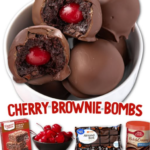
The complete ingredient list, emphasizing the structural additions needed for conversion:
I. The Conversion Components:
- **1 box (18 oz)** brownie mix (Fudge and flavor base)
- **¼ cup** all-purpose flour (Structure stabilizer)
- **2 large** eggs (Primary binder)
II. The Binding Fat and Flavor (Assumed):
- **½ cup** vegetable oil (Or melted, cooled unsalted butter)
- **1 tsp** vanilla extract (Assumed, flavor depth)
- **Optional:** $\frac{1}{2}$ cup chocolate chips or walnuts (Assumed, texture)
Instructions: Conversion, Chilling, and Baking Protocol
Phase 1: Dough Conversion and Mixing
- **Pre-Mix Dry Ingredients:** In a large mixing bowl, combine the **1 box brownie mix** and the **¼ cup all-purpose flour**. Whisk briefly to ensure the flour is evenly dispersed.
- **Combine Wet Ingredients:** In a separate small bowl, whisk together the **2 large eggs**, **$\frac{1}{2}$ cup vegetable oil** (or melted butter), and **1 tsp vanilla extract** (assumed).
- **Form Dough:** Pour the wet ingredients into the dry mix. Stir or mix on low speed until the ingredients are **just combined**. The dough will be very thick and sticky. [Image illustrating the texture of brownie mix cookie dough—thick, sticky, and fudge-like]
- **Add Mix-Ins (Optional):** Fold in any optional mix-ins, such as $\frac{1}{2}$ cup chocolate chips or chopped walnuts, using a spatula.
Phase 2: Cold Stabilization and Shaping
- **Chill Dough (MANDATORY):** Cover the cookie dough and refrigerate for a minimum of **30 minutes**. A 1-hour chill is ideal. This is essential for stabilizing the fat and preventing excessive spread.
- **Prep Oven and Sheets:** Preheat oven to **$350^\circ\text{F}$ ($175^\circ\text{C}$)**. Line baking sheets with parchment paper (highly recommended for easy removal).
- **Scoop:** Use a cookie scoop or tablespoon to drop uniform balls of the **chilled dough** onto the prepared sheets, leaving 2 inches between each cookie.
Phase 3: Baking and Cooling Protocol
- **Bake:** Bake for **9–12 minutes**. The cookies are done when the edges look set and slightly cracked, but the centers still look **soft and slightly underbaked** (the fudge factor). They will appear glossy and dark.
- **Cooling (CRITICAL):** Remove the cookies from the oven and let them cool completely on the **baking sheet for 5 minutes** before transferring to a wire rack. Because the centers are very soft, transferring too early will cause them to break.
- **Finish:** Once fully cooled, the cookies will have a perfect soft, fudgy center and chewy edges.
Serving and Storage: Retaining the Fudge Texture
These cookies stay soft due to their high fat and cocoa content, but require proper storage to retain the moisture.
- **Serving:** Best served slightly warm, or fully cooled. Dust with powdered sugar for a crinkle cookie look.
- **Storage:** Store in an **airtight container at room temperature for up to 5 days**. To maximize the “fudge factor,” place a half-slice of plain white bread in the container; the cookies will absorb the bread’s moisture.
- **Freezing Dough:** Scoop the dough into balls (Step 7), place them on a tray, and freeze until solid. Transfer the frozen balls to a freezer bag and bake from frozen, adding 2–3 minutes to the cook time.
Tips: Essential Techniques for Fudge Cookies
Do Not Over-Mix: Only mix the ingredients until they are **just combined** (Step 3). Over-mixing the flour activates gluten, which can lead to a tougher, less fudgy cookie texture.
The Fudge Test: When removing the cookies (Step 8), they should look slightly **puffy and glossy** in the center. If they lose all their gloss and appear completely matte, they are likely overbaked and will be drier.
Chilling for Crackle: The mandatory chilling step (Step 5) is also key for the classic “crackle” surface look common to fudge cookies. The cold exterior cracks upon rapid heating.
Oil vs. Butter: **Vegetable oil** provides a slightly moister, chewier cookie than butter (Step 2). If using butter, ensure it is melted and cooled completely before mixing, and know the resulting cookie may be slightly crispier.
Dough Texture Correction: If your dough seems too dry (depending on the brand of brownie mix used), add $\frac{1}{2}$ teaspoon of milk at a time during the mixing (Step 3) until the dough holds together when scooped.
Variations: Customizing Texture and Flavor
The brownie mix base is versatile and accepts many flavor additions:
- **Peppermint Mocha:** Add **$\frac{1}{2}$ teaspoon of peppermint extract** and **$\frac{1}{2}$ teaspoon of instant espresso powder** to the wet ingredients (Step 2). Fold in chocolate chips.
- **Peanut Butter Swirl:** Mix **$\frac{1}{4}$ cup of creamy peanut butter** into the dough after mixing (Step 4). Gently swirl it through the dough but do not fully incorporate it.
- **Caramel Center:** Before baking, gently press a **small unwrapped Rolo candy** or a cube of soft caramel into the center of each scooped dough ball (Step 7).
- **Extra Cakey:** For a cookie that is slightly more cake-like (less dense), substitute the **$\frac{1}{2}$ cup oil** with **2 tablespoons of oil plus $\frac{1}{4}$ cup of applesauce** (Step 2).
- **Crinkle Finish:** After scooping the chilled dough (Step 7), roll the ball completely in **powdered sugar** before baking. The sugar creates a dramatic white crust with a dark crackle.
**Use Light-Colored Pans:** Use light-colored aluminum baking sheets (Step 6). Dark pans absorb more heat and can cause the bottoms of the cookies to burn before the centers are fully set.
**Room Temperature Eggs:** Ensure the **2 large eggs** (Step 2) are at room temperature. They incorporate better into the fat and sugar mixture, leading to a smoother, more emulsified dough.
**The Water Drop:** If your baked cookies seem too flat (Step 8), your dough was likely too warm. Try a shorter bake time on the next batch, or slightly increase the flour to $\frac{1}{3}$ cup.
**Clean Cutting:** For brownie-style bars (less spread, thicker), press the dough into an 8×8 inch pan, bake for 20-25 minutes, and then cut into squares after cooling completely.
Conclusion: Convenience and Quality
Converting a brownie mix into **Cookies Made From Brownie Mix** is a streamlined method for achieving maximum chocolate flavor and a perfect fudgy texture. By strategically adding extra **flour** for structure and employing a **mandatory cold stabilization cycle**, the dough is transformed from a batter designed to spread into a base engineered for chewiness. This recipe delivers a satisfyingly rich, crackled cookie that maintains its softness and flavor for days.
Frequently Asked Questions (FAQ)
Q: Why did my cookies spread too much and turn crispy?
A: You likely **skipped the mandatory chilling step** (Step 5). The fat was too warm, causing it to melt and spread rapidly. Also, your oven might be running too cool.
Q: Can I use the exact ingredients listed on the brownie box?
A: **No.** The box instructions create a wet batter. This recipe converts that into a stiff, scoopable dough by replacing or limiting the liquid and adding extra flour/fat for structure.
Q: My cookies are falling apart when I try to move them.
A: You are moving them too soon (Step 9). The centers are very fudgy and need the **full 5 minutes on the hot pan** to set before they can be safely transferred to the wire rack.
Q: Can I use different sized brownie mix boxes?
A: Yes, but adjust the binder: For smaller boxes (16 oz), you may need slightly less oil (a scant $\frac{1}{2}$ cup). For larger boxes (20 oz+), you may need an extra tablespoon of flour and oil to maintain the correct consistency.