

Every component is essential for creating the perfect balance of texture and flavor:
I. The Vegetable Base (Texture and Bulk):
- **1 medium head fresh cauliflower:** Cut into uniformly sized florets for even cooking.
- **1 medium head fresh broccoli:** Cut into uniformly sized florets, complementing the cauliflower.
II. The Mornay Sauce (Creaminess and Binder):
- **4 tablespoons butter:** The fat component for the roux.
- **4 tablespoons all-purpose flour:** The thickening agent for the roux.
- **2 cups milk (whole milk recommended):** The liquid base for the béchamel; whole milk provides the richest flavor and best texture.
III. Cheese and Seasoning (Flavor and Richness):
- **1.5 cups shredded sharp cheddar cheese:** The primary flavor cheese; sharp cheddar provides necessary tang.
- **1/4 cup grated Parmesan cheese:** Adds a salty, nutty, complex layer to the sauce.
- **1 teaspoon salt & 1/2 teaspoon black pepper:** Basic seasoning.
- **1/4 teaspoon ground nutmeg (optional but recommended):** A classic, subtle enhancer for cream sauces.
IV. The Topping (Crunch):
- **1/2 cup Panko breadcrumbs:** Provides superior crispiness compared to regular breadcrumbs.
Instructions: Mastering the Roux and Vegetable Prep
Phase 1: Preparing and Draining the Vegetables (Water Control)
1. Preheat & Prep: Preheat your oven to **$375^\circ\text{F}$ ($190^\circ\text{C}$)**. Lightly grease a $9 \times 13$ inch baking dish. Cut the cauliflower and broccoli into even, bite-sized florets.
2. Par-Cook and Drain (CRITICAL): Bring a large pot of salted water to a boil. Blanch the broccoli and cauliflower florets for about **5–7 minutes**. The goal is to reach a **tender-crisp** texture; they should still have a slight bite as they will continue to cook in the oven. **Drain the vegetables immediately and thoroughly.** Shake them dry in the colander or gently pat them with a clean towel. Transfer the drained florets to the prepared baking dish.
Phase 2: Creating the Stable Cheese Sauce (Mornay)
3. Create the Roux: In a medium saucepan, melt the **4 tablespoons of butter** over medium heat. Once melted and sizzling, whisk in the **4 tablespoons of all-purpose flour**. Cook, stirring constantly, for 1 minute. This cooking removes the raw flour taste.
4. Build the Béchamel: Slowly pour in the **2 cups of milk** while whisking continuously to prevent lumps. Increase the heat slightly and bring the sauce to a simmer, whisking constantly. The sauce will thicken rapidly as it reaches a simmer. Cook until it is thick enough to coat the back of a spoon (about 3–5 minutes).
5. Finish the Mornay Sauce (Off Heat): **Remove the sauce from the heat immediately.** Stir in the **shredded cheddar, Parmesan cheese, salt, pepper, and nutmeg**. Stir until the cheese is completely melted and the sauce is smooth and luxurious. **Adding the cheese off the heat prevents the milk proteins from separating**, which results in a grainy or broken sauce.
Phase 3: Assembly and Bake
6. Combine and Assemble: Pour the finished cheese sauce evenly over the prepared vegetables in the baking dish. Gently toss the vegetables and sauce together, ensuring all the florets are thoroughly coated.
7. Topping and Bake: Sprinkle the **Panko breadcrumbs** evenly over the top of the casserole. Bake for **15–20 minutes**, or until the topping is golden brown and the sauce is bubbling hot around the edges. The casserole should be thoroughly heated through and not just warm.
8. Rest and Serve: Remove from the oven and let it **rest for 5 minutes** before serving. This allows the sauce to settle and thicken slightly, preventing it from running all over the plate when scooped.
Serving and Storage: Retaining Texture and Quality
This bake is a versatile side dish that pairs wonderfully with roasted meats (like turkey, chicken, or ham) or can serve as a vegetarian main course. Always serve warm, preferably right after the short resting period, to enjoy the sauce at its creamiest and the topping at its crispiest.
- **Serving:** Use a large serving spoon to scoop generous portions. A light sprinkle of paprika or chopped fresh parsley over the top adds visual appeal.
- **Refrigeration:** Store leftovers in an airtight container in the **refrigerator for up to 3 days**. The sauce will thicken considerably upon cooling.
- **Reheating:** Reheat individual portions in the microwave or a toaster oven until bubbly. For the best result, reheat in the oven at $350^\circ\text{F}$ ($175^\circ\text{C}$) for 10–15 minutes. Note that the sauce may weep slightly after reheating.
- **Freezing:** **Freezing is not recommended.** The delicate balance of the cheese sauce breaks down during freezing and thawing, resulting in a grainy, separated texture when reheated.
Tips: Essential Techniques for a Flawless Sauce
The Flour-Milk Temperature Rule: To guarantee a lump-free béchamel (Step 4), ensure your milk is **cold or room temperature** when added to the hot roux. Adding hot milk to the hot roux can cause the flour to clump instantly. Whisking continuously is also mandatory.
Roux Cook Time: Cook the butter and flour (roux) for a full minute (Step 3). This removes the raw, floury taste that can otherwise linger in the sauce, making it taste heavy.
The Final Stirring: After adding the cheese off the heat (Step 5), stir only until the cheese is melted. Over-stirring, or continuing to heat the sauce once the cheese is added, can cause the emulsion to break, making the cheese sauce oily and grainy.
Cheese Shredding: Always shred your own cheese from the block. Pre-shredded cheeses contain anti-caking agents (like cornstarch) that prevent them from melting smoothly, which can ruin the texture of the Mornay sauce.
Variations: Customizing Flavors and Textures
The base recipe is highly adaptable to many different flavor combinations:
- **Protein Boost:** Add 1 cup of cubed, cooked **ham, shredded chicken**, or crumbled, cooked **bacon** to the vegetable mixture before pouring the sauce over it.
- **Spice and Herb Swap:** For a sophisticated flavor, swap the cheddar for **Gruyère** cheese and replace the nutmeg with a pinch of **cayenne pepper** or **Dijon mustard** stirred into the béchamel (Step 5).
- **Low-Carb Topping:** Replace the Panko breadcrumbs with a mixture of 1/4 cup **crushed pork rinds** and 1/4 cup **grated Parmesan cheese** for a crunchy, keto-friendly crust.
- **Vegetable Mix:** Substitute up to half the broccoli/cauliflower with other par-cooked vegetables, such as **diced carrots, sliced Brussels sprouts**, or **blanched green beans**.
Tips: Troubleshooting and Presentation
Troubleshooting a Lumpy Sauce: If your béchamel becomes lumpy, remove it from the heat and push the sauce through a fine-mesh sieve or give it a quick blend with an immersion blender until smooth. Then return it to the heat to finish thickening.
Achieving a Crispier Topping: Mix the Panko breadcrumbs with 1 tablespoon of **melted butter** before sprinkling them over the top. The added fat helps the crumbs achieve a deeper, more even golden-brown color and better crunch.
Preventing Over-browning: If your topping is turning brown too quickly but the sauce isn’t bubbling yet, cover the casserole loosely with a piece of aluminum foil and continue baking until the center is piping hot.
Using Frozen Vegetables: Frozen vegetables can be used, but they must be completely thawed and thoroughly patted dry with paper towels before being added to the baking dish. If you skip this, they will release excessive water into the sauce during baking.
Conclusion: The Defining Comfort Side
The Cauliflower and Broccoli Cheese Bake stands as a testament to the power of fundamental cooking techniques. By mastering the roux for sauce stability, managing the high moisture content of the vegetables, and respecting the temperature constraints of the cheese, you guarantee a casserole that is perfectly creamy, deeply flavorful, and free of textural imperfections. This dish is an absolute keeper, delivering luxurious comfort that will earn its place as a celebrated side dish on any table.
Frequently Asked Questions (FAQ)
Q: Why do I need to par-cook the vegetables? Can’t I just add them raw?
A: Adding them raw results in two issues: 1) they will release too much water during baking, making the sauce thin and watery, and 2) the bake time won’t be long enough to cook the tough raw vegetables fully before the cheese sauce overcooks.
Q: My cheese sauce broke and is oily/grainy. How do I fix it?
A: The sauce broke because it was too hot when the cheese was added or it was overheated after the cheese was incorporated. To potentially rescue it, remove it from the heat and vigorously whisk in 1-2 tablespoons of **cold milk** or water.
Q: Can I use low-fat milk or half-and-half?
A: Yes, but with adjustments. Low-fat milk results in a thinner sauce, so you may need to add an extra teaspoon of flour to the roux. Half-and-half or heavy cream will create a much richer, thicker, and more stable sauce.
Q: How can I make this vegetarian-friendly?
A: The base recipe is already vegetarian. Ensure the cheese you use does not contain animal rennet (check the label), and use only vegetable oil if substituting the butter, to ensure it meets all vegetarian standards.
Related posts:
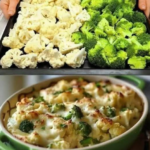 Golden Comfort: Mastering the Creamy Cauliflower and Broccoli Cheese Bake
 The Golden Crisp: Mastering Australian-Style Roasted Cauliflower
 Vegetarian Elegance: Mastering Creamy Spinach & Mushroom Lasagna
 The Regal Stuffed Cauliflower with Savory Minced Meat
 Crock Pot Potato Broccoli Cheddar Soup — Slow Comfort, Big Flavor
 The Classic Christmas Broccoli-Cauliflower Salad
