
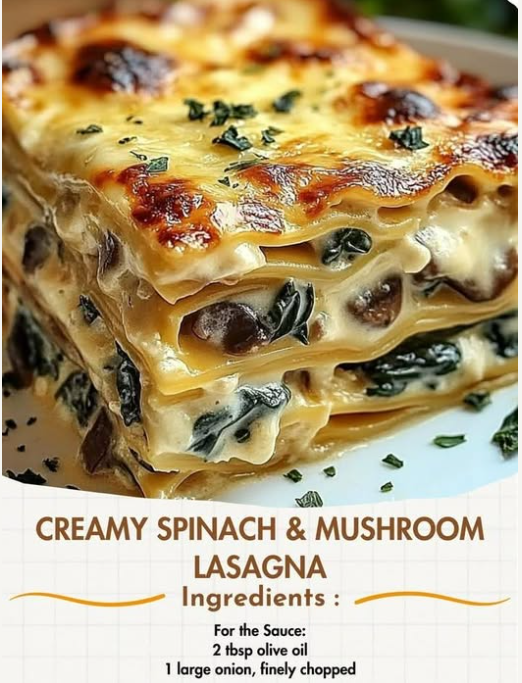
Vegetarian Elegance: Mastering Creamy Spinach & Mushroom Lasagna
Introduction: Balancing Moisture and Creaminess
This **Creamy Spinach & Mushroom Lasagna** trades the heaviness of red sauce for a bright, earthy, and supremely creamy filling. The final structure and taste depend on three critical culinary processes: **The Vegetable Dehydration Technique, The Roux-Stabilized Béchamel, and The Hydration-Balanced Layering.**
The first process, **The Vegetable Dehydration Technique** (Steps 1-3), is the most crucial moisture management step. Both **10 oz mushrooms** and **10 oz fresh spinach leaves** release a substantial amount of water when cooked. If this moisture remains, it will weep out during the bake, resulting in a soggy, runny lasagna. The ingredients must be sautéed over high heat until the liquid has completely evaporated, allowing the vegetables to concentrate their flavor and prevent waterlogging.
The second process, **The Roux-Stabilized Béchamel**, creates the creamy element. A traditional white sauce is made by whisking heated milk into a roux (a cooked mixture of butter and flour, assumed). The roux acts as a binder, stabilizing the milk and preventing it from curdling under heat while also providing the necessary thickness. We will enrich this béchamel by adding the **1 cup grated Parmesan cheese** to create a smooth, lump-free cheese sauce that coats the vegetables beautifully (Assumed: 2 cups milk, $\frac{1}{4}$ cup butter, $\frac{1}{4}$ cup flour).
The third process, **The Hydration-Balanced Layering**, ensures the lasagna sets correctly. Lasagna noodles (Assumed: 12-15 oven-ready noodles) can absorb a lot of liquid. By ensuring the creamy sauce is thick and the vegetables are dry, we achieve a final structure that holds its shape and is not watery when sliced. The final, mandatory **resting time** allows the remaining liquid to be fully absorbed by the noodles, making the lasagna sliceable.
