
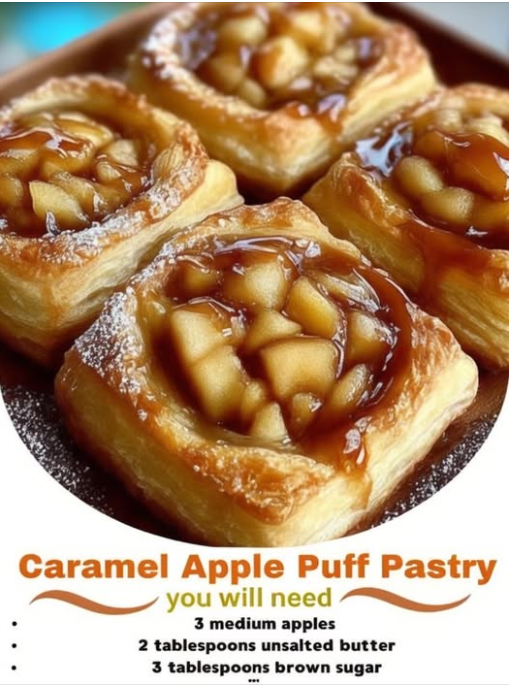
Golden Perfection: The Lamination Science of Caramel Apple Puff Pastries 🍎🍂
The **Caramel Apple Puff Pastry** is a perfect example of how complex pastry textures can be achieved effortlessly using a store-bought laminated dough. The success of this dessert is built on two key scientific principles: the **controlled caramelization** of the fruit filling and the **explosive steam leavening** of the puff pastry itself. The filling, composed of $\mathbf{3 \text{ medium diced apples}}$, $\mathbf{2 \text{ tablespoons of butter}}$, and $\mathbf{3 \text{ tablespoons of brown sugar}}$, is cooked down to a tender yet structured consistency, ensuring minimal residual moisture.
This dryness is critical because the **frozen puff pastry** relies entirely on the rapid conversion of water to steam (Step 6) to achieve its signature flaky layers. Puff pastry is a **laminated dough**, composed of hundreds of alternating thin layers of dough and butter. When the pastry is hit with high heat ($\mathbf{400^{\circ}\text{F}}$), the water in the dough and the butter quickly turns to steam. Because the butter layers create a hydrophobic barrier, the steam is trapped between the dough layers, forcing them apart. This dramatic rise, known as **oven spring**, occurs within the first few minutes of baking. A filling that is too wet would impede this process by creating soggy dough layers or leaking, preventing the essential separation. The $\mathbf{15 \text{ to } 20 \text{ minutes}}$ of baking result in a **2.5 to 3x height increase** and a gorgeously golden-brown crust, sealed with a protein-rich **egg wash** for shine and deep color. The final generous drizzle of **caramel sauce** integrates the pastry’s flaky texture with the rich, autumnal apple core.
Introduction: The Thermodynamics of Flakiness
Understanding the structure of puff pastry is essential to appreciating how these pastries achieve such an impressive rise.
Lamination and Steam Leavening
Puff pastry (or *pâte feuilletée*) is created through a repetitive process of folding and rolling known as **lamination**, which yields up to $\mathbf{1,024 \text{ distinct layers}}$ of dough separated by thin sheets of fat. When the pastry is placed in a hot oven ($\mathbf{400^{\circ}\text{F}}$), the water vaporizes instantly. The butter layers, acting as a non-permeable barrier, prevent the steam from escaping laterally. The steam is instead directed vertically, creating internal pressure that pushes the dough layers apart. The speed of this process—**thermal shock**—is what sets the delicate layers, resulting in a light, crispy texture that is entirely leavened by physical expansion (steam), not biological or chemical agents.
Controlling Filling Moisture
The instruction to cook the apples until the **liquid has thickened slightly** (Step 1) is a technical requirement. Apples are approximately $\mathbf{85\% \text{ water}}$. If the filling is not cooked down, the free water will weep out during baking. This moisture saturates the bottom layers of the pastry, preventing the essential steam conversion and resulting in a heavy, soggy base rather than a crisp, separated shell. The combination of $\mathbf{3 \text{ tablespoons of brown sugar}}$ and $\mathbf{2 \text{ tablespoons of melted butter}}$ forms a thick syrup that coats the apples, acting as a **moisture inhibitor** and binding agent.
