
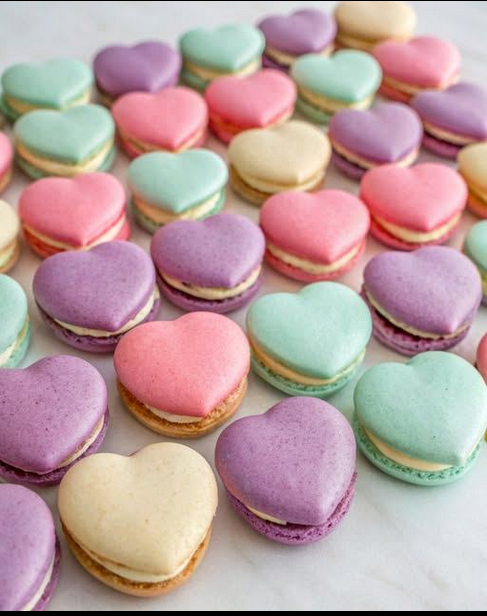
Heart-Shaped Macarons
“The macaron is a temperamental masterpiece, but the heart shape proves that love—and baking—requires equal parts patience and science.”
1. The Anatomy of a Perfect Macaron
A successful heart macaron must possess three distinct characteristics: a smooth, eggshell-like top, a well-defined “pied” (foot) at the base, and a moist, chewy interior. Unlike standard cakes, macarons do not use chemical leaveners. Instead, they rely on Physical Leavening—the expansion of air bubbles trapped within a protein matrix during the whipping of the meringue.
By 2026 standards, the use of “aged” egg whites and precision weighing (grams over cups) is mandatory for consistent results. Even 2 grams of extra moisture can cause the shells to crack or fail to develop feet.
2. Ingredients and Ratios
Pro-Baking Scale Conversion
| Component | Volume | Mass (Recommended) | Role |
|---|---|---|---|
| Almond Flour | 1 cup | 100g | The “Structure” |
| Powdered Sugar | 1 ¾ cups | 130g | The “Skin” Formant |
| Egg Whites | 3 large | 100g | The “Protein Matrix” |
| Granulated Sugar | ¼ cup | 50g | Meringue Stabilizer |
3. The Chemistry of the Meringue
When you beat egg whites, you are denaturing proteins. The hydrophilic (water-loving) parts of the protein stay in the water, while the hydrophobic (water-fearing) parts grab onto the air you are whipping in. This creates a foam.
Adding sugar gradually is vital. Sugar dissolves in the water film surrounding the air bubbles, increasing its viscosity. This prevents the bubbles from popping, resulting in Stiff Peaks. For heart shapes, your meringue must be extremely stiff (resembling shaving cream) to hold the “V” shape without spreading into a blob.
