
Holiday Tradition Simplified: Easy Family Christmas Fruit Cake
Introduction: Density, Moisture, and Low-and-Slow Baking
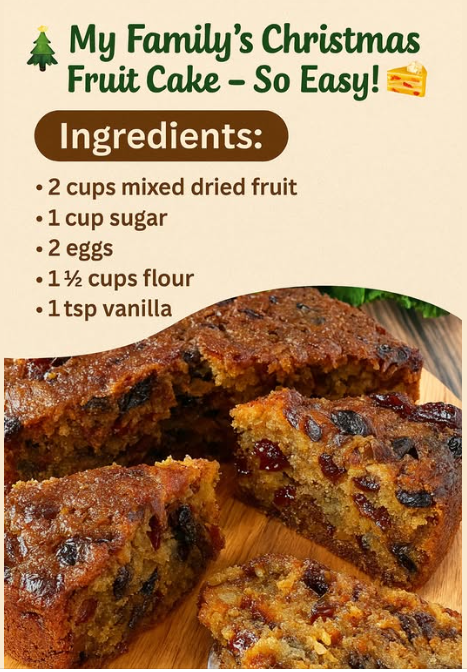
This **Easy Family Christmas Fruit Cake** is designed to avoid the dense, dry texture often associated with traditional recipes. Its success hinges on balancing the heavy load of **2 cups mixed dried fruit** with sufficient fat, leavening, and a low, sustained oven temperature. The cake is built upon three critical regulations: **Fruit Hydration, Fat-Sugar Aeration, and The Thermal Baking Protocol.**
The first regulation, **Fruit Hydration**, is key to the cake’s longevity and moisture. Dry fruit, if added straight into the batter, will absorb moisture from the surrounding dough during baking, resulting in a dry cake and hard fruit bits. To counteract this, the fruit must be pre-softened, typically by being simmered in a liquid (water, juice, or spirits—assumed in the full recipe) or soaked overnight. This process not only plumps the fruit but ensures that the cake’s final crumb remains tender and moist.
The second regulation, **Fat-Sugar Aeration**, dictates the cake’s lift and tenderness. The combination of **1 cup sugar**, **2 eggs**, and the necessary fat (**assumed butter**) must be creamed vigorously (creaming method). This process incorporates tiny air pockets into the fat matrix. When the dry ingredients (**$1 \frac{1}{2}$ cups flour** and leavening) and the fruit are folded in, these air pockets expand in the oven, giving the dense batter the lift it needs to rise and preventing it from becoming a brick.
The third regulation is **The Thermal Baking Protocol**. Fruit cakes are inherently dense and require a longer baking time at a lower temperature—typically around **$300^\circ\text{F}$ to $325^\circ\text{F}$** (assumed, low and slow). This gentle heat ensures the center cooks completely without scorching the edges or the exposed fruit pieces. The finished cake is often wrapped and allowed to mature for several days or weeks, a process that fully distributes moisture and allows the holiday spices and vanilla (**1 tsp vanilla**) to deepen and fully permeate the crumb.
