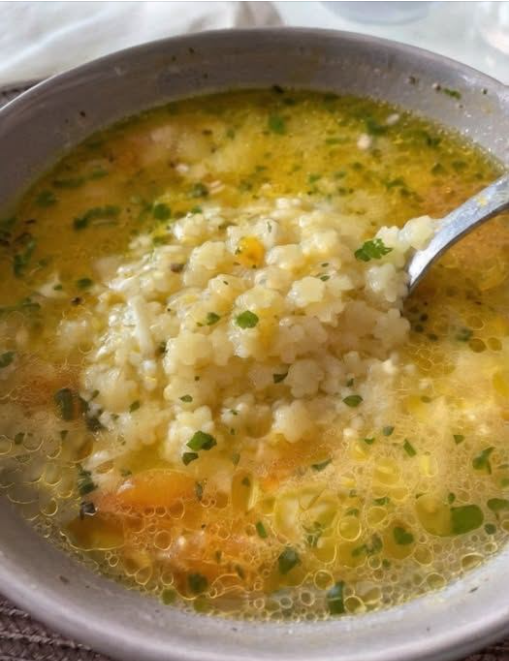
The ingredients list showcases a masterful balance between bulk, flavor, and immune-supporting nutrients. Each component is essential to the final flavor and function of the “healing” soup.
| Component | Quantity | Culinary and Nutritional Role |
|---|---|---|
| **The Base and Aromatics** | ||
| **Olive Oil** | 3 tbsp | Healthy fat for sautéing; carrier for fat-soluble vitamins (A, K) and flavors. |
| **Garlic & Onion** | 4 cloves / 1 medium | Sulfur compounds (allicin) for aroma and recognized immune-boosting properties. |
| **Carrots & Celery** | 2 of each | The traditional soffritto base; provides sweetness, fiber, and vitamins. |
| **Bulk and Body** | ||
| **Potato** | 1 medium | Thickens the broth slightly as it breaks down; provides essential carbohydrates. |
| **Zucchini** | 1 | Adds delicate texture and bulk; high water content keeps the soup light. |
| **Kale or Spinach** | 1 cup | Iron, Vitamin C, and antioxidants; added last for minimal cooking. |
| **Liquid and Seasoning** | ||
| **Broth (Veg or Chicken)** | 6 cups | The liquid medium; carries collagen (if chicken) and minerals. |
| **Thyme & Rosemary** | 1 tsp of each | Aromatic herbs; contain potent antioxidants and essential oils. |
| **Bay Leaf** | 1 | Adds a subtle, sophisticated background flavor (must be removed before serving). |
Instructions: The Staged Simmer for Maximum Flavor
- **Sauté the Aromatics (Building the Base):** Heat **olive oil** in a large soup pot or Dutch oven over medium heat. Add **onion, garlic, carrots, and celery**. Cook for **5–7 minutes**, stirring occasionally, until the onion is translucent and the vegetables are softened and fragrant. This ensures the maximum flavor extraction from the aromatic compounds.
- **Add the Potatoes and Herbs (Deepening the Flavor):** Stir in the **diced potato, dried thyme, dried rosemary, and bay leaf**. Cook for an additional **2–3 minutes**. This brief, dry sautéing step is crucial, as the heat helps “bloom” the dried herbs, intensifying their volatile oils before the liquid is added.
- **Pour in the Broth (The Simmer):** Add the **6 cups of broth** and bring the mixture to a rolling boil. Immediately reduce the heat to a gentle simmer. Cook for **15–20 minutes**, or until the potatoes and carrots are easily pierced with a fork (tender).
- **Add the Greens and Zucchini (Finishing the Vegetables):** Stir in the **zucchini** and **kale or spinach**. Simmer for only another **5–7 minutes**. This short cooking time prevents the zucchini from becoming mushy and ensures the greens wilt while retaining their vibrant color and most of their nutritional value.
- **Finish with Lemon and Seasoning (The Brightness):** Remove and discard the **bay leaf**. Stir in the **juice of 1 fresh lemon**. The acidity cuts the richness of the oil and balances the sweetness of the carrots and the savoriness of the broth. Add **salt and pepper** to taste. Start with a small amount and adjust; remember that the saltiness of the broth may already be high.
- **Serve and Garnish:** Ladle the hot soup into bowls. Top generously with **fresh parsley, chopped**, and sprinkle with **grated Parmesan** if desired. Serve immediately, enjoying the soothing, herbaceous aroma.
Serving and Storage: Maximizing the Comfort and Longevity
The Ritual of Serving
This soup is best enjoyed hot, particularly when seeking its restorative qualities. The garnish is more than aesthetic; it adds critical flavor contrast:
- **Lemon Zest:** A final grating of **lemon zest** over the top just before serving enhances the citrus aroma dramatically.
- **Fresh Herbs:** The use of fresh parsley or basil adds a bright, contrasting note that cooked herbs lose.
- **Bread:** Serve with a slice of **crusty sourdough or Italian bread** for dipping into the flavorful broth.
- **Serving Size:** The recipe yields approximately 8 cups, perfect for 4-6 generous servings.
Storage and Reheating
Soup is a classic make-ahead meal, but proper storage maintains its quality:
- **Refrigeration:** Store leftover soup in an airtight container in the refrigerator for **4–5 days**. The flavor often deepens overnight.
- **Freezing:** This soup freezes very well. Cool completely, then transfer to freezer-safe containers, leaving about an inch of headspace for expansion. Freeze for up to **3 months**.
- **Reheating Tip:** If the soup contains pasta (in a variation), the pasta may absorb a lot of liquid and become mushy upon thawing and reheating. It is often best to add pasta, rice, or grains just before the final serving. Reheat gently on the stovetop rather than using high heat or a microwave, which can break down the remaining vegetables.
Tips: Guaranteeing a Restorative and Flavorful Broth
Tip: The Importance of Fresh Lemon Juice
Do not substitute fresh lemon juice with bottled or concentrate. The **fresh juice** is critical for providing the bright, sharp, immune-boosting tang (Vitamin C) that earns the soup its “penicillin” moniker. It should be added **off-heat** to retain its maximum flavor and nutritional value.
Technique Enhancements
- **Thickening:** If you prefer a slightly thicker soup without adding cream or flour, remove $\mathbf{1 \text{ cup of the finished soup}}$, blend it until smooth, and stir the puree back into the pot. The starch from the potato will naturally thicken the broth.
- **Garlic Infusion:** For maximum garlic flavor, add $\mathbf{2 \text{ cloves of minced garlic}}$ with the onion and $\mathbf{2 \text{ more cloves of minced garlic}}$ during the last minute of simmering (Step 4). This dual application provides both a mellow cooked flavor and a sharp, pungent raw finish.
- **Broth Quality:** Invest in a high-quality, **low-sodium broth**. Since broth constitutes the majority of the soup’s liquid, its quality significantly affects the final flavor. Using low-sodium allows you to control the seasoning precisely.
- **Cutting Uniformity:** Ensure all root vegetables (**carrots and potatoes**) are cut to a similar, small size. This guarantees they cook evenly and become tender at the same time.
Variations: Customizing Your Elixir
Protein and Grain Additions
While often served as a vegetable soup, adding protein or a complex carbohydrate makes it a complete meal:
- **Chicken:** Shredded, cooked chicken breast (about $\mathbf{1 \text{ cup}}$) can be stirred in during the final minutes of simmering, or use chicken broth as the base.
- **Beans/Legumes:** Add $\mathbf{\frac{1}{2} \text{ cup of drained and rinsed cannellini beans or small white beans}}$ during the last 10 minutes of simmering. They add fiber, protein, and a creamy texture.
- **Pasta/Grain:** Stir $\mathbf{\frac{1}{2} \text{ cup of small pasta (orzo or ditalini)}}$ or **quinoa** into the soup right after adding the broth. Simmer for the required time until the pasta is cooked through. Note: adding pasta increases the likelihood of mushiness when reheating.
Flavor Profile Swaps
- **Spicy Immunity:** Add $\mathbf{\frac{1}{4} \text{ teaspoon of red pepper flakes}}$ and $\mathbf{1 \text{ tablespoon of fresh grated ginger}}$ with the aromatics (Step 1).
- **Italian Rustic:** Add $\mathbf{\frac{1}{2} \text{ cup of diced canned tomatoes}}$ (undrained) with the broth for a deeper, more rustic tomato base.
- **Creamy Finish:** For a richer soup, stir in $\mathbf{\frac{1}{4} \text{ cup of heavy cream or half-and-half}}$ just before serving (Step 5), but do not allow the soup to boil afterward.
Tips: Advanced Techniques for Nutritional Value
Tip: Maximizing Mineral Content (Broth)
To pull maximum nutrients from the broth, particularly if using vegetable scraps, allow the soup to simmer for an extended period (up to 45 minutes) **before** adding the quick-cooking vegetables (zucchini and greens). This ensures the minerals and vitamins from the broth base and root vegetables are fully infused.
Ingredient Integrity and Preparation
- **Oil Temperature:** Do not let the olive oil get so hot that it smokes. Sautéing should be a gentle, low-to-medium heat process (often called “sweating”) to soften the vegetables without browning or crisping them.
- **Kale Prep:** If using kale, be sure to **remove the tough center ribs** before chopping and adding it to the soup. Kale ribs remain chewy and fibrous even after simmering. Spinach requires no special preparation.
- **Salt Adjustment:** When simmering, only add a minimal amount of salt initially. Wait until the end (Step 5, when the lemon juice is added) to add the final, large adjustment of salt. The broth will naturally concentrate and the saltiness will intensify as the liquid evaporates.
Conclusion: A Heritage of Wholesome Wellness
The **Italian Penicillin Soup** is a brilliant demonstration of how simple, fresh ingredients, when handled with sequential cooking techniques, can produce a dish that is both profoundly flavorful and deeply restorative. It represents the best of Mediterranean cuisine: reliance on quality olive oil, fresh herbs, and abundant vegetables. The deliberate layering of aromatics, the timed addition of vegetables, and the final, vibrant finish of lemon juice all contribute to its designation as a comforting elixir. This soup is a timeless reminder that true healing often begins in the kitchen, served warm in a bowl of beautifully balanced flavor.
Frequently Asked Questions:
Q: Can I use dried garlic and onion powder instead of fresh?
A: While technically possible, it is **highly discouraged**. Fresh garlic and onion are essential for building the *soffritto* base and releasing the crucial sulfur compounds and volatile oils that give the soup its signature flavor and aroma. Powders will result in a flat-tasting soup.
Q: I don’t have fresh lemon. Can I skip it?
A: The **lemon juice** is a defining ingredient. While you could omit it, the soup will lack its signature “bright” and “penicillin” tang. If you must substitute, a splash of high-quality **white wine vinegar** or a few drops of **balsamic vinegar** can provide a necessary acidic lift.
Q: Why are the greens added last?
A: Greens like kale and spinach cook very quickly. Adding them last (Step 4) prevents them from becoming mushy, maintains their bright green color, and minimizes the loss of **heat-sensitive vitamins** like Vitamin C and some B vitamins.
Q: Do I have to remove the bay leaf?
A: Yes, **the bay leaf must be removed** before serving. It is a flavor infuser and is tough, sharp, and potentially hazardous if swallowed.