
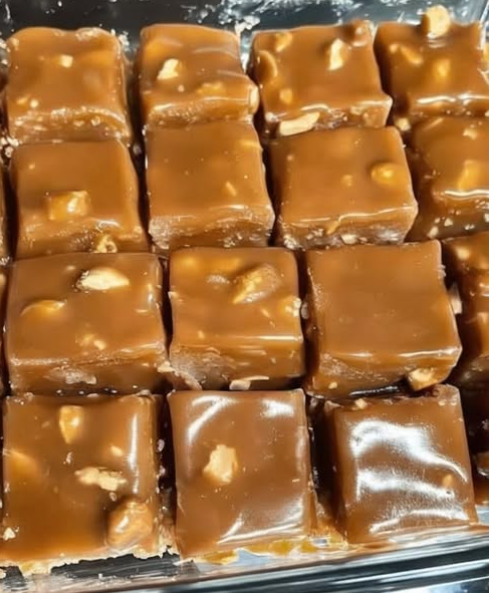
Prairie Perfection: The Crystallization Science of Oklahoma Nut Candy 🌡️🌰
Oklahoma Nut Candy, often classified as a type of **divinity or fudge**, is a confection defined by its delicate **crystalline structure**. Its success hinges entirely on achieving a perfect supersaturated sugar solution and then controlling the formation of sugar crystals. This recipe utilizes a large proportion of $\mathbf{6 \text{ cups of sugar}}$, cooked with $\mathbf{2 \text{ cups of heavy cream}}$ and $\mathbf{\frac{1}{2} \text{ cup of unsalted butter}}$.
The cooking process involves boiling the sugar mixture to a specific **Soft-Ball Stage** ($\mathbf{235^{\circ}\text{F}}$ to $\mathbf{245^{\circ}\text{F}}$). This temperature indicates that the water content has reduced to a point where the sugar solution is **supersaturated**—it holds more dissolved sugar than it normally could at room temperature. The challenge is cooling this solution without allowing large, gritty crystals to form. The $\mathbf{2 \text{ cups of heavy cream}}$ and $\mathbf{\frac{1}{2} \text{ cup of butter}}$ are crucial here; the fat molecules physically interfere with the sugar molecules, inhibiting the formation of large, hard crystals. The addition of $\mathbf{\frac{1}{4} \text{ teaspoon of baking soda}}$ is another technical measure, as its alkalinity slightly raises the pH, which further prevents the sugar from setting into a solid, clear mass like hard candy. The rapid beating and incorporation of $\mathbf{1 \frac{1}{2} \text{ cups of nuts}}$ just before setting forces the solution to crystallize into thousands of micro-crystals, yielding the final texture: **smooth, creamy, and fudge-like**.
Introduction: Confectionery States and the Soft-Ball Stage
Candy making is essentially the precise control of the boiling point of a sugar-water solution.
The Significance of $\mathbf{240^{\circ}\text{F}}$
The target temperature range for this nut candy ($\mathbf{235^{\circ}\text{F}}$ to $\mathbf{245^{\circ}\text{F}}$) is known as the **Soft-Ball Stage** in confectionery science. At this temperature, the sugar concentration is roughly $\mathbf{85\%}$. When a small amount of the hot syrup is dropped into cold water, the temperature causes it to solidify into a flexible, easily molded ball that holds its shape but flattens when removed from the water. This specific water content is what defines the final **chewiness and softness** of the candy.
Controlling Crystallization
Successful creamy fudge-style candies, like this recipe, are known as **crystalline candies**. The goal is a texture made of **microscopic, uniform sugar crystals**. Large crystals make the candy gritty. The $\mathbf{2 \text{ cups of heavy cream}}$ and $\mathbf{\frac{1}{2} \text{ cup of butter}}$ act as **interfering agents**—the fat and milk solids physically block the sugar molecules from aggregating into large structures during the cooling and beating process, promoting the smooth texture.
