
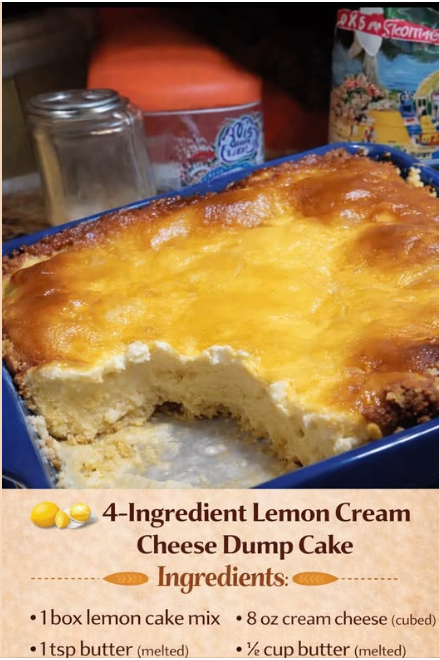
Lemon Cream Cheese Dump Cake: A Study in Gradient Hydration
Introduction: The Physics of the “No-Stir” Matrix
The “Dump Cake” is a unique culinary phenomenon where Gravity and Capillary Action replace mechanical whisking. Because you do not mix the ingredients, the cake forms a Heterogeneous Layering. The bottom layer remains creamy and dense, while the top layer—saturated by butter—undergoes the Maillard Reaction to create a crisp, cobbler-like crust.
Ingredients: The Molecular Building Blocks
The Dry Scaffold
- 1 box Lemon Cake Mix: The Pre-Engineered Chemical Matrix. It contains flour for structure, sugar for flavor, and leavening agents (sodium bicarbonate) that activate upon contact with the acidic lemon notes and heat.
The Lipid Stabilizers
- 8 oz Cream Cheese (Cubed): The High-Viscosity Inclusion. Because it is cubed and not melted, it maintains its Phase Integrity during baking, creating “cheesecake pockets” rather than a uniform batter.
- ½ cup Butter (Melted): The Hydrating Solvent. Butter serves as the medium that carries heat through the dry mix, triggering the gelatinization of starches.
The Acidic Component (Implicit/Included)
- Lemon Curd or Pie Filling (Standard Addition): Most dump cakes include 1 can (approx. 21 oz) of filling. This provides the Aqueous Phase necessary to hydrate the bottom of the cake mix.
