
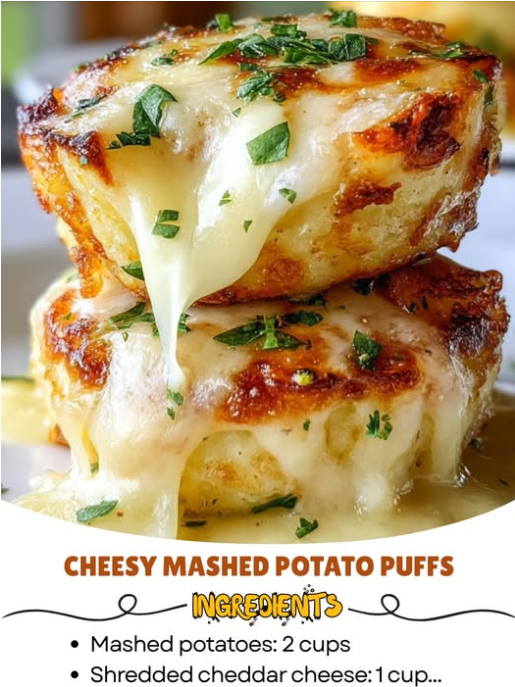
Golden Delight: Mastering Cheesy Mashed Potato Puffs
Introduction: Transforming Leftovers into Gold
This recipe elevates simple mashed potatoes into a sophisticated, bite-sized appetizer, relying on careful mixing and precise temperature control for texture.
The **Cheesy Mashed Potato Puff** is the ideal solution for leftover mashed potatoes, repurposing them into a crispy exterior and a molten, cheesy interior. Its success is rooted in controlling the internal structure and external crispness. This is achieved through three key regulations: **The High-Starch, Low-Moisture Rule, The Essential Binder Protocol, and The High-Heat Crisp Method.**
The first regulation, **The High-Starch, Low-Moisture Rule**, dictates the state of the potato base. The **2 cups mashed potatoes** must be cold and firm. Ideally, these are day-old leftovers or freshly made potatoes that have been allowed to chill completely. Mashed potatoes that are too warm or too loose (high in milk/cream) will not hold their shape when rolled, resulting in a flat puddle during baking.
The second regulation, **The Essential Binder Protocol**, provides the necessary glue. Combining the **2 cups mashed potatoes** with the **1 cup shredded cheddar cheese** and **$\frac{1}{4}$ cup grated Parmesan cheese** alone is not enough to create a cohesive ball. A binder, typically **one large egg** (assumed addition), is crucial. The egg’s proteins coagulate during baking, firmly locking the potatoes and melted cheese together and preventing the puff from collapsing or spreading in the heat.
The third regulation, **The High-Heat Crisp Method**, ensures a professional finish. The puffs are baked at a high temperature (assumed $400^\circ\text{F}$ or $200^\circ\text{C}$) (Direction 3). This high heat quickly dries out the potato surface, forming a crust, while the interior cheese melts, creating the “puff.” The addition of **grated Parmesan cheese** to the mixture is strategic; its low moisture content helps the puff achieve a golden, savory crust faster than cheddar alone.
