ADVERTISEMENT
Phase 1: Pasta and Beef Preparation
- **Cook Penne:** Cook **penne pasta** in salted boiling water according to package instructions until *al dente*. Drain and reserve about $\frac{1}{4}\text{ cup}$ of the starchy pasta water (see Tip 6). Set the pasta aside.
- **Garlic Butter Base:** In a large skillet over medium-high heat, melt the **butter**. Add the **minced garlic** and sauté until fragrant, about **$1\text{ minute}$**. Be careful not to burn the garlic.
- **Brown Beef:** Add **ground beef** to the skillet. Cook until thoroughly browned, breaking it apart with a spoon. Drain excess fat if needed (**GARLIC BUTTER PROTOCOL**).
- **Season:** Season the beef with **onion powder, Italian seasoning, salt, pepper, and red pepper flakes**. Stir well to combine and toast the spices for $30\text{ seconds}$.
Phase 2: Sauce and Assembly
- **Simmer Liquid:** Pour in the **beef broth and heavy cream**. Bring to a **gentle simmer** (do not boil rapidly), stirring occasionally for $3\text{–}4\text{ minutes}$ until slightly reduced and thickened.
- **Add Cheese (EMULSIFICATION MANDATE):** Reduce heat to **low**. Gradually stir in the **mozzarella and Parmesan cheese** until melted and the sauce is smooth. If the sauce is too thick, stir in a spoonful of reserved pasta water.
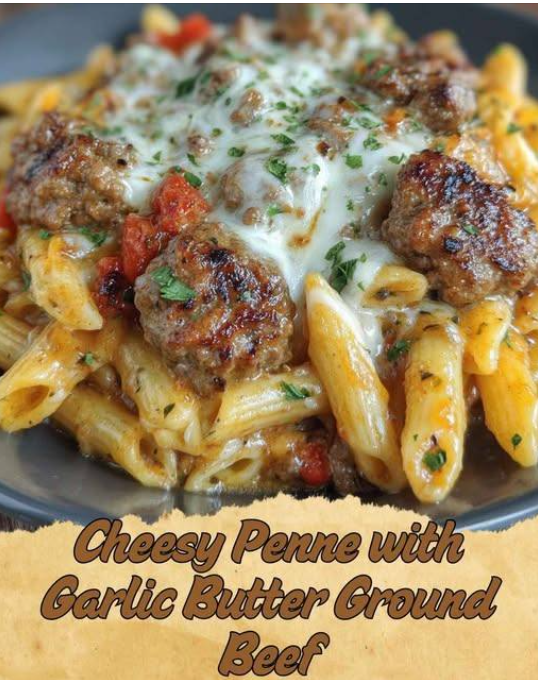
- **Combine:** Add the cooked **penne** to the skillet and toss until every piece is evenly coated in the cheesy garlic butter sauce.
- **Garnish and Serve:** Garnish with chopped **parsley** and serve immediately while hot.
Serving and Storage: Post-Assembly Management
Optimal handling for this rich, dairy-based dish:
- **Serving:** Serve immediately. Dairy-based sauces solidify as they cool, so consume promptly for the best creamy texture.
- **Storage:** Store leftovers in an airtight container in the refrigerator for up to **3 days**. The pasta will absorb the sauce upon cooling.
- **Reheating:** Reheat gently on the stovetop over low heat, adding a splash of **milk or beef broth** to restore the creaminess and moisture that the pasta absorbed.
Tips: Essential Techniques for Smoothness and Flavor
Al Dente Pasta: Cook the penne (Instruction 1) about **1 minute less** than package directions (*al dente*). The pasta will finish cooking in the hot sauce (Instruction 7), ensuring it doesn’t become mushy.
Reserved Pasta Water: Always reserve a small amount of the starchy water (Instruction 1). This liquid is rich in starch, which is an excellent emulsifier. If the sauce separates or becomes too thick, adding a tablespoon of this water will often **re-emulsify** it and improve the texture.
Fresh Grated Cheese: Use **freshly grated mozzarella and Parmesan** (Ingredient III) rather than pre-shredded. Pre-shredded cheeses contain anti-caking agents (starches), which prevent smooth melting and can lead to a grainy or separated sauce.
Browning the Beef: Cook the beef (Instruction 3) over medium-high heat. **High heat** encourages the Maillard reaction, which browns the meat and develops savory, umami flavor notes necessary for the dish’s depth.
Warming the Cream: For maximum stability, bring the **heavy cream** (Ingredient I) to room temperature before adding it to the hot skillet (Instruction 5). Adding cold cream to a hot reduction can shock the sauce and increase the risk of curdling.
Variations: Customizing Flavor and Toppings
Easily adapt the flavor profile of the dish:
- **Cream Cheese Boost:** For an extra thick, tangy sauce, stir in $\frac{1}{4}\text{ cup}$ of **softened cream cheese** along with the other cheeses (Instruction 6).
- **Mushroom Earthiness:** Sauté $\frac{1}{2}\text{ cup}$ of **diced mushrooms** after the garlic (Instruction 2), cooking until their liquid is released and evaporated, before adding the ground beef.
- **Different Pasta:** Use **rigatoni, ziti, or cavatappi** instead of penne. These tubular and ridged shapes are excellent for catching and holding the creamy sauce.
- **Spice Swap:** Replace the **Italian seasoning** with **smoked paprika and dried oregano** for a slightly different savory profile.
**Starchy Finish:** To ensure the sauce clings perfectly (Instruction 7), add the penne directly from the pot to the skillet using tongs or a spider strainer. The residual starchy water clinging to the penne helps thicken and bind the sauce further.
**Use Unsalted Butter:** Starting with **unsalted butter** (Ingredient I) gives you complete control over the final salinity of the dish, especially since both the beef broth and Parmesan cheese already contribute salt.
**No High Boil:** Once the cream is added (Instruction 5), **never allow the sauce to come to a rolling boil**. The high, rapid heat can cause the heavy cream’s fat and protein components to separate (curdle).
**Cheese Introduction:** Introduce the cheese in **small batches**, stirring until the first batch is completely melted before adding the next (Instruction 6). This gradual approach prevents clumping and maintains the sauce’s smooth temperature flow.
Conclusion: A Creamy, Satisfying Fusion
The **Cheesy Penne with Garlic Butter Ground Beef** is a technical triumph of emulsion and flavor layering. By successfully adhering to **The Sauce Emulsification Mandate** (low heat and high-fat base) and executing **The Garlic Butter and Beef Protocol** (draining fat and toasting spices), you achieve a perfectly textured, savory, and satisfying dish that brings maximal comfort to the table.
Frequently Asked Questions (FAQ)
Q: Why did my cheese sauce turn grainy or separate?
A: The sauce was likely **too hot** (failure of **The Emulsification Mandate**, Instruction 6) when the cheese was added, causing the milk proteins to seize. Always remove the skillet from direct heat or turn the heat to the lowest setting when adding cheese.
Q: My sauce is too thin. How can I thicken it?
A: Simmer the sauce for an additional $2\text{ minutes}$ (Instruction 5) to allow more liquid to evaporate. Alternatively, remove the pasta and stir in $\frac{1}{2}\text{ teaspoon}$ of **cornstarch** mixed with $1\text{ tablespoon}$ of cold water (a slurry) and simmer until thickened.
Q: Can I use milk instead of heavy cream?
A: **It is not recommended.** Milk has a much lower fat content, making it highly susceptible to curdling when heated or when acid (from seasoning/cheese) is introduced. Heavy cream is necessary for a stable emulsion.
Q: How can I prevent the garlic from burning?
A: Add the garlic to the melted butter (Instruction 2) when the butter is foaming but not yet browning. Sauté it quickly, and if you must leave the pan, immediately remove the skillet from the heat to stop the cooking.
ADVERTISEMENT