
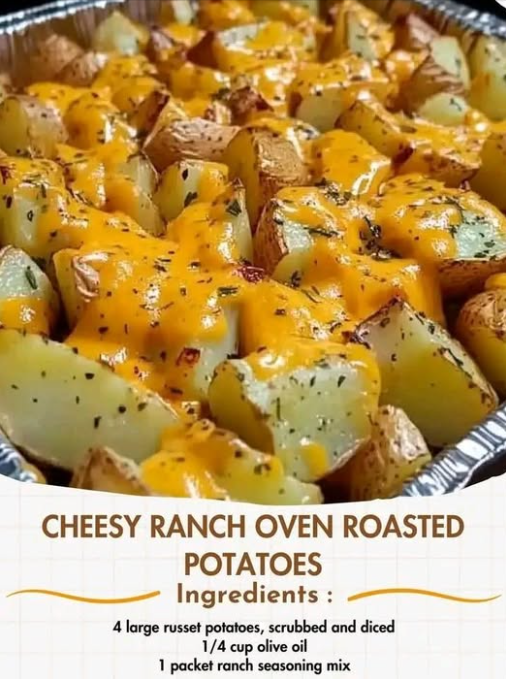
The Perfect Side: Mastering Cheesy Ranch Oven Roasted Potatoes
Introduction: The Science of Starch and Sear
The secret to a truly great oven-roasted potato lies in the preparation of the starch. **Russet potatoes** are high in starch, which, when properly handled, is essential for a crisp exterior. The surface of the diced potatoes must be rough and dry to allow the **olive oil** and **ranch seasoning** to adhere and achieve maximum **Maillard Reaction** (browning and flavor development) in the high-heat oven. The cheese, added near the end, forms a savory, crunchy crust.
The core success of this recipe hinges on controlling the starch and moisture, governed by **The Starch Release and Drying Mandate**. Before seasoning, the potatoes should be rinsed to remove surface starch. However, in some roasting techniques, a brief parboil or an aggressive shake after cutting is used to intentionally damage the surface, creating a rough, slurry-like coating of released starch that crisps beautifully. For this simpler oven-roasting method, keeping the surface dry is the key to crispness.
Success requires adherence to three core regulations: **The Starch Release and Drying Mandate, The Maillard Reaction and High-Heat Protocol, and The Cheese Timing Principle.**
The first regulation, **The Starch Release and Drying Mandate** (Instruction 1 & 2), focuses on texture. After dicing the **potatoes**, they must be completely **dry** before the oil and seasoning are added. Any moisture will create steam in the oven, preventing the surface from reaching the temperature required for browning.
The second regulation, **The Maillard Reaction and High-Heat Protocol** (Instruction 3), ensures flavor. The oven must be cranked to a high temperature, typically **$425^\circ\text{F}$ ($220^\circ\text{C}$)**. This heat ensures the chemical browning reaction (Maillard) occurs quickly. Crucially, the potatoes must be arranged in a **single layer** on the baking sheet to maximize contact with the hot air and the surface of the pan.
The third regulation, **The Cheese Timing Principle** (Instruction 5), dictates the final creamy crust. The shredded **cheddar/mozzarella** must be added near the end of the cooking time. Adding the cheese too early will cause it to burn and harden before the potatoes are cooked. Adding it late allows it to melt and form a savory, bubbly crust right before serving.
Ingredients: Defining Bulk, Fat, and Flavor
The full components for $4\text{–}6$ side servings:
I. The Core & Fat:
- **$4\text{ large}$** russet potatoes, scrubbed and diced (High starch, core ingredient)
- **$\frac{1}{4}\text{ cup}$** olive oil (Fat carrier, browning agent)
II. Flavor and Seasoning:
- **$1\text{ packet}$** dry ranch seasoning mix (Flavor concentration, salt)
- **$1\text{ teaspoon}$** kosher salt (Enhances potato flavor)
- **$\frac{1}{2}\text{ teaspoon}$** black pepper (Aromatic contrast)
- **$1\text{ cup}$** shredded sharp cheddar and/or mozzarella cheese (Melting agent, crust)
- **$1\text{ tablespoon}$** fresh parsley, chopped (Garnish, fresh contrast)
